About VMware Certification Courses
VMware Certification Courses help learners build practical skills in virtualization, cloud infrastructure, data centre management, virtual networking, storage, security, and digital workspace technologies.
At SkillDynamo, our VMware training programs cover VMware vSphere, NSX, vSAN, Horizon, VMware Cloud, and infrastructure management solutions. Each course is designed with expert guidance, hands-on labs, real-world scenarios, and certification-focused preparation.
Why Learn VMware Technologies?
VMware technologies are widely used by enterprises to manage virtual machines, data centres, cloud platforms, networks, storage, and modern digital workspaces. Learning VMware skills can help professionals improve infrastructure efficiency, support hybrid cloud environments, strengthen system security, and advance their careers in IT and cloud computing.
SkillDynamo Training Approach
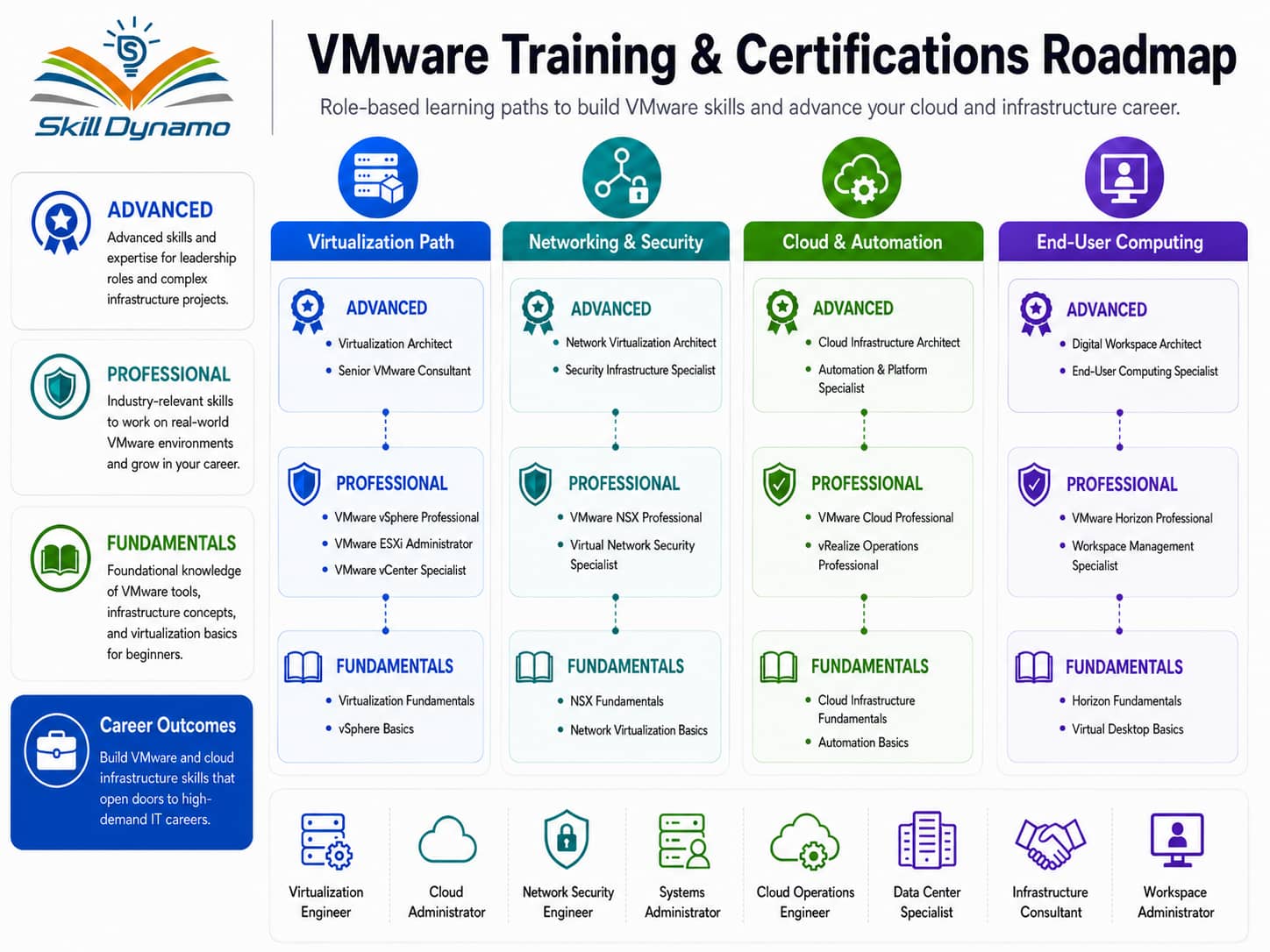
SkillDynamo provides structured VMware training through expert-led sessions, practical labs, guided exercises, infrastructure projects, and role-focused learning paths. Our approach helps learners understand VMware concepts clearly and apply their skills confidently in professional IT environments.
Who Can Join?
These courses are suitable for students, fresh graduates, system administrators, network engineers, cloud professionals, infrastructure engineers, IT support professionals, data centre teams, and anyone interested in virtualization and cloud technologies.
Start Your VMware Learning Journey
Choose the right VMware course with SkillDynamo and develop future-ready skills in virtualization, cloud infrastructure, networking, storage, and enterprise IT management.
Additional Information
VMware training helps learners understand how modern organizations create, manage, secure, and monitor virtual infrastructure. Courses may cover virtual machines, hypervisors, resource allocation, virtual networking, storage management, high availability, disaster recovery, automation, and hybrid cloud environments.
SkillDynamo provides structured VMware learning paths for beginners, system administrators, cloud professionals, network engineers, and experienced IT specialists. The courses combine conceptual learning with practical scenarios to help learners apply VMware skills in professional environments.
Key VMware Technologies
- VMware vSphere and ESXi
- VMware vCenter Server
- VMware NSX Networking
- VMware vSAN Storage
- VMware Horizon
- VMware Cloud Solutions
- Infrastructure Monitoring and Management
- Virtual Machine Administration
Latest Trends in VMware Technologies
VMware technologies are evolving beyond traditional server virtualization into a unified platform for private cloud, artificial intelligence, modern applications, security, automation, and enterprise workload management. Professionals now need broader skills across VMware Cloud Foundation, vSphere, NSX, vSAN, Kubernetes, cloud operations, and infrastructure automation.
Modern Private Cloud with VMware Cloud Foundation
VMware Cloud Foundation is becoming the central platform for managing enterprise private cloud environments. It combines compute, networking, storage, security, automation, and cloud management capabilities within an integrated infrastructure platform.
The latest VMware Cloud Foundation releases focus on improving operational efficiency, application delivery, infrastructure resilience, workload performance, and centralized management across modern data centres.
AI-Ready Private Cloud Infrastructure
Artificial intelligence is becoming an important part of VMware’s private cloud strategy. VMware Cloud Foundation is being developed to support secure enterprise AI workloads, accelerated computing, data privacy, governance, and scalable infrastructure management.
Organizations increasingly require professionals who can deploy and manage AI-ready infrastructure while maintaining control over sensitive data, security policies, costs, and computing resources.
Kubernetes and Modern Application Platforms
VMware environments now support both traditional virtual machines and containerized applications. Kubernetes integration enables development and infrastructure teams to operate modern applications alongside existing enterprise workloads.
Skills in VMware vSphere Kubernetes Service, containers, application platforms, GitOps, and cloud-native operations are becoming increasingly valuable for VMware administrators and cloud engineers.
Infrastructure Automation and Self-Service Cloud
Automation is becoming essential for managing large VMware environments. Organizations are adopting infrastructure-as-code, APIs, templates, automated lifecycle management, and self-service provisioning to deploy resources faster and reduce manual administration.
VMware professionals should develop knowledge of automated deployment, configuration management, policy-based operations, monitoring, and cloud resource governance.
Advanced Networking and Micro-Segmentation
VMware NSX continues to play an important role in software-defined networking and infrastructure security. Modern VMware environments use network virtualization, distributed firewalls, micro-segmentation, load balancing, and policy-driven security to protect applications and workloads.
These capabilities are particularly important for organizations implementing zero-trust security strategies and operating regulated or business-critical infrastructure.
Cyber Resilience and Compliance
Cyber resilience is now a major priority for VMware environments. Businesses require infrastructure that can protect workloads, meet regulatory requirements, support ransomware recovery, and maintain service availability during security incidents.
Professionals should understand workload protection, disaster recovery, compliance controls, backup strategies, network security, and secure private cloud architecture.
Software-Defined Storage and Data Management
VMware vSAN supports software-defined storage by combining storage resources across infrastructure into a centrally managed platform. Current trends focus on improving storage efficiency, availability, scalability, resilience, and integration with private cloud environments.
Knowledge of storage policies, capacity planning, performance monitoring, data protection, and vSAN administration remains valuable for infrastructure professionals.
Hybrid Cloud and Workload Portability
Organizations continue to operate workloads across on-premises infrastructure, private clouds, and supported public cloud environments. VMware technologies help businesses maintain consistent operations, security, networking, and workload management across these environments.
Hybrid cloud skills are useful for professionals involved in workload migration, infrastructure modernization, disaster recovery, cloud operations, and multi-environment management.
Open Infrastructure Ecosystem
VMware Cloud Foundation is increasingly designed to integrate with a wider ecosystem of hardware, storage, networking, security, cloud, and application technologies. This gives organizations greater flexibility when designing and extending their private cloud environments.
Professionals should understand interoperability, infrastructure architecture, third-party integrations, APIs, and platform extension options.
Skills VMware Professionals Should Learn
VMware Cloud Foundation administration
VMware vSphere and ESXi management
VMware NSX networking and security
VMware vSAN storage administrationPrivate and hybrid cloud architecture
Kubernetes and container management
Infrastructure as code and automation
AI-ready infrastructure fundamentals
Cyber resilience and disaster recovery
Monitoring, governance, and lifecycle management
Prepare for the Future of VMware
SkillDynamo’s VMware courses help learners develop practical skills aligned with modern private cloud, virtualization, networking, storage, security, automation, Kubernetes, and AI infrastructure. Structured learning paths and hands-on training can prepare professionals for evolving roles in cloud operations, infrastructure engineering, virtualization, and enterprise IT.




 SkillDynamo