About CompTIA Certification Courses
CompTIA Certification Courses help learners build practical, vendor-neutral skills in IT support, networking, cybersecurity, cloud computing, servers, infrastructure, and technical troubleshooting.
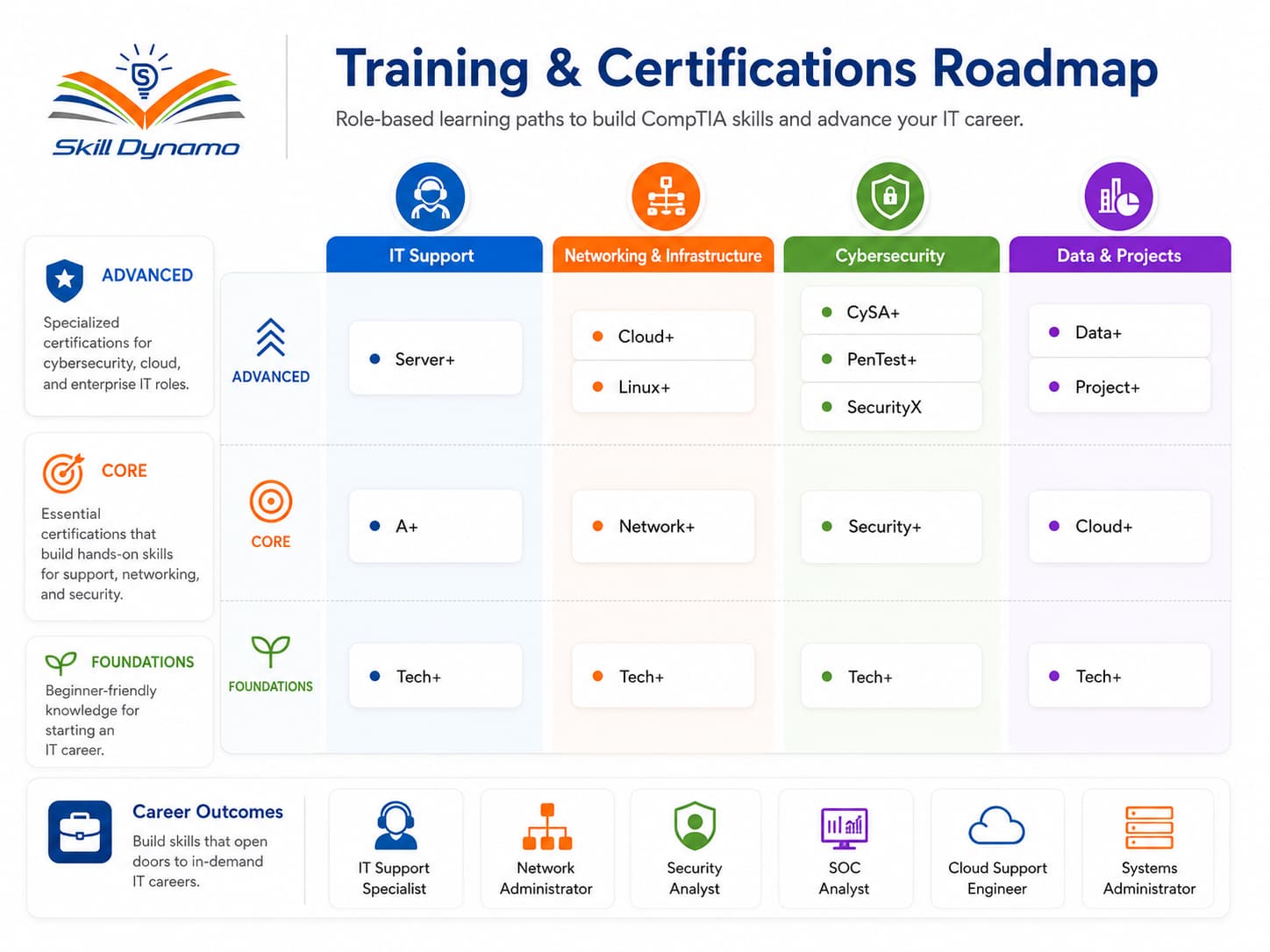
At SkillDynamo, our CompTIA training programs cover CompTIA A+, Network+, Security+, Cloud+, Server+, Linux+, CySA+, PenTest+, and advanced cybersecurity certifications. Each course includes expert guidance, hands-on exercises, practical labs, and certification-focused preparation.
Why Learn CompTIA Technologies?
CompTIA certifications are widely recognized across the global IT industry and provide a strong foundation for technical and cybersecurity careers.
Learning CompTIA skills can help students and professionals understand computer hardware, operating systems, networks, cloud platforms, security threats, system administration, troubleshooting, and risk management.
SkillDynamo Training Approach
SkillDynamo provides structured CompTIA training through expert-led sessions, practical demonstrations, guided labs, real-world IT scenarios, and exam-focused learning paths.
Our training approach helps learners understand technical concepts clearly, gain practical confidence, and prepare for professional IT roles and CompTIA certification exams.
Who Can Join?
CompTIA courses are suitable for:
- Students and fresh graduates
- IT beginners
- Technical support professionals
- Network administrators
- System administrators
- Cybersecurity learners
- Cloud and infrastructure professionals
- Help desk technicians
- Working professionals planning an IT career change
Start Your CompTIA Learning Journey
Choose the right CompTIA Certification Course with SkillDynamo and build career-ready skills in IT support, networking, cybersecurity, cloud computing, and infrastructure management.
CompTIA: From Technology Industry Association to Global IT Certification Leader
CompTIA was established in 1982 as the Association of Better Computer Dealers, commonly known as ABCD. It was created to support businesses involved in computer sales, distribution, and emerging information technology services.
As the technology industry expanded, the organization broadened its focus beyond computer dealers. In 1993, it adopted the name Computing Technology Industry Association, or CompTIA, reflecting its growing role across the global IT ecosystem.
CompTIA became widely recognized for developing vendor-neutral certifications that measure practical technology skills rather than knowledge of a single company’s products. This approach helped students and professionals build transferable skills that could be applied across different IT environments.
One of CompTIA’s most influential certifications is CompTIA A+, created to validate essential skills in computer hardware, operating systems, troubleshooting, networking, and technical support. It became a popular entry-level certification for help desk and IT support careers.
CompTIA later introduced certifications across networking, cybersecurity, cloud computing, Linux, servers, data, and advanced security. These include Network+, Security+, Cloud+, Server+, Linux+, CySA+, PenTest+, and other role-focused credentials.
Over time, CompTIA expanded beyond certification exams by offering digital learning materials, practical labs, workforce-development programs, career resources, and training solutions for educational institutions, governments, military organizations, employers, and training partners.
Today, CompTIA is one of the world’s largest vendor-neutral technology credentialing organizations. It has awarded more than 3.6 million globally recognized certifications to technology professionals across industries.
CompTIA certifications continue to evolve with changes in cybersecurity, cloud infrastructure, artificial intelligence, networking, data, and modern IT operations. Certification content is regularly updated to reflect current job roles and industry requirements.
For learners, CompTIA’s history represents the growth of IT certification from basic computer support to advanced cloud and cybersecurity careers. Learning CompTIA skills can help students and professionals create a strong technical foundation and prepare for globally relevant technology roles.
SkillDynamo’s CompTIA courses are designed to help learners understand core IT concepts, develop practical skills, prepare for certification exams, and build confidence for careers in technical support, networking, cybersecurity, cloud computing, and infrastructure management.
Latest Trends in CompTIA Certifications and IT Skills
CompTIA certifications are evolving to reflect major changes in artificial intelligence, cybersecurity, cloud computing, networking, data analytics, automation, and modern IT support. Today’s IT professionals need practical skills that combine technical knowledge, security awareness, problem-solving, and hands-on experience.
Artificial Intelligence Skills Across IT Roles
Artificial intelligence is becoming an important skill across cybersecurity, data, cloud, networking, and technical support roles. Organizations increasingly expect IT professionals to understand how AI tools work, how they affect business operations, and how they can be used responsibly.
CompTIA learners should develop skills in AI fundamentals, prompt interaction, intelligent automation, data protection, risk management, and the secure use of AI within technical environments.
CompTIA SecAI+ and AI Security
CompTIA SecAI+ is a vendor-neutral certification focused on securing artificial intelligence systems. It validates skills in protecting AI models, managing AI-related risks, securing data pipelines, automating security operations, and supporting responsible AI governance.
This certification is relevant for experienced cybersecurity and IT professionals working with generative AI, machine learning platforms, intelligent automation, and AI-enabled business systems.
AI-Driven Cybersecurity Operations
Artificial intelligence is changing how security teams detect threats, investigate incidents, identify unusual behaviour, and respond to attacks. At the same time, attackers are also using AI to improve phishing, malware, social engineering, and automated attacks.
Cybersecurity professionals increasingly need skills in security monitoring, threat detection, incident response, vulnerability management, AI-assisted analysis, and human validation of automated security decisions.
Updated CompTIA Cybersecurity Pathways
CompTIA continues to strengthen its cybersecurity learning path through Security+, CySA+, PenTest+, SecurityX, and SecAI+.
The latest cybersecurity training focuses on cloud security, identity management, zero-trust principles, threat intelligence, security operations, penetration testing, risk management, governance, and AI-related threats.
Cloud-First and Hybrid IT Environments
Modern organizations operate across cloud platforms, on-premises infrastructure, remote devices, and hybrid work environments. IT professionals must understand how to configure, monitor, secure, and troubleshoot systems across these connected environments.
CompTIA Cloud+, Network+, Security+, and Server+ help learners build knowledge in cloud infrastructure, networking, virtualization, availability, security, storage, and operational support.
Cybersecurity Resilience
Cybersecurity is moving beyond basic prevention toward resilience. Organizations need professionals who can prepare for attacks, reduce business disruption, recover systems, protect critical data, and improve security processes after an incident.
Important skills include incident response, disaster recovery, risk assessment, vulnerability management, backup strategies, business continuity, and security awareness.
Updated CompTIA A+ Skills
The latest CompTIA A+ certification reflects modern IT support responsibilities, including hardware, operating systems, networking, cloud services, cybersecurity, mobile devices, remote support, and troubleshooting.
A+ remains a strong starting point for learners preparing for help desk, IT support, desktop support, and technical service roles.
Growing Importance of Data Skills
Data skills are becoming valuable across technology and business roles. The updated CompTIA Data+ certification focuses on collecting, preparing, analysing, interpreting, and visualising data.
Professionals can benefit from learning databases, data quality, basic statistics, analytical methods, reporting, dashboards, governance, and data-driven decision-making.
Practical and Performance-Based Learning
CompTIA exams increasingly use performance-based questions to assess how learners apply their knowledge in realistic technical situations.
Training programs should therefore include practical labs, troubleshooting activities, security scenarios, command-line tasks, network configuration, data exercises, and real-world problem-solving—not only theory and memorisation.
Continuous Learning and Certification Renewal
Technology skills change quickly, especially in AI, cybersecurity, cloud computing, and data. CompTIA professionals are increasingly expected to update their knowledge through continuing education, advanced certifications, practical experience, and ongoing training.
Server+ and Project+ have also moved into CompTIA’s Continuing Education program for certifications earned after October 1, 2025.
Skills CompTIA Professionals Should Learn
Artificial intelligence fundamentals
AI system security and governance
Cybersecurity operations
Threat detection and incident response
Cloud computing and virtualization
Network configuration and troubleshooting
Zero-trust and identity security
Data analysis and visualization
Linux and server administration
Automation and scripting
Risk management and compliance
Practical technical troubleshooting
Prepare for the Future of IT with CompTIA
SkillDynamo’s CompTIA courses help learners develop practical skills aligned with modern IT support, networking, cybersecurity, cloud infrastructure, data analytics, artificial intelligence, and technical operations.
Through structured learning paths, hands-on labs, real-world scenarios, and certification-focused preparation, learners can prepare for careers in IT support, network administration, cybersecurity, cloud operations, data analysis, and infrastructure management.





 SkillDynamo