About EC-Council Certification Courses
EC-Council Certification Courses help learners build practical skills in ethical hacking, penetration testing, cybersecurity operations, digital forensics, incident response, threat intelligence, and information security management.
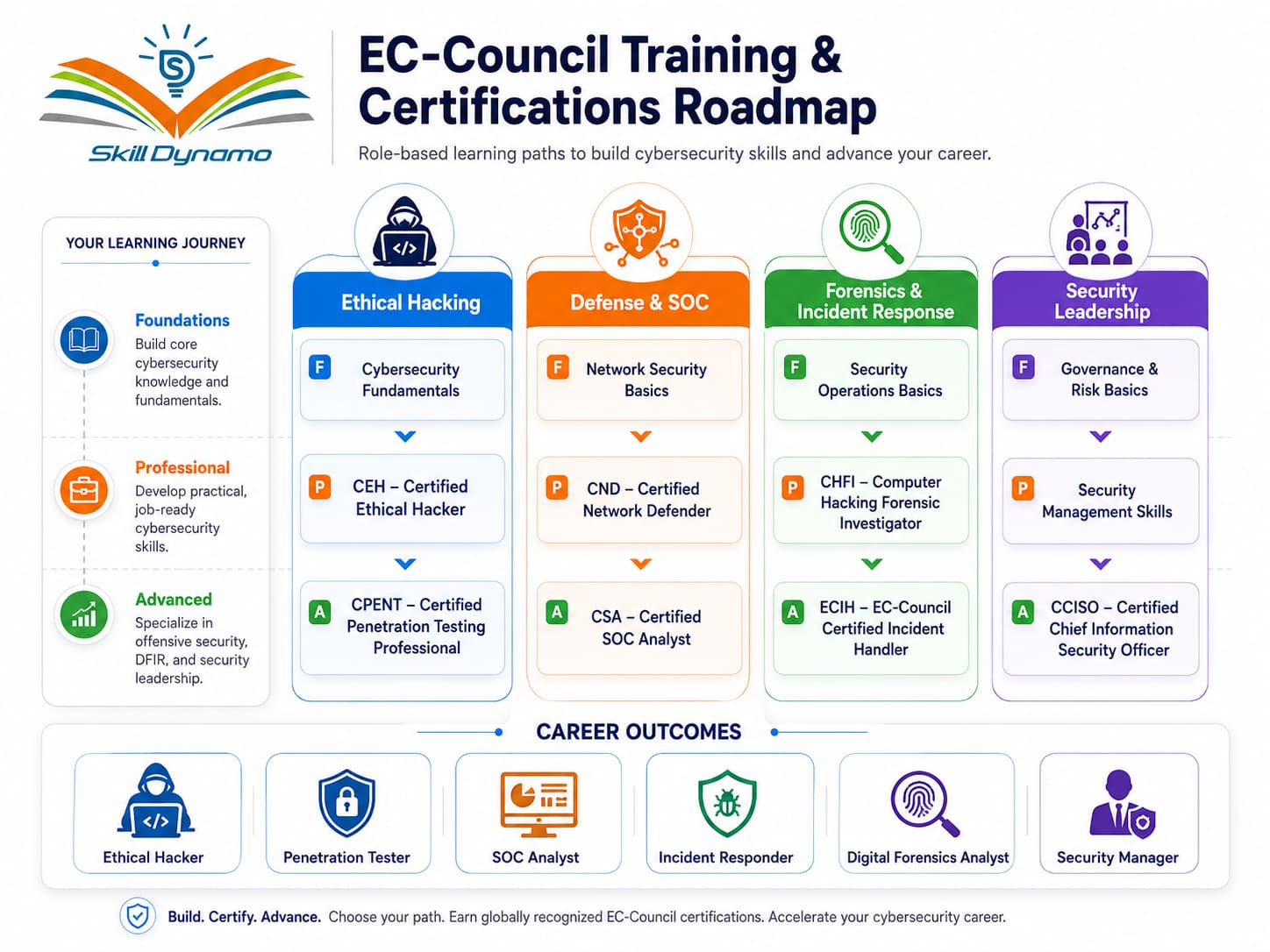
At SkillDynamo, our EC-Council training programs cover Certified Ethical Hacker (CEH), Computer Hacking Forensic Investigator (CHFI), Certified Penetration Testing Professional (CPENT), Certified SOC Analyst (CSA), Certified Network Defender (CND), EC-Council Certified Security Specialist (ECSS), and other role-based cybersecurity programs.
Each course is designed with expert guidance, hands-on labs, real-world security scenarios, practical exercises, and certification-focused preparation.
Why Learn EC-Council Cybersecurity Skills?
Organizations need skilled cybersecurity professionals to identify vulnerabilities, protect networks, investigate incidents, monitor threats, and secure sensitive information.
Learning EC-Council cybersecurity skills can help students and professionals prepare for roles in ethical hacking, penetration testing, SOC operations, digital forensics, network defence, and security management.
SkillDynamo Training Approach
SkillDynamo provides structured EC-Council training through expert-led sessions, practical ethical-hacking labs, guided exercises, simulated cyberattack scenarios, and exam-focused learning paths.
Our approach helps learners understand cybersecurity concepts clearly, develop practical problem-solving skills, and apply their knowledge confidently in professional security environments.
Who Can Join?
EC-Council courses are suitable for:
- Students and fresh graduates
- Cybersecurity beginners
- Ethical-hacking learners
- Network and system administrators
- SOC analysts
- Security engineers
- Penetration testers
- Digital-forensics professionals
- IT auditors
- Working professionals planning a cybersecurity career
Start Your EC-Council Learning Journey
Choose the right EC-Council Certification Course with SkillDynamo and build career-ready skills in ethical hacking, penetration testing, cyber defence, digital forensics, incident response, and security operations.
EC-Council: From Cybersecurity Awareness to a Global Certification Leader
EC-Council, officially known as the International Council of E-Commerce Consultants, was founded in 2001 by Jay Bavisi. The organization was created to strengthen cybersecurity education and prepare professionals to defend organizations against emerging cyber threats.
In 2003, EC-Council introduced the Certified Ethical Hacker certification. CEH became one of its best-known programs by teaching cybersecurity professionals how attackers identify and exploit vulnerabilities so that organizations can improve their defences.
As cyber risks increased, EC-Council expanded its certification portfolio into network defence, penetration testing, digital forensics, incident handling, disaster recovery, secure programming, SOC operations, and information security leadership.
Major EC-Council programs include Certified Ethical Hacker, Computer Hacking Forensic Investigator, Certified Network Defender, Certified SOC Analyst, Certified Penetration Testing Professional, EC-Council Certified Incident Handler, and Certified Chief Information Security Officer.
EC-Council University was established in 2006 to provide higher-education programs in cybersecurity. The organization also expanded internationally and developed training, certification, academic, enterprise, and cybersecurity awareness initiatives.
Over time, several EC-Council certification programs gained recognition from government, defence, academic, and enterprise organizations. Its certifications are designed to validate practical knowledge for professionals responsible for protecting networks, systems, applications, and sensitive data.
Today, EC-Council provides cybersecurity education and certifications across more than 170 countries and reports hundreds of thousands of certified professionals worldwide. Its programs continue to evolve with developments in artificial intelligence, cloud security, ransomware, threat intelligence, digital forensics, and ethical hacking.
For learners, EC-Council’s history represents the growth of cybersecurity from a specialised technical field into a critical global profession. Learning EC-Council technologies can support careers in ethical hacking, penetration testing, SOC operations, incident response, digital forensics, network defence, and security leadership.
SkillDynamo’s EC-Council courses help learners build practical cybersecurity skills, work through realistic security scenarios, prepare for certification exams, and develop knowledge aligned with modern industry requirements.
Latest Trends in EC-Council Cybersecurity Training
EC-Council certifications are evolving to address artificial intelligence, advanced ethical hacking, cloud security, digital forensics, security operations, penetration testing, and enterprise cyber-risk management. Modern cybersecurity professionals need practical skills that combine offensive security, defensive operations, automation, governance, and real-world threat analysis.
AI-Driven Ethical Hacking
Artificial intelligence is transforming vulnerability assessment, reconnaissance, penetration testing, threat analysis, and security automation.
The latest Certified Ethical Hacker training includes AI-driven cybersecurity concepts that help learners understand how attackers and defenders use intelligent tools. Professionals should develop skills in AI-assisted reconnaissance, vulnerability discovery, attack simulation, risk analysis, and ethical use of automation.
AI Security and Red Teaming
Securing artificial intelligence systems is becoming a specialized cybersecurity discipline. Traditional penetration testing alone may not identify risks such as prompt injection, model manipulation, data poisoning, insecure AI integrations, and exposed training data.
EC-Council’s offensive AI security pathways focus on AI attack-surface mapping, adversarial testing, prompt-injection attacks, model evasion, vulnerability scanning, red teaming, and incident response.
Prompt-Injection Defence
Prompt injection is an emerging attack method that attempts to manipulate AI applications through malicious instructions.
Cybersecurity professionals increasingly need to understand AI guardrails, input validation, access controls, secure system prompts, data isolation, monitoring, and testing methods that reduce the risk of unauthorized AI behaviour.
Enterprise AI Governance
Organizations adopting AI need clear policies for security, privacy, compliance, accountability, and responsible use.
EC-Council’s expanding AI training portfolio covers AI governance, program management, security frameworks, enterprise risk, legal considerations, workforce readiness, and secure AI implementation.
AI-Enhanced Security Operations
Security operations centres are increasingly using AI to analyse alerts, identify suspicious behaviour, prioritise threats, and accelerate incident response.
SOC professionals should build knowledge in SIEM, threat intelligence, log analysis, detection engineering, incident investigation, security automation, and human verification of AI-generated findings.
Cloud and Multicloud Security
As organizations move applications and data to cloud environments, cloud security has become a critical cybersecurity skill.
Professionals need knowledge of identity and access management, cloud misconfiguration, workload protection, encryption, monitoring, least-privilege access, incident response, and security across hybrid and multicloud environments.
Advanced Penetration Testing
Modern penetration testing extends beyond traditional network attacks. Security professionals now test web applications, APIs, cloud platforms, mobile applications, wireless systems, identity environments, and AI-powered applications.
Practical skills in reconnaissance, exploitation, privilege escalation, lateral movement, vulnerability validation, reporting, and remediation remain essential.
Digital Forensics and Incident Response
Cyberattacks, ransomware, insider threats, and data breaches are increasing the need for digital-forensics and incident-response professionals.
Relevant skills include evidence collection, disk and memory analysis, malware investigation, network forensics, timeline reconstruction, incident containment, recovery, and legally defensible reporting.
Ransomware and Cyber Resilience
Organizations are shifting from basic cyberattack prevention toward resilience, rapid recovery, and business continuity.
Cybersecurity professionals should understand ransomware behaviour, backup protection, attack containment, disaster recovery, incident communication, threat hunting, and post-incident improvement.
Continuous Practical Learning
EC-Council increasingly emphasizes role-based learning, cyber ranges, practical labs, live challenges, and realistic attack-and-defence scenarios.
Learners should combine certification study with hands-on exercises, capture-the-flag challenges, ethical-hacking labs, SOC simulations, forensic investigations, and security reporting.
Role-Based Cybersecurity Career Paths
Current EC-Council learning paths support careers across:
Ethical hacking
Penetration testing
SOC operations
Digital forensics
Incident response
Network defence
Cloud security
AI security
Cybersecurity management
Governance and risk
Skills EC-Council Learners Should Develop
AI-assisted ethical hacking
AI red teaming and model security
Prompt-injection testing
Vulnerability assessment
Penetration testing
SOC monitoring and threat detection
Digital forensics
Incident response
Cloud security
Ransomware defence
Network security
Security automation
AI governance and risk management
Technical reporting and remediation
Prepare for the Future of Cybersecurity
SkillDynamo’s EC-Council courses help learners build practical skills aligned with ethical hacking, artificial intelligence security, penetration testing, SOC operations, digital forensics, incident response, cloud security, and cyber-risk management.
Through structured learning paths, hands-on labs, real-world attack scenarios, and certification preparation, learners can prepare for fast-growing roles across offensive security, defensive operations, AI security, and cybersecurity leadership.





 SkillDynamo