About ISC2 Certification Courses
ISC2 Certification Courses help learners and cybersecurity professionals build practical knowledge in security operations, cloud security, risk management, security architecture, governance, secure software development, and information security leadership.
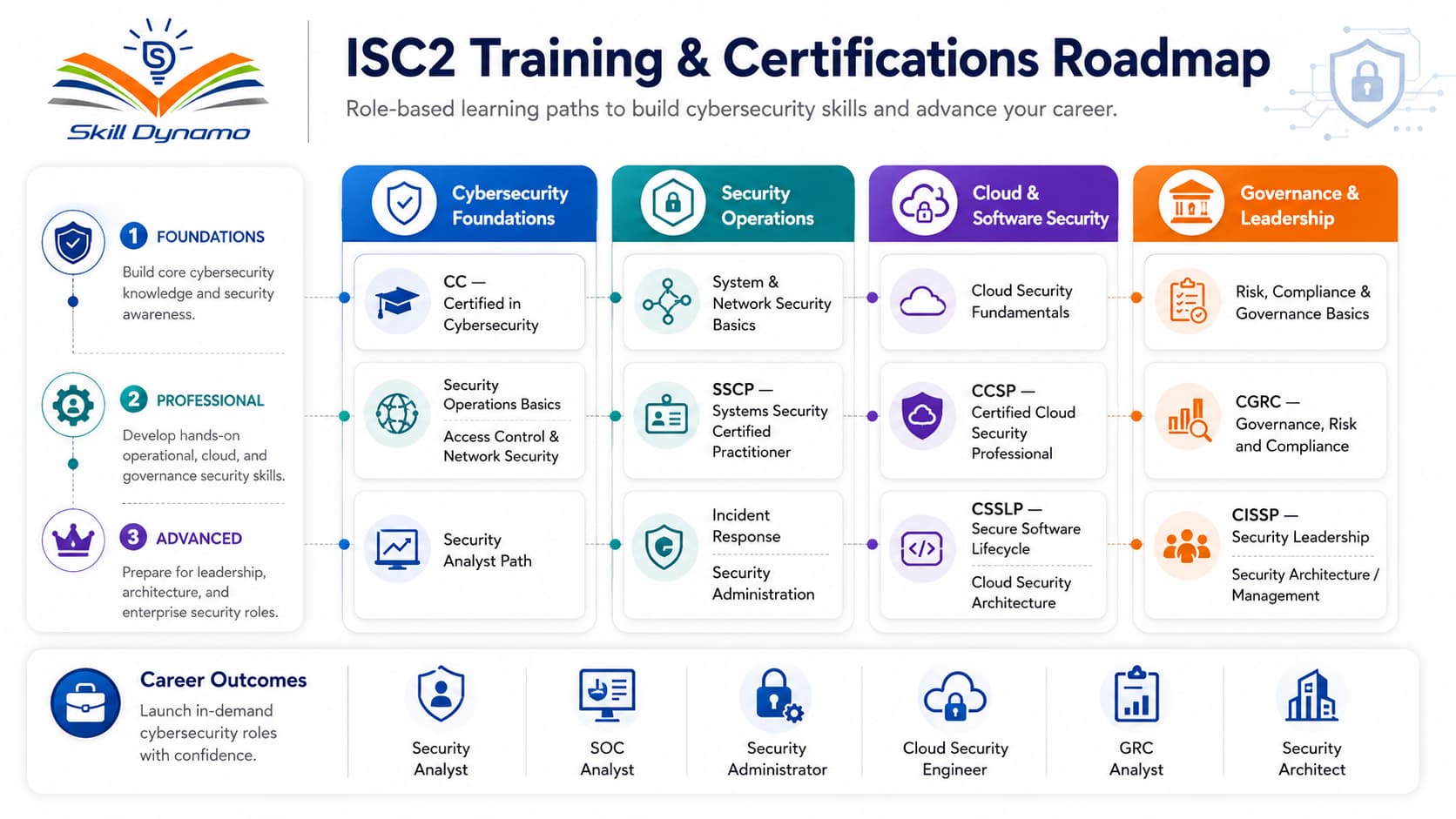
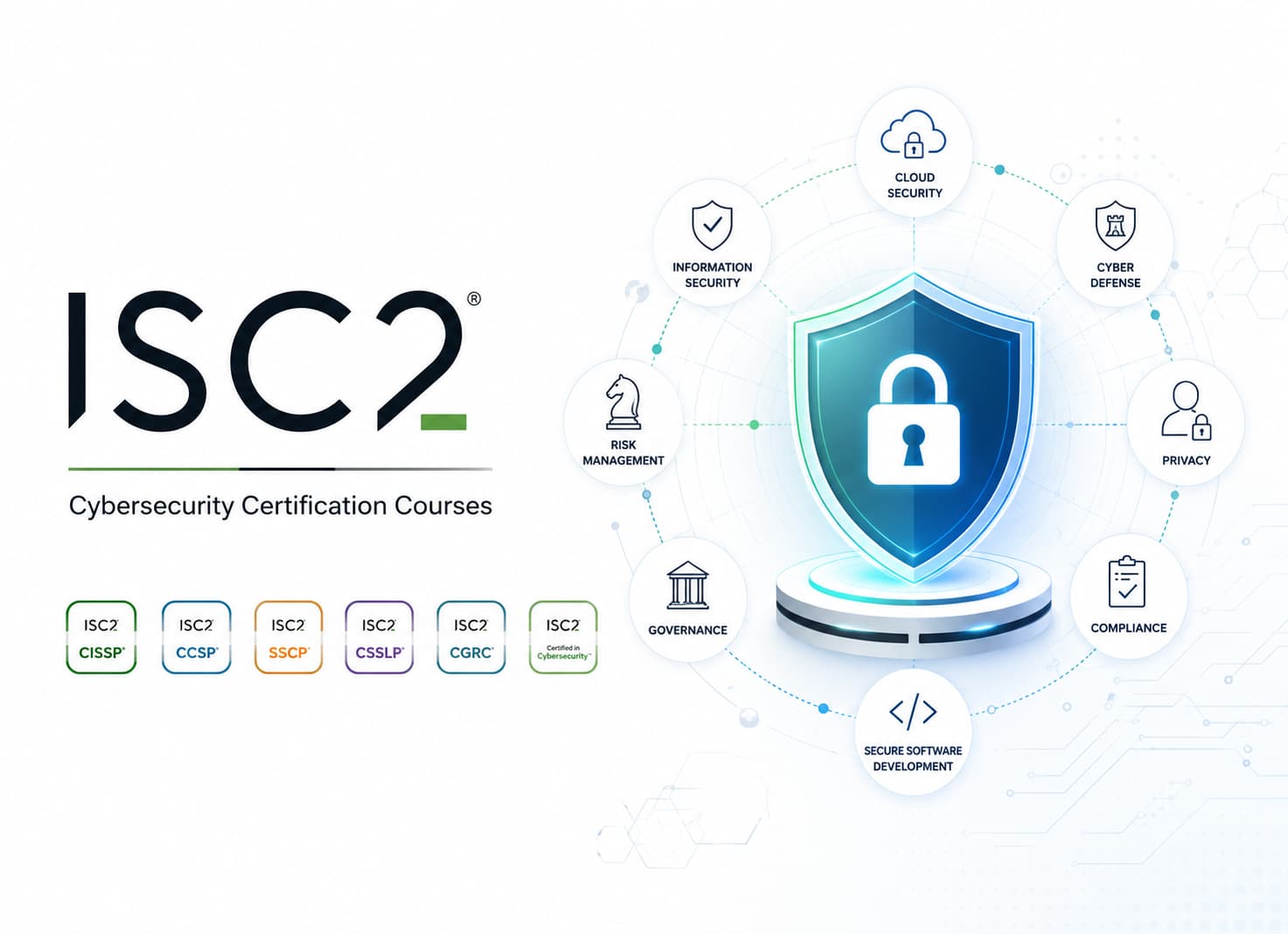
At SkillDynamo, our ISC2 training programs cover Certified in Cybersecurity (CC), SSCP, CISSP, CCSP, CSSLP, and advanced ISC2 concentrations. Each course includes expert guidance, practical examples, real-world security scenarios, and certification-focused preparation.
Why Learn ISC2 Cybersecurity Skills?
Organizations need skilled cybersecurity professionals to protect systems, manage security risks, secure cloud environments, develop security policies, respond to incidents, and maintain business resilience.
Learning ISC2 skills can help professionals prepare for globally recognised roles in cybersecurity operations, information security management, cloud security, security architecture, engineering, governance, and risk.
SkillDynamo Training Approach
SkillDynamo provides structured ISC2 training through expert-led sessions, practical case studies, security-domain exercises, exam-focused guidance, and role-based learning paths.
Our training helps learners understand complex cybersecurity concepts clearly, apply security best practices, and prepare confidently for ISC2 certification exams and professional responsibilities.
Who Can Join?
ISC2 courses are suitable for:
- Cybersecurity beginners
- Security analysts
- Network and system administrators
- Security engineers
- Cloud security professionals
- Risk and compliance specialists
- Security architects
- IT managers
- Software security professionals
- Working professionals seeking cybersecurity career growth
Start Your ISC2 Learning Journey
Choose the right ISC2 Certification Course with SkillDynamo and build career-ready skills in cybersecurity, cloud security, risk management, security architecture, governance, and information security leadership.
ISC2: From Cybersecurity Certification Body to a Global Professional Association
ISC2 was established in 1989 as the International Information System Security Certification Consortium. It was formed as a nonprofit organization to create a shared, vendor-neutral body of cybersecurity knowledge and establish professional standards for information security practitioners.
The organization’s founding members recognized that the rapidly growing information security field needed consistent skills, ethical standards, and independent certifications that could be applied across different technologies and industries.
In 1994, ISC2 launched its first certification, the Certified Information Systems Security Professional (CISSP). CISSP was designed to validate broad expertise across security architecture, engineering, operations, risk management, identity, networks, and software security. It later became one of the most widely recognized credentials for experienced cybersecurity professionals and leaders.
In 2004, CISSP became the first information security credential accredited by the ANSI National Accreditation Board under the ISO/IEC 17024 personnel-certification standard. This milestone strengthened its international recognition and demonstrated the quality of ISC2’s certification process.
As cybersecurity roles became more specialized, ISC2 expanded its certification portfolio beyond CISSP. New credentials were introduced for security administration, cloud security, secure software development, governance, risk and compliance, security architecture, and security engineering.
Its certification portfolio now supports professionals at different career stages, including:
Certified in Cybersecurity (CC)
Systems Security Certified Practitioner (SSCP)
Certified Information Systems Security Professional (CISSP)
Certified Cloud Security Professional (CCSP)
Certified Secure Software Lifecycle Professional (CSSLP)
Governance, Risk and Compliance Certification (CGRC)
Advanced CISSP concentrations
ISC2 also developed and maintained cybersecurity knowledge domains through its Common Body of Knowledge. These domains are regularly reviewed and updated through an ANSI and ISO-aligned process to reflect changes in threats, technologies, professional practices, and workplace responsibilities.
Over time, ISC2 expanded beyond certification exams by offering professional development, continuing education, research, advocacy, scholarships, industry insights, local chapters, and a global community for cybersecurity practitioners.
In 2023, the organization modernized its public brand from (ISC)² to ISC2 while continuing its mission of supporting cybersecurity professionals and creating a safe and secure cyber world.
Today, ISC2 serves a global cybersecurity community and provides certifications for learners, practitioners, managers, engineers, architects, and security leaders. Its credentials help professionals validate their expertise, maintain ethical standards, and keep their knowledge current throughout their careers.
For learners, ISC2’s history reflects the evolution of cybersecurity from a specialist technical function into a globally important profession covering cloud security, governance, software security, risk, architecture, operations, and executive leadership.
SkillDynamo’s ISC2 courses help learners understand core security domains, practise real-world scenarios, prepare for certification exams, and build skills aligned with modern cybersecurity roles.
Latest Trends in ISC2 Cybersecurity Certifications
ISC2 certifications and cybersecurity training are evolving to address artificial intelligence, cloud security, application protection, governance, risk management, security engineering and the growing demand for job-ready professionals.
Cybersecurity learners now need a combination of technical expertise, business knowledge, practical experience and continuous professional development.
Artificial Intelligence Security
Artificial intelligence is becoming one of the most important cybersecurity skill areas. Organizations need professionals who understand how to protect AI systems, data, models and business applications.
Important AI security topics include:
- Secure AI implementation
- AI risk assessment
- Data and model protection
- Prompt-injection defence
- Access control and monitoring
- Responsible and ethical AI use
- AI governance and compliance
ISC2 professionals should understand how attackers may misuse AI and how security teams can use AI responsibly for threat detection, analysis and incident response.
AI-Powered Security Operations
Security teams are increasingly using AI to analyse alerts, identify unusual behaviour, automate repetitive tasks and support faster investigations.
Professionals should develop skills in security monitoring, SIEM, threat intelligence, detection engineering, automated response and human validation of AI-generated findings.
Cloud Security
Cloud security remains one of the most in-demand cybersecurity skill areas. Organizations need professionals who can protect data, applications, identities and infrastructure across public, private, hybrid and multicloud environments.
Relevant skills include:
- Cloud identity and access management
- Secure cloud architecture
- Workload and container security
- Data encryption
- Cloud configuration management
- Continuous monitoring
- Incident response
- Compliance and governance
ISC2 credentials such as CCSP can support professionals who want to specialize in cloud security architecture, operations and risk management.
Application and Software Security
As organizations build more digital products, APIs and cloud-native applications, software security is becoming increasingly important.
Cybersecurity professionals should understand secure development practices, threat modelling, vulnerability management, DevSecOps, API security, software supply-chain risk and secure coding principles.
The CSSLP learning path is particularly relevant for professionals involved in secure software design, development, testing and lifecycle management.
Governance, Risk and Compliance
Governance, risk and compliance skills are becoming essential as organizations face stricter regulations, complex technology environments and growing stakeholder expectations.
Professionals need practical knowledge in:
- Security governance
- Enterprise risk assessment
- Regulatory compliance
- Privacy requirements
- Security policies and controls
- Third-party risk
- Audit readiness
- Board and executive reporting
ISC2 certifications such as CISSP and CGRC help professionals connect technical security controls with organizational governance and business risk.
Security Engineering and Architecture
Organizations need security professionals who can design secure systems rather than only respond to incidents.
Important skills include zero-trust architecture, secure network design, identity architecture, cryptography, cloud architecture, security automation, resilience and defence-in-depth.
Experienced professionals may use CISSP and its advanced concentrations to develop deeper expertise in security architecture, engineering and management.
Zero-Trust Security
Zero trust continues to influence modern cybersecurity strategies. It is based on continuously verifying users, devices, applications and access requests rather than automatically trusting anything inside the network.
Professionals should understand identity verification, least-privilege access, segmentation, device security, continuous monitoring and policy-based access control.
Cyber Resilience and Incident Response
Organizations are expanding their focus from preventing attacks to maintaining operations and recovering quickly when incidents occur.
Cyber resilience skills include:
- Incident preparation
- Threat detection
- Ransomware response
- Business continuity
- Disaster recovery
- Backup protection
- Crisis communication
- Post-incident improvement
Security teams need professionals who can coordinate technical response while reducing operational and business disruption.
Third-Party and Supply-Chain Security
Businesses increasingly depend on cloud providers, software vendors, contractors, APIs and technology partners. These relationships can introduce additional security and compliance risks.
Professionals should understand vendor assessment, software supply-chain security, contractual controls, access management, continuous monitoring and third-party incident response.
Practical Cybersecurity Skills
Employers increasingly value professionals who can apply security knowledge in real environments.
Cybersecurity training should include practical labs, security investigations, configuration exercises, cloud scenarios, risk assessments, incident simulations and technical reporting.
Certification preparation should be supported by hands-on experience rather than theory and memorisation alone.
Entry-Level Cybersecurity Development
The cybersecurity industry needs stronger pathways for students, career changers and junior professionals.
ISC2 Certified in Cybersecurity provides an entry point for learners who want to understand security principles, access controls, network security, incident response and security operations before progressing to advanced certifications.
Continuous Professional Development
Cybersecurity threats, regulations and technologies change continuously. Professionals must regularly update their knowledge through further training, practical projects, research, workshops and continuing education.
ISC2 members can use continuing professional education to maintain their certifications while building skills in emerging areas such as AI, cloud security, application security and governance.
Skills ISC2 Professionals Should Develop
- Artificial intelligence security
- Cloud security architecture
- Application and software security
- Security engineering
- Governance, risk and compliance
- Risk assessment
- Zero-trust architecture
- Identity and access management
- Incident response
- Cyber resilience
- Third-party risk management
- Secure software development
- Security leadership
- Technical and executive communication
Prepare for the Future with ISC2
SkillDynamo’s ISC2 courses help learners build practical knowledge aligned with cybersecurity operations, artificial intelligence, cloud security, software security, governance, risk, architecture and security leadership.
Through structured learning paths, real-world security scenarios, practical exercises and certification-focused preparation, learners can prepare for careers in cybersecurity analysis, cloud security, security engineering, architecture, risk management and information security leadership.




 SkillDynamo