About SAP Certification Courses
SAP Certification Courses help learners build practical skills in enterprise resource planning, finance, supply chain, procurement, sales, human resources, analytics, cloud, and business process management.
At SkillDynamo, our SAP training programs cover SAP S/4HANA, SAP FICO, SAP MM, SAP SD, SAP HCM, SAP SuccessFactors, SAP ABAP, SAP Basis, SAP BW/4HANA, SAP Analytics Cloud, and SAP Business Technology Platform. Each course is designed with expert guidance, hands-on exercises, real-world business scenarios, and certification-focused preparation.
Why Learn SAP Technologies?
SAP technologies are widely used by organizations to manage finance, operations, supply chains, employees, procurement, sales, customer data, and enterprise reporting.
Learning SAP skills can help students and professionals understand real business processes, improve job readiness, and prepare for careers in consulting, implementation, support, analytics, and enterprise technology.
SkillDynamo Training Approach
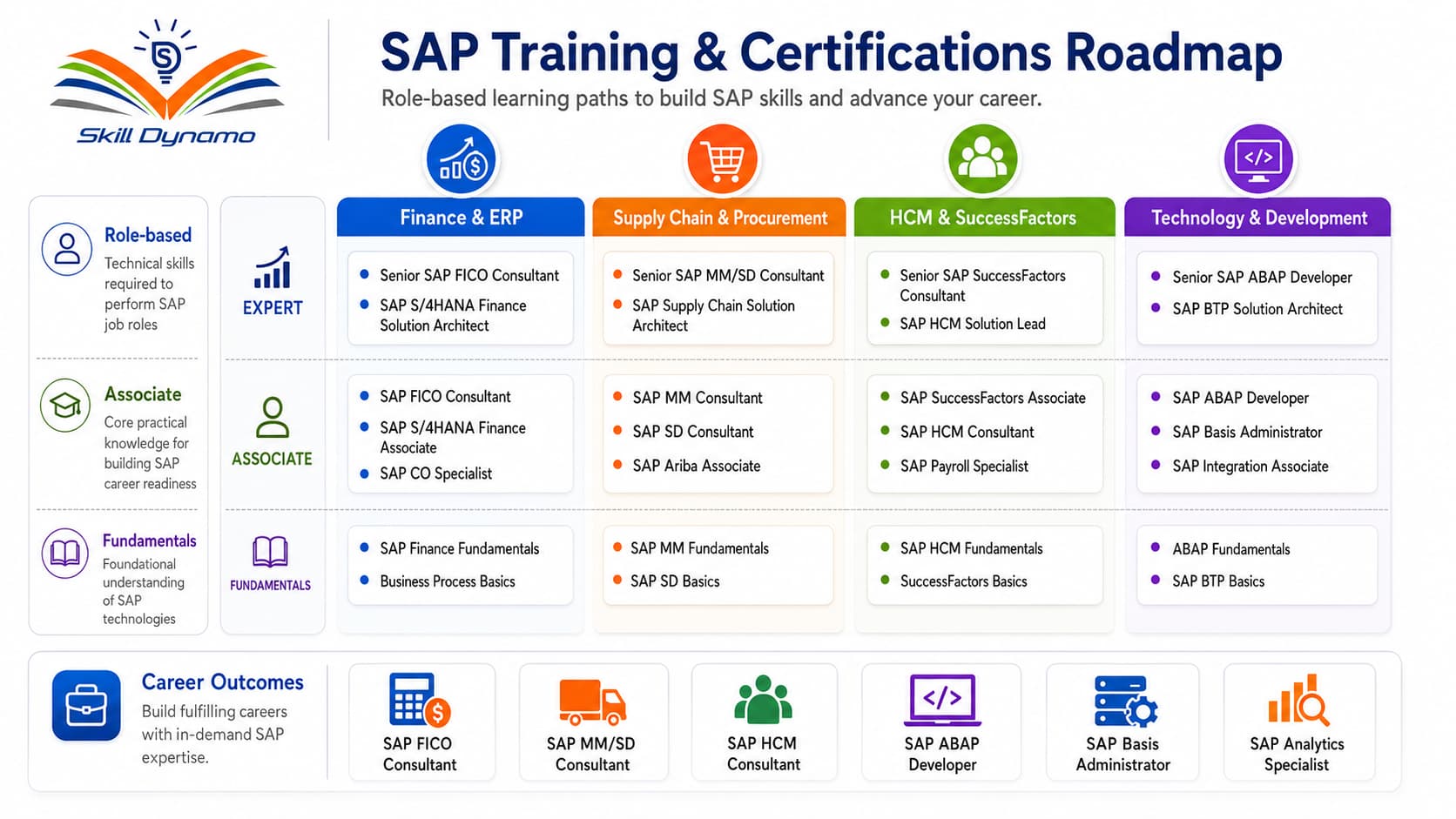
SkillDynamo provides structured SAP training through expert-led sessions, practical exercises, business process examples, implementation scenarios, and role-based learning paths.
Our approach helps learners understand SAP concepts clearly and apply their knowledge confidently in real organizational environments.
Who Can Join?
SAP courses are suitable for:
- Students and fresh graduates
- Finance and accounting professionals
- Supply chain and procurement professionals
- HR professionals
- Sales and operations teams
- IT professionals and developers
- Business analysts
- ERP consultants
- Working professionals planning a career change
Start Your SAP Learning Journey
Choose the right SAP Certification Course with SkillDynamo and build future-ready skills in enterprise applications, cloud ERP, analytics, business processes, and digital transformation.
SAP: From Business Software Innovation to Global Enterprise Transformation
SAP was founded in 1972 in Germany by five former IBM engineers: Dietmar Hopp, Hasso Plattner, Claus Wellenreuther, Klaus Tschira, and Hans-Werner Hector. Their goal was to create software that could process business information in real time and help organizations manage operations more efficiently.
The company’s original name was Systemanalyse Programmentwicklung, which later became Systems, Applications, and Products in Data Processing. SAP first gained recognition through financial accounting and enterprise management software designed for large organizations.
SAP’s early products introduced integrated business processes, allowing departments such as finance, sales, inventory, procurement, production, and human resources to work with shared data. This reduced duplication, improved accuracy, and helped businesses make faster decisions.
The launch of SAP R/2 and later SAP R/3 played a major role in SAP’s global growth. SAP R/3 brought enterprise resource planning to client-server environments and enabled organizations to connect multiple business functions through one integrated platform.
Over time, SAP expanded into supply chain management, customer relationship management, human capital management, analytics, business intelligence, procurement, and industry-specific applications.
A major step in SAP’s evolution was the introduction of SAP HANA, an in-memory database designed to process large volumes of data quickly. SAP HANA became the foundation for SAP S/4HANA, SAP’s modern ERP platform for real-time business operations, analytics, automation, and digital transformation.
SAP also developed cloud-based solutions such as SAP SuccessFactors, SAP Ariba, SAP Concur, SAP Analytics Cloud, and SAP Business Technology Platform. These solutions help organizations manage employees, procurement, travel, analytics, application development, data integration, and business automation.
Today, SAP technologies are used by organizations across manufacturing, retail, banking, healthcare, logistics, telecommunications, energy, government, and many other industries. Businesses rely on SAP to manage finance, supply chains, human resources, sales, procurement, operations, and enterprise data.
For learners, SAP’s history reflects the evolution of enterprise software from basic accounting systems to intelligent, cloud-based business platforms. Learning SAP technologies can support careers in consulting, implementation, development, administration, analytics, and enterprise transformation.
SkillDynamo’s SAP courses help learners understand the SAP ecosystem, gain practical knowledge of business processes, prepare for certification exams, and build skills aligned with modern enterprise requirements.
Latest Trends in SAP Technologies
SAP technologies are evolving around artificial intelligence, cloud ERP, trusted business data, process automation, application development, and intelligent enterprise operations. SAP professionals now need a combination of functional, technical, cloud, data, automation, and AI skills.
SAP Business AI and Joule Agents
SAP Business AI is becoming a core part of finance, procurement, supply chain, human resources, sales, service, and project management.
Joule Agents can analyse business information, automate multi-step activities, identify risks, recommend actions, and support users within SAP applications. Professionals should understand business processes, AI-assisted workflows, data governance, security, and responsible AI use.
SAP Business Data Cloud
SAP Business Data Cloud brings SAP and third-party business data together for analytics, planning, artificial intelligence, and intelligent applications.
It helps organizations use trusted and well-governed data without relying on excessive data duplication. Important skills include data products, SAP HANA Cloud, SAP Analytics Cloud, data integration, semantic modelling, governance, and enterprise AI.
Cloud ERP and SAP S/4HANA Transformation
Organizations continue to modernize legacy ERP environments using SAP S/4HANA Cloud and SAP Cloud ERP.
Current projects focus on process standardization, real-time analytics, automation, simplified landscapes, and faster innovation. SAP professionals should develop skills in S/4HANA business processes, migration, configuration, integration, testing, and cloud operations.
Clean Core and Upgrade-Stable Extensions
The clean-core approach encourages organizations to reduce unnecessary ERP customizations and build upgrade-friendly extensions.
SAP BTP, SAP Build, and ABAP Cloud support side-by-side and on-stack development without heavily modifying the ERP core. Clean-core knowledge is becoming important for SAP developers, architects, consultants, and transformation teams.
SAP Business Technology Platform
SAP BTP connects application development, integration, automation, data, analytics, and AI capabilities.
Organizations use SAP BTP to extend SAP applications, connect SAP and non-SAP systems, automate workflows, create business applications, and deliver AI-powered solutions.
Relevant skills include SAP Integration Suite, SAP Build, SAP HANA Cloud, SAP Analytics Cloud, application development, APIs, automation, and AI Foundation.
Low-Code, Pro-Code and AI-Assisted Development
SAP Build enables business users and developers to create applications, automate processes, and design digital workspaces.
Joule for Developers also supports coding, documentation, testing, application extensions, and repetitive development activities. SAP professionals can benefit from learning both low-code and professional development approaches.
Intelligent Applications and Real-Time Insights
SAP is expanding intelligent applications that combine trusted data, analytics, AI, planning, and business simulations.
These applications help business leaders monitor performance, predict outcomes, identify risks, and take faster action across finance, workforce, supply chain, procurement, and operations.
Supply-Chain Automation and Resilience
SAP is introducing AI agents and intelligent workflows across supply-chain planning, logistics, procurement, manufacturing, and business networks.
Companies are using these capabilities to improve forecasting, reduce manual tasks, manage disruptions, improve inventory visibility, and accelerate operational decisions.
Embedded AI in SAP Business Applications
AI is increasingly embedded directly into SAP S/4HANA Cloud, SuccessFactors, Ariba, Fieldglass, Concur, Sales Cloud, Service Cloud, and supply-chain applications.
This creates opportunities for consultants who understand both SAP functional processes and AI-enabled automation.
Open Data and Multiplatform Integration
SAP is expanding integrations with platforms such as Databricks, Snowflake, Google Cloud, and other enterprise technologies.
Professionals should understand SAP and non-SAP data integration, APIs, business data fabrics, analytics platforms, data products, and secure cross-platform access.
Sovereign Cloud and Enterprise Security
Regulated organizations increasingly require cloud environments that support data residency, operational control, compliance, security, and sovereignty requirements.
SAP cloud professionals should understand identity management, authorization, data protection, governance, compliance, cybersecurity, and resilient cloud architecture.
Skills SAP Professionals Should Learn
SAP S/4HANA Cloud
SAP Business AI and Joule
SAP Business Data Cloud
SAP Business Technology Platform
SAP HANA Cloud
SAP Analytics Cloud
SAP Integration Suite
SAP Build and workflow automation
ABAP Cloud and clean-core development
SAP FICO, MM, SD and HCM
SAP SuccessFactors and SAP Ariba
Data governance and security
Cloud migration and system integration
AI-enabled business-process automation
Prepare for the Future of SAP
SkillDynamo’s SAP courses help learners develop practical skills aligned with cloud ERP, SAP S/4HANA, Business AI, Joule, SAP BTP, data analytics, automation, enterprise applications, and digital transformation.
Through structured learning paths, hands-on exercises, real-world business scenarios, and certification preparation, learners can prepare for careers in SAP consulting, development, administration, analytics, integration, cloud operations, and enterprise transformation.






 SkillDynamo