 -by
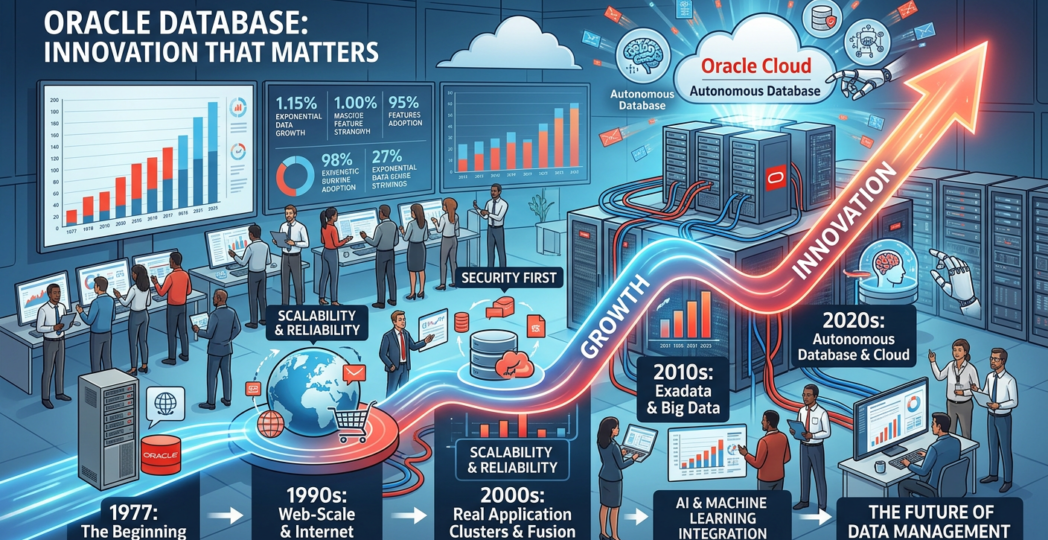
Oracle Database continues to evolve as enterprises demand faster data processing, stronger security, cloud flexibility, and intelligent applications. Traditionally recognized for supporting mission-critical business systems, Oracle is expanding its role in artificial intelligence (AI), real-time analytics, application development, and distributed data management.
A major milestone is Oracle AI Database 26ai, announced in October 2025 as the next long-term support release replacing Oracle Database 23ai. Its innovations combine AI capabilities with established database technologies, helping organizations develop intelligent applications while maintaining enterprise data governance. Further agentic AI announcements in 2026 demonstrate Oracle’s focus on connecting AI systems with trusted business data.
These developments are influencing how companies evaluate database platforms, modernize infrastructure, manage costs, and build new digital services.
1. Oracle AI Database 26ai: An AI-Native Architecture
One of Oracle’s most significant innovations is the integration of AI capabilities directly into its database platform. Rather than requiring every AI application to depend on separate data stores and complex synchronization processes, Oracle AI Database 26ai aims to bring data retrieval, analytics, security, and AI application development closer together.
This approach allows organizations to combine existing enterprise data with AI models while preserving database controls and transactional capabilities. Businesses can explore AI-enabled applications without necessarily replacing their established Oracle database environments.
Oracle positioned 26ai as a long-term support release, providing a path from 23ai through release updates. Organizations should still review their current versions, compatibility requirements, and applicable support documentation before planning a transition.
2. AI Vector Search and Retrieval-Augmented Generation
AI Vector Search is among Oracle’s most important innovations. Vector representations capture semantic relationships between information, enabling applications to find content based on meaning rather than relying exclusively on exact keyword matches.
For example, a customer support application could retrieve documents related to a question even when the user phrases it differently from the original documentation. By combining vector search with relational queries, text search, JSON, graph, and spatial capabilities, Oracle can support more comprehensive retrieval workflows.
This is especially relevant to retrieval-augmented generation (RAG), where an AI model retrieves relevant enterprise information before generating an answer. Organizations can use this approach to build internal knowledge assistants, document discovery tools, and data-informed business applications.
The market impact is increased competition between traditional database vendors and specialist vector database providers. Oracle’s proposition is that organizations can combine semantic search with existing enterprise data and security controls rather than automatically introducing another database platform.
3. Agentic AI and Natural-Language Data Access
Oracle’s 2026 agentic AI announcements expand its strategy beyond conventional database queries. AI agents can be designed to retrieve information, perform multi-step analysis, and support business workflows using authorized enterprise data.
Oracle AI Database Private Agent Factory is intended to help business users and developers build and deploy data-driven AI agents. Oracle also announced capabilities including a database MCP server, which can enable compatible AI clients and agents to interact with database resources through the Model Context Protocol.
These capabilities could support applications such as financial analysis assistants, operational reporting agents, and enterprise research tools. For example, an authorized business analyst might use a natural-language interface to investigate sales performance and request additional analysis without manually constructing every query.
However, AI agents should not be granted unrestricted database access. Authentication, least-privilege permissions, validation, auditing, and human approval for sensitive actions remain essential. Some announced capabilities have specific availability or deployment conditions, which organizations should verify before adopting them.
4. Multicloud and the Autonomous AI Lakehouse
Enterprises increasingly operate across multiple cloud providers and on-premises environments. Oracle’s innovations reflect this trend by supporting AI and analytics across different infrastructure choices.
Oracle Autonomous AI Lakehouse introduces support for Apache Iceberg, an open table format used to manage analytical data in data lakes. The approach enables organizations to work with lakehouse data while using Oracle database and analytics capabilities. Oracle has described support across Oracle Cloud Infrastructure, Amazon Web Services, Microsoft Azure, and Google Cloud.
This matters because businesses often want to preserve existing investments in cloud platforms, analytics tools, and data engineering pipelines. Open data formats and interoperability can reduce the need to move or duplicate data simply to support new AI workloads.
For the market, this strategy increases competition in the data lakehouse sector. It also gives enterprises more architectural choices, although actual performance, integration complexity, and cost depend on workloads and implementation.
5. Security, Data Protection, and Database Resilience
Security remains a critical requirement as organizations expose more data to applications and AI systems. Oracle AI Database 26ai includes SQL Firewall capabilities designed to monitor and block unauthorized SQL activity and help defend against SQL injection attacks.
Oracle has also announced innovations such as Deep Data Security, which aims to enforce access rules based on the individual user or AI agent accessing information. This is particularly important when AI applications operate on behalf of employees with different permissions.
Other developments include Zero Data Loss Cloud Protect for protecting eligible on-premises Oracle databases through Oracle’s recovery services, along with enhancements to globally distributed database architectures.
These technologies can help organizations strengthen data protection and resilience. Nevertheless, they do not eliminate the need for secure application design, identity management, patching, tested recovery plans, and ongoing monitoring.
The commercial impact is significant in industries such as banking, healthcare, telecommunications, and government, where data protection and service continuity are central purchasing requirements.
6. JSON Relational Duality and Developer Productivity
Modern applications frequently combine structured relational information with JSON-based data. Oracle’s JSON Relational Duality capabilities allow developers to access and update related data through relational tables and JSON documents using a unified approach.
This can reduce the complexity of maintaining separate representations of the same business information. Developers can build application interfaces around JSON while benefiting from relational database capabilities, including transaction consistency and established security controls.
Oracle AI Database 26ai also introduces enhancements to SQL, PL/SQL, application development, and database administration. These improvements can simplify development and maintenance, particularly in large enterprise environments with established Oracle applications.
For businesses, improved developer productivity may shorten implementation cycles and reduce the effort needed to maintain complex systems. The actual benefit depends on application architecture, developer skills, and how effectively teams adopt the new features.
7. Performance, Caching, and Operational Efficiency
Oracle continues to invest in database performance and operational reliability. True Cache provides an application-transparent caching approach designed to help reduce repeated database access while maintaining transactional consistency. Other improvements target SQL execution, data management, and administrative tasks.
These developments can benefit high-volume transaction systems, digital commerce platforms, and analytics applications that must respond quickly under changing workloads.
Improved efficiency may reduce infrastructure pressure, but performance gains should be validated using realistic benchmarks. Organizations need to evaluate licensing, compute consumption, storage, networking, and operational costs rather than assuming that every new capability automatically reduces total expenditure.
8. Market Impact and Future Opportunities
Oracle’s latest innovations affect the database market in several ways. First, integrating AI into an established enterprise database increases competition with cloud-native databases, specialist vector databases, and independent AI data platforms.
Second, multicloud support and open formats respond to organizations seeking flexibility and reduced dependency on a single infrastructure provider. Third, agentic AI creates new opportunities for developers, database administrators, data engineers, and security specialists who can build reliable AI-enabled business systems.
These changes also introduce challenges. Organizations must assess migration risks, skills gaps, governance requirements, vendor costs, and the maturity of new capabilities. Not every workload needs AI search or autonomous agents, and some applications may benefit more from conventional database optimization.
Conclusion
Oracle Database is moving beyond traditional data storage and transaction processing toward an integrated platform for AI, analytics, secure application development, and multicloud data management. Oracle AI Database 26ai, vector search, agentic AI capabilities, Apache Iceberg support, stronger security features, and developer-focused improvements illustrate this direction.
The market impact will depend on how effectively organizations turn these capabilities into measurable business outcomes. Enterprises that evaluate new features against real workloads, preserve strong governance, and invest in the right technical skills can use Oracle’s innovations to modernize applications and develop intelligent services. Ultimately, the competitive advantage comes not from adopting every new feature, but from applying the right database capabilities to solve important business problems.