 -by
In modern finance, organizations must close their books accurately, reconcile accounts efficiently, and deliver reliable financial reports within increasingly demanding deadlines. Manual spreadsheets, disconnected financial systems, and inconsistent approval processes can slow the financial close, increase operational risk, and make audits more complicated. Oracle Account Reconciliation Cloud Service (ARCS), now commonly associated with Oracle Account Reconciliation in Oracle Fusion Cloud Enterprise Performance Management (EPM), addresses these challenges through automated reconciliation, centralized monitoring, workflow management, and stronger financial controls.
Oracle ARCS is designed to help finance teams standardize account reconciliation activities and improve visibility throughout the financial close. By replacing fragmented processes with a controlled cloud-based platform, organizations can reduce repetitive work, identify discrepancies earlier, and focus their expertise on complex accounting issues.
Its significance extends beyond automation. Oracle Account Reconciliation supports a more consistent, transparent, and data-driven approach to financial governance.
1. Understanding Oracle ARCS
Oracle ARCS is a cloud-based financial reconciliation solution within Oracle’s EPM ecosystem. It helps organizations manage account reconciliations, transaction matching, supporting documentation, approvals, and exception resolution.
Traditional reconciliation processes often require finance professionals to compare balances from general ledgers, subledgers, bank statements, and external systems manually. This approach becomes increasingly difficult when organizations manage multiple legal entities, currencies, accounting standards, and reporting deadlines.
Oracle Account Reconciliation provides a centralized environment where reconciliation assignments, supporting evidence, review status, and outstanding issues can be monitored systematically. Finance teams gain a clearer view of progress and can prioritize accounts that require additional attention.
The platform is particularly valuable for organizations seeking consistent financial close procedures across departments, business units, and geographic regions.
2. Automated Account Reconciliation
One of the core features of Oracle ARCS is automated account reconciliation. The solution helps organizations establish standardized reconciliation methods based on account characteristics, risk levels, and accounting policies.
Reconciliation rules can determine how accounts are prepared, what supporting information is required, who reviews the results, and when tasks must be completed. Depending on the configured workflow, balances can be imported from supported financial systems and evaluated against established criteria.
For example, a finance department managing hundreds of balance sheet accounts can use predefined reconciliation formats and automated assignments to reduce repetitive administration. Reviewers can concentrate on unusual balances, incomplete evidence, and discrepancies instead of spending excessive time coordinating spreadsheets.
Automation does not eliminate the need for accounting judgment. Complex accounts and unusual transactions still require investigation, documentation, and approval by appropriately qualified personnel.
3. Transaction Matching and Exception Management
Transaction matching is another important capability. Organizations frequently need to compare large volumes of transactions from different sources, including bank statements, payment processors, subledgers, and general ledger systems.
Oracle Account Reconciliation’s Transaction Matching functionality helps identify corresponding transactions using configured matching rules. Depending on the scenario, rules may use transaction identifiers, amounts, dates, reference fields, and permitted tolerances.
For example, a retailer processing thousands of daily payments may need to match sales records with payment gateway settlements and bank deposits. Automated matching can identify corresponding records, while unmatched items are directed for further investigation.
This can reduce manual comparison effort and improve the consistency of exception handling. However, successful matching depends on source-data quality, appropriate rule design, and carefully defined tolerance levels. Incorrect rules can produce false matches or leave legitimate transactions unresolved.
4. Workflow, Approvals, and Financial Governance
Financial reconciliation is not simply a comparison of balances. It also requires evidence, accountability, review, and approval. Oracle ARCS supports structured workflows that help organizations assign responsibilities and monitor reconciliation status.
Finance managers can use dashboards and task lists to identify overdue reconciliations, outstanding approvals, and accounts that require additional review. Role-based responsibilities help separate preparation from approval and support established internal control requirements.
Standardized workflows can also improve audit readiness by keeping supporting documentation and reconciliation information organized within the process.
For multinational organizations, this is particularly valuable because accounting activities may be distributed across shared-service centers, regional finance teams, and local business units.
The platform can support stronger governance, but organizations must still define suitable control policies, access permissions, review procedures, and escalation paths.
5. Integration with Oracle Cloud EPM and Financial Systems
Oracle ARCS operates most effectively when integrated into a broader financial data environment. Organizations may need to reconcile information from Oracle Fusion Cloud ERP, Oracle E-Business Suite, other enterprise resource planning platforms, banking systems, and external financial applications.
Supported integration methods help transfer relevant balances and transaction data into reconciliation workflows. Integration design depends on the source system, available connectors, data formats, and organizational architecture.
For example, a company may import general ledger balances from its ERP system and transaction records from a payment platform. Account Reconciliation can then apply configured reconciliation and matching processes to those datasets.
Integrations should include data validation, error handling, reconciliation of imported totals, and monitoring of failed transfers. Establishing clear ownership for integration support helps prevent missing or inconsistent data from delaying the financial close.
6. Analytics, Dashboards, and Close Visibility
Financial teams need visibility into the status of the close, not merely access to individual reconciliation records. Oracle ARCS provides monitoring and reporting capabilities that help users understand workload, completion status, overdue items, and exceptions.
Managers can use this information to identify bottlenecks and direct resources toward high-risk or time-sensitive accounts. Historical trends can also reveal recurring reconciliation issues, such as repeated data-quality problems or accounts that consistently require manual investigation.
When combined with wider Oracle EPM planning and reporting processes, reconciliation information can contribute to a more coordinated finance function.
The business value lies in transforming close management from reactive follow-up into a measurable operational process. Effective dashboards should focus on indicators that drive action rather than presenting large volumes of metrics without clear priorities.
7. Security, Auditability, and Compliance
Financial information is highly sensitive, making security and traceability essential. Oracle ARCS supports controlled access and structured financial workflows that help organizations manage responsibilities and preserve relevant reconciliation evidence.
Role-based access can restrict users to appropriate tasks and information. Supporting documentation, review activity, and process status help provide visibility into how reconciliations were prepared and approved.
These capabilities can support internal control programs and external audit preparation. However, a software platform alone does not guarantee regulatory compliance. Organizations must configure controls correctly, manage access rights, retain records according to applicable requirements, and periodically test the effectiveness of their processes.
Data protection policies, user access reviews, integration security, and change management should remain part of the overall governance framework.
8. Business Benefits and Market Impact
Oracle ARCS reflects the growing demand for finance automation and cloud-based financial control systems. Organizations are increasingly moving away from spreadsheet-driven processes toward standardized platforms that support repeatability, visibility, and measurable accountability.
Key potential benefits include:
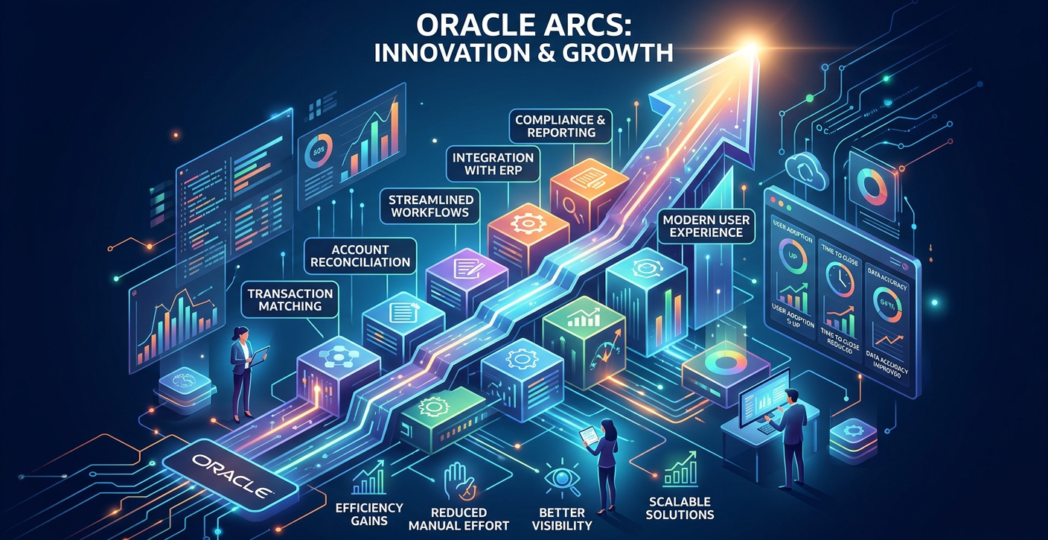
Reduced manual effort: Automated assignments and transaction matching can reduce repetitive reconciliation activities.
Faster financial close: Centralized workflows and exception tracking can help teams resolve outstanding items sooner.
Improved consistency: Standardized templates and rules encourage consistent processes across accounts and business units.
Better audit preparation: Organized evidence and controlled review processes improve access to relevant documentation.
Greater management visibility: Dashboards help finance leaders identify delays, exceptions, and workload concerns.
Scalable operations: Cloud-based workflows can support organizations managing complex reconciliation requirements across multiple entities.
The impact depends on implementation quality, source-system integration, process standardization, and user adoption. Organizations should establish baseline measures and track improvements in reconciliation time, unmatched transaction volume, overdue tasks, and manual adjustments.
9. Future Opportunities: AI and Intelligent Finance
The future of account reconciliation is likely to involve greater use of AI-assisted exception analysis, anomaly detection, predictive insights, and intelligent workflow support.
These technologies could help finance teams prioritize unusual transactions, identify recurring reconciliation patterns, and investigate potential causes of discrepancies more efficiently. AI assistants may also support the preparation of explanations or summaries based on authorized financial data.
Such capabilities should be assessed according to the specific Oracle product release and licensing available to the organization; they should not be assumed to be included in every ARCS deployment.
Human oversight will remain important for material accounting decisions, unusual adjustments, and financial approvals. AI-generated explanations must be traceable to source information and reviewed before they are used in formal reporting.
Conclusion
Oracle ARCS provides organizations with a structured approach to account reconciliation, transaction matching, exception management, workflow control, and financial close monitoring. By centralizing reconciliation activities and automating suitable tasks, it can help finance teams reduce repetitive work, improve visibility, and strengthen operational consistency.
Its long-term value comes from combining automation with sound accounting policies, reliable integrations, effective governance, and measurable process improvement. As finance functions become increasingly digital, Oracle Account Reconciliation can help organizations build a more controlled, efficient, and scalable financial close process while allowing professionals to devote more attention to analysis and informed decision-making.