 -by
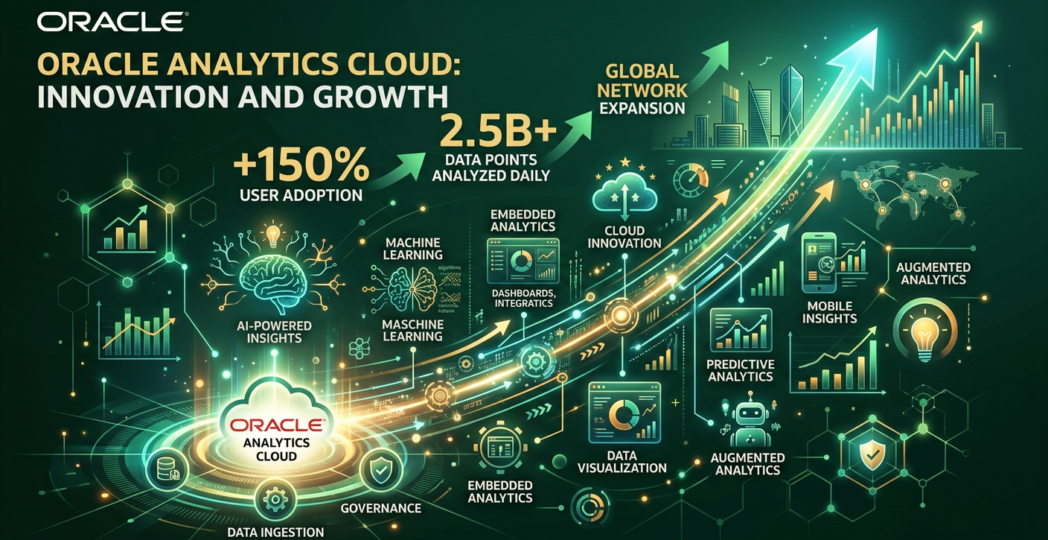
Oracle Analytics Cloud (OAC) is evolving from a traditional business intelligence platform into an intelligent analytics environment that helps organizations transform business data into actionable decisions. As enterprises generate increasing volumes of information from finance, sales, supply chains, customer interactions, and cloud applications, the ability to understand that data quickly has become a competitive advantage.
Oracle is strengthening OAC through generative artificial intelligence (AI), conversational analytics, automated data preparation, machine learning, interactive visualizations, and integrations with external AI tools. These developments aim to make analytics accessible to business users while maintaining the governance and consistency required by enterprise organizations.
The platform’s future growth depends on how effectively it helps businesses move beyond static reports toward continuous, context-aware decision-making.
1. Generative AI and Conversational Analytics
One of the most significant innovations in Oracle Analytics Cloud is the expansion of AI-powered assistance. Instead of relying exclusively on predefined dashboards or manually constructed queries, users can increasingly explore data using natural-language questions.
Oracle’s AI Assistant supports conversational exploration, helping users investigate business questions and develop visualizations through prompts. The broader AI ecosystem includes homepage and workbook assistants, AI agents, mobile experiences, and embedded analytics.
For example, a sales manager could ask which product categories experienced declining revenue during a particular quarter. An AI-assisted workflow can help identify relevant information and present findings in a more accessible format.
This reduces some of the technical barriers associated with traditional business intelligence. However, reliable answers still depend on well-modeled data, clear business definitions, appropriate permissions, and verification of AI-generated results.
2. AI Agents and Context-Aware Insights
Another important development is the movement toward agentic analytics. Traditional dashboards show performance indicators, but users often need additional context to understand why a metric changed and what action might be appropriate.
Oracle’s AI agents can combine enterprise datasets with relevant organizational knowledge to help explain trends and business conditions. Retrieval-augmented generation (RAG) can support this approach by connecting structured data with documents such as reports, policies, and reference material.
For example, a supply chain analyst might investigate rising delivery costs and use an AI-assisted workflow to compare operational metrics with relevant business policies or supporting documents.
This creates opportunities for faster investigations and more informed discussions. AI-generated explanations should nevertheless be treated as decision support, not unquestionable conclusions. Business owners must validate findings before making significant financial or operational decisions.
3. AI-Assisted Data Preparation and Modeling
Preparing data for analytics can consume substantial time. Analysts often need to clean records, derive new columns, create calculations, and standardize business terminology before producing useful reports.
Oracle Analytics Cloud’s 2026 updates introduced preview capabilities for creating and editing data flows with AI assistance. Users can describe desired transformations in plain English and receive suggestions for derived fields and formulas.
For example, a retail analyst could request a calculated indicator identifying products with declining sales or create a derived field to categorize orders based on business rules.
AI-assisted preparation can reduce repetitive formula writing and help analysts explore useful metrics more quickly. Because these capabilities include preview features, organizations should verify availability and suitability in their own environments before depending on them for critical production workflows.
4. Oracle Analytics Cloud MCP Server and Open AI Integration
The Model Context Protocol (MCP) is an emerging standard for connecting AI applications with external tools and data services. Oracle Analytics Cloud’s MCP Server provides a way for compatible AI clients to interact with governed analytics resources through supported operations.
Depending on the configured capabilities, external AI tools can discover accessible datasets, inspect metadata, and execute supported queries against the Oracle Analytics semantic layer. September 2026 documentation also lists a preview capability for executing ANSI-friendly logical SQL queries through the MCP Server.
This can help organizations connect enterprise analytics with AI assistants and developer workflows without discarding their existing semantic models.
The semantic layer is particularly important because it preserves business definitions for measures, dimensions, joins, and analytical granularity. Nevertheless, integrations must use appropriate authentication, access controls, query restrictions, and monitoring. Preview functionality should not be assumed to have the same production readiness as generally available features.
5. Advanced Visualization and Interactive Dashboards
Visual analytics remains a central part of OAC. Interactive dashboards, workbook visualizations, filtering, and data actions help users explore performance from different perspectives.
Recent updates have introduced improvements to workbook editing, shared filter groups, time-series calculations, chart formatting, and embedded workbook experiences. September 2026 enhancements also include improved Insights panel configuration, Auto Insights for consumers, and additional visualization controls.
These features help teams develop dashboards that are easier to navigate and adapt to business needs.
For example, a finance team could build an interactive profitability dashboard that allows managers to compare business units, examine historical changes, and investigate performance variations without requiring a separate report for every question.
The real value of visualization is not the number of charts available. It is the ability to present information clearly, highlight meaningful changes, and help users take appropriate action.
6. Embedded and Mobile Analytics
Business decisions increasingly happen outside dedicated analytics applications. Managers work in operational systems, employees use mobile devices, and customer-facing teams need information within their existing workflows.
Oracle’s AI analytics ecosystem supports mobile and embedded experiences that can bring analytics closer to where decisions are made. Its documented capabilities include mobile AI assistance and options for embedding AI-assisted analytics into supported applications.
For instance, a regional manager could review performance information while travelling, while an operations employee might access analytics from within an internal business application.
Embedding analytics can reduce context switching and make insights easier to access. Organizations should carefully design these experiences to ensure that embedded content respects user permissions, privacy requirements, and the intended audience.
7. Market Growth and Competitive Impact
The market for enterprise analytics is being reshaped by cloud adoption, AI-assisted decision-making, and demand for self-service business intelligence. Organizations increasingly want analytics platforms that connect data preparation, reporting, machine learning, and natural-language interaction.
Oracle Analytics Cloud benefits from its relationship with Oracle’s wider ecosystem, including Oracle Cloud Infrastructure, enterprise databases, and business applications. Organizations already using Oracle technologies may find value in integrating analytics with existing data assets and security frameworks.
The platform also competes with established analytics solutions such as Microsoft Power BI, Tableau, and other cloud-based business intelligence services. Competitive success depends on usability, integration, performance, governance, licensing, and the ability to produce measurable business value.
Rather than assuming that market demand automatically guarantees adoption, organizations should evaluate OAC through practical use cases, proof-of-concept projects, and total-cost-of-ownership analysis.
8. Business Benefits Across Industries
Oracle Analytics Cloud can support a wide range of enterprise scenarios.
Finance: Analyze profitability, spending patterns, budgets, and financial performance.
Retail: Monitor sales trends, product performance, inventory, and customer demand.
Manufacturing: Investigate production efficiency, operational costs, and supply chain performance.
Healthcare: Support operational reporting and resource utilization using appropriately governed data.
Human resources: Examine workforce trends, staffing patterns, and organizational metrics.
Technology and services: Track service performance, project delivery, customer engagement, and revenue indicators.
The potential benefits include faster analysis, more accessible reporting, improved data consistency, and reduced manual effort. Realized results depend on data quality, implementation design, user adoption, and the clarity of the business objectives.
9. Challenges and Future Opportunities
AI-powered analytics introduces new responsibilities. Organizations must address inaccurate AI-generated explanations, inconsistent business definitions, data access risks, and the cost of AI usage. They must also ensure that employees understand how to interpret analytical findings and recognize uncertainty.
Successful implementation requires trusted semantic models, well-maintained datasets, appropriate identity and access management, and clear governance policies. AI responses should be validated against authoritative data, especially in regulated or financially sensitive environments.
Looking forward, Oracle Analytics Cloud is positioned to develop further toward conversational and agentic analytics, automated data preparation, integrated AI workflows, and more contextual decision support. These developments may make analytics more accessible to nontechnical users while preserving a governed foundation for enterprise reporting.
Conclusion
Oracle Analytics Cloud is advancing through generative AI, AI agents, natural-language exploration, intelligent data preparation, interactive visualization, and external AI integration. These innovations reflect a broader transformation in business intelligence: moving from static reporting toward more conversational, contextual, and action-oriented analytics.
Its long-term growth will depend on the practical value it delivers, the quality of its AI-assisted insights, and its ability to integrate securely with existing enterprise systems. Organizations that combine these capabilities with strong data governance and measurable business objectives can use Oracle Analytics Cloud to improve decision-making and build a more responsive, data-driven business.