-by
The evolution of digital experience management is entering a new phase as Generative Artificial Intelligence (GenAI) and intelligent automation reshape how organizations create, manage, personalize, and deliver digital content. Adobe Experience Manager (AEM), Adobe’s enterprise content management and digital experience platform, is increasingly important in this transformation because it connects content creation, asset management, web experiences, and enterprise publishing workflows.
Traditional content management systems primarily help organizations organize information and publish digital experiences. AI-enhanced approaches introduce additional capabilities, including content generation, intelligent asset discovery, automated metadata creation, personalized experiences, and more efficient content operations. When applied thoughtfully, these innovations allow marketing teams, developers, designers, and content strategists to spend less time on repetitive activities and more time improving customer engagement.
The real opportunity is not simply adding AI to a website. It is building an intelligent content ecosystem in which enterprise information, creative resources, business rules, and customer needs work together to deliver relevant digital experiences at scale.
1. Generative AI Is Redefining Content Creation in AEM
Generative AI can assist content teams in producing and refining digital material, including headlines, product descriptions, campaign copy, summaries, and variations of existing content. Within an AEM-based workflow, these capabilities can help teams prepare content for websites, landing pages, campaign experiences, and other digital channels.
For example, a marketing team launching a new product might need several versions of a product introduction for different audiences. AI-assisted workflows can generate initial drafts based on approved product information and brand guidelines. Content authors can then review the output, verify factual accuracy, and refine the language before publication.
This approach reduces repetitive drafting while preserving human editorial control. It also supports content reuse by helping teams transform approved source material into different formats without starting from scratch.
However, organizations should distinguish between AI capabilities available directly within Adobe products and capabilities delivered through separately licensed Adobe services, external AI platforms, or custom integrations. The exact experience depends on the AEM deployment model, product configuration, and available entitlements.
2. Intelligent Digital Asset Management with AI
Adobe Experience Manager Assets helps organizations manage digital resources such as images, videos, documents, campaign graphics, and product photography. AI can improve the way these assets are described, classified, searched, and reused.
Automated metadata suggestions can help asset managers create more consistent descriptions. AI-assisted tagging may identify visible objects, themes, or other characteristics that make assets easier to discover. Semantic search can help users find resources by describing what they need rather than remembering an exact filename or folder location.
Consider a global retailer managing thousands of product and campaign images. Instead of searching through nested folders, a designer might search for an image featuring a particular product category, visual setting, or campaign theme. Better asset discovery can reduce duplication and help teams reuse approved creative resources.
Generative image capabilities can also support the creation or adaptation of visual content. Adobe Firefly provides generative AI capabilities that may be incorporated into creative workflows, subject to product availability and licensing. Such capabilities can help creative teams explore visual concepts, produce variations, or adapt assets for different formats. Generated results still require review for brand consistency, usage rights, and suitability.
3. AI-Driven Personalization and Customer Experiences
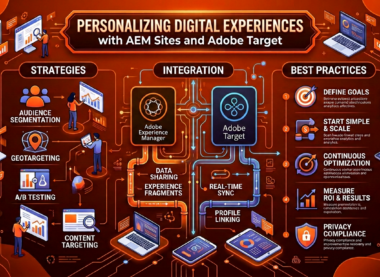
Personalization is another important area of AI-driven innovation. Customers increasingly expect digital experiences that reflect their interests, needs, and stage in the purchasing journey. AEM can serve as the content foundation for experiences that use audience data, contextual signals, and personalization rules.
When integrated with appropriate Adobe Experience Cloud products or other authorized systems, AI-driven approaches can help teams identify audience patterns, evaluate content performance, and develop relevant experience variations. For example, an online education provider might present different course recommendations to visitors exploring beginner training and professionals researching advanced certification programs.
Generative AI can support this process by helping teams create alternative headlines, summaries, or content variations for different audience segments. Predictive and analytical systems can help evaluate which experiences perform better when suitable data and experimentation methods are available.
Responsible personalization requires appropriate consent, privacy controls, data governance, and transparency. AI should support relevant experiences without exposing sensitive information or making unjustified assumptions about individual customers.
4. Structured Content, Headless AEM, and AI Integration
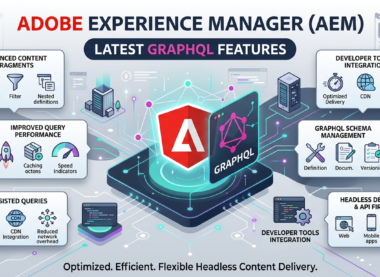
Modern digital ecosystems often distribute content across websites, mobile applications, commerce experiences, customer portals, and other channels. AEM’s structured content capabilities, including Content Fragments and APIs such as GraphQL where supported, can help organizations separate content from its presentation.
This architecture can make enterprise content more accessible to downstream applications and approved AI services. A product description, for instance, may be maintained as structured content and reused across several digital channels. An AI-enabled application could use that approved information to draft a summary or answer a product-related question, provided the integration is designed with appropriate access controls and validation.
The Model Context Protocol (MCP) is another emerging approach for connecting AI applications with tools and contextual information through a defined interface. Where an organization implements a compatible MCP server or integration, an AI assistant may be able to access approved content operations or supporting systems within explicitly granted permissions.
MCP should not be assumed to be universally built into every AEM environment. Such workflows may require custom development, compatible services, authentication configuration, and security review. The integration should expose only the actions and information necessary for the intended use case.
5. AI-Assisted Content Operations and Workflow Automation
Enterprise content production involves more than writing and publishing. Teams coordinate reviews, approvals, translations, asset preparation, metadata management, compliance checks, and release schedules. AI-assisted automation can help reduce administrative effort across these activities.
For example, an AI-enabled workflow could summarize a long content draft, suggest missing metadata, identify potentially inconsistent terminology, or flag material for additional legal review. Workflow automation can route tasks to the appropriate reviewers, while AEM’s content management processes provide a controlled environment for managing revisions and publication.
Translation and localization workflows may also benefit from AI-assisted drafting and terminology suggestions. However, content intended for regulated industries or culturally sensitive markets should receive qualified human review.
A practical implementation begins with repetitive, measurable tasks rather than attempting to automate the entire publishing lifecycle. Organizations can evaluate time savings, review effort, error rates, and content quality before expanding the solution.
6. Developer Productivity and AI-Enhanced AEM Engineering
Generative AI is changing how developers build and maintain AEM applications. AI coding assistants can help explain existing code, draft unit tests, generate documentation, suggest refactoring approaches, and investigate build errors.
For AEM developers, potential applications include assistance with Sling Models, HTL templates, Java services, front-end components, dispatcher configuration, and API integrations. AI tools may also help teams understand legacy implementations or prepare migration plans, provided they are supplied with suitable technical context.
AI-generated code must not be treated as production-ready by default. Developers should verify API usage, security implications, performance, compatibility with AEM as a Cloud Service, and compliance with project standards.
Combining AI-assisted development with continuous integration and continuous delivery pipelines can create a more efficient engineering process. Automated tests, code quality checks, dependency reviews, and deployment controls remain essential safeguards for every change.
7. Governance, Security, and Responsible AI
Enterprise AI adoption introduces risks that must be managed from the beginning. Generated content may contain inaccurate claims, biased language, unsuitable imagery, or information that is not supported by approved sources. Integrations can also expose confidential information if permissions and data boundaries are poorly designed.
Organizations should establish clear rules covering approved AI services, permitted data, content ownership, access controls, auditability, and human approval. Sensitive information should not be sent to an AI service unless the organization has confirmed that the service and its configuration are approved for that use.
Brand guidelines, approved terminology, legal requirements, and accessibility standards should be incorporated into content review processes. AI-generated material should be checked for accuracy and accessibility before publication.
For AI assistants connected to content repositories or APIs, teams should apply least-privilege permissions, validate inputs, restrict available actions, protect credentials, and log important operations. Governance should be proportionate to the risk of the task, with stricter controls for regulated or customer-sensitive activities.
8. Implementing an AI-Driven AEM Strategy
A successful implementation starts with a clear business objective. Organizations should identify a high-value problem, such as slow asset discovery, repeated content drafting, inconsistent metadata, or lengthy review cycles.
Next, teams should map the existing content architecture, available Adobe capabilities, licensing requirements, data sources, and integration constraints. A small proof of concept can then test the proposed workflow with representative content and realistic user scenarios.
Success should be measured using indicators such as content production time, asset search effectiveness, approval turnaround, reuse rates, error rates, and user satisfaction. Results should be compared with a baseline rather than relying on assumptions about AI productivity.
Once a pilot demonstrates value, the organization can expand gradually, strengthen governance, train employees, and integrate the workflow into standard content operations. This phased approach limits unnecessary complexity and allows teams to learn before making broader investments.
Conclusion
Generative AI and AI-driven innovations are creating new possibilities for Adobe Experience Manager by improving content creation, digital asset discovery, personalization, workflow automation, and developer productivity. The strongest results come from combining these capabilities with structured content, reliable integrations, established publishing controls, and human expertise.
AEM can provide an important foundation for intelligent digital experience delivery, while Adobe’s broader ecosystem and carefully designed third-party integrations can extend what organizations achieve. Yet successful adoption depends on more than technology. It requires a clear business purpose, secure architecture, responsible data practices, measurable outcomes, and continuous evaluation.
Organizations that adopt AI incrementally and embed it into well-governed content workflows can build digital experiences that are more efficient to produce, easier to manage, and better aligned with customer expectations.