 -by
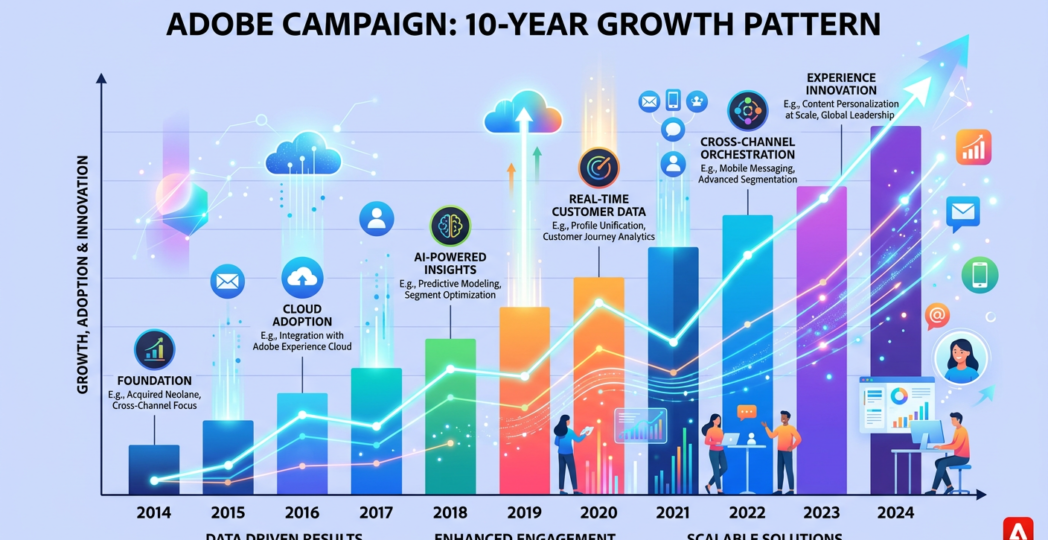
Adobe Campaign has evolved significantly over the past decade, reflecting the transformation of digital marketing from traditional email campaigns into sophisticated, data-driven, cross-channel customer engagement. Businesses increasingly expect marketing technology to deliver relevant messages, coordinate customer interactions across channels, and measure campaign performance with greater precision.
Adobe Campaign supports these needs through campaign management, audience segmentation, marketing workflows, transactional messaging, and integrations with other digital experience technologies. Its development from earlier Campaign Classic and Campaign Standard offerings toward Adobe Campaign v8 represents an important step in modernizing the platform’s architecture and user experience.
The future of Adobe Campaign will be shaped by artificial intelligence, automation, cloud infrastructure, real-time customer engagement, and closer connections between marketing data and customer journey orchestration.
1. Adobe Campaign’s Growth Over the Last 10 Years
From Traditional Campaigns to Cross-Channel Marketing
Around 2016, many organizations were expanding beyond email newsletters and basic promotional campaigns. Marketers needed better ways to segment audiences, personalize messages, coordinate customer communications, and measure results.
Adobe Campaign’s established capabilities in campaign workflows, data management, and complex audience segmentation helped organizations manage large marketing operations. As digital channels expanded, businesses increasingly sought coordinated communication through email, SMS, mobile push notifications, and transactional messaging.
This evolution changed campaign management from a simple message-sending activity into a broader process involving customer data, audience selection, content preparation, scheduling, delivery, and performance analysis.
Campaign Classic and Campaign Standard
Adobe Campaign Classic developed from Neolane, which Adobe acquired in 2013. It became known for extensive customization, advanced data manipulation, and complex marketing workflows suited to organizations with demanding technical requirements.
Adobe Campaign Standard offered a more approachable experience for marketers who wanted simplified campaign creation and streamlined workflows. Its development reflected the growing need to make marketing automation more accessible without sacrificing the capabilities required by enterprise teams.
These offerings addressed different organizational requirements and contributed to the evolution of Adobe’s campaign management portfolio.
The Move Toward Adobe Campaign v8
Adobe Campaign v8 represents a major step toward a more modern, cloud-managed architecture. It combines enterprise campaign orchestration with enhancements to infrastructure, security, monitoring, data management, and user experience.
Campaign v8 introduces a modern web interface alongside the traditional client console, helping marketers create and manage campaigns through more accessible workflows. It also supports large-scale data processing through its Full Federated Data Access architecture, which uses a cloud database approach based on Snowflake.
Adobe’s managed cloud model includes infrastructure oversight and operational support. Campaign v8 is offered as a Managed Cloud Service rather than as a new on-premises deployment option. Migration planning remains important because moving from older environments can involve substantial technical and operational considerations.
2. Major Technological Developments in Adobe Campaign
Cloud Modernization and Scalability
Cloud-managed infrastructure has become a central part of Adobe Campaign’s evolution. Modern campaign operations must handle large customer databases, complex segmentation, high-volume deliveries, and changing business demands.
Campaign v8’s cloud architecture is designed to improve scalability and simplify infrastructure management. This allows organizations to focus more on campaign strategy, customer engagement, and operational efficiency rather than managing every infrastructure component themselves.
Improved Web-Based Campaign Management
The modern Campaign web interface provides a more accessible experience for marketers. Visual workflows, simplified navigation, and drag-and-drop capabilities help reduce the technical effort involved in creating and managing campaigns.
Recent developments include multilingual deliveries, campaign approval management, content experiments, enhanced integrations with Adobe Experience Manager, and improvements to SMS and mobile push capabilities. Availability depends on the relevant Campaign version and interface.
Integration With the Adobe Experience Ecosystem
Marketing technology has increasingly shifted toward connected platforms rather than isolated applications. Adobe Campaign can participate in broader digital experience workflows involving content management, analytics, customer data, and journey orchestration.
Integration with Adobe Experience Manager helps teams coordinate content and campaign assets. Connections with analytics and customer experience platforms can support better measurement and more informed campaign planning.
This interconnected approach helps businesses align content creation, audience targeting, campaign delivery, and performance evaluation.
3. Artificial Intelligence and Generative AI
Artificial intelligence is one of the most important influences on the future of marketing automation. Adobe is introducing AI-assisted content generation and other intelligent capabilities into its marketing technology portfolio.
Within Adobe Campaign, AI-assisted workflows can help marketers explore content variations, accelerate message preparation, and reduce repetitive work. Brand guidelines, approval procedures, and human review remain important for ensuring that generated content is appropriate and accurate.
The broader Adobe CX Enterprise initiative, announced in April 2026, emphasizes agentic AI: systems that coordinate multiple tasks and workflows across customer experience applications. Adobe also announced CX Enterprise Coworker as a solution for coordinating activities such as audience selection, content creation, campaign preparation, and performance monitoring.
These developments point toward a future in which marketers can define business objectives and use AI-assisted workflows to prepare campaign plans, recommend actions, and coordinate execution under appropriate human supervision.
4. The Future of Adobe Campaign Technology
Intelligent Customer Journey Orchestration
Future marketing platforms will increasingly focus on understanding customer context and coordinating communications across multiple touchpoints. Campaign management will become more closely connected to journey orchestration, allowing organizations to design more coherent experiences across email, mobile, and other channels.
The opportunity is to move from disconnected campaigns toward coordinated interactions that reflect customer preferences, previous engagement, and business objectives.
Greater Personalization
Personalization will continue to develop through improved segmentation, richer customer context, and AI-assisted content adaptation. Organizations will seek to deliver messages that reflect customer interests, lifecycle stages, and previous interactions.
However, personalization must be balanced with consent, privacy, data quality, and customer expectations. Using more data does not automatically create a better experience.
Automation and Predictive Insights
Automation will likely expand across campaign setup, quality checks, audience analysis, reporting, and operational monitoring. Predictive insights can help marketers identify engagement patterns, estimate potential campaign outcomes, and prioritize audiences for further analysis.
AI-generated recommendations should be tested against actual campaign performance rather than accepted without validation. Organizations will need clear performance indicators and experimentation practices to determine whether automation produces measurable improvements.
Deeper Analytics and Cross-Platform Integration
The future of campaign technology will depend on stronger connections between marketing execution and business results. Organizations will increasingly seek to combine campaign data with customer behavior, sales outcomes, and broader digital experience analytics.
This will help teams understand which communications contribute to engagement and conversion, while supporting more informed decisions about marketing investment.
5. Career and Business Opportunities
The evolution of Adobe Campaign creates opportunities for marketing automation consultants, campaign developers, solution architects, data specialists, and digital marketing professionals.
Key skills include campaign workflow design, advanced segmentation, email and SMS delivery, transactional messaging, API integration, data management, troubleshooting, and reporting. Knowledge of cloud architecture, privacy controls, and AI-assisted marketing workflows will become increasingly valuable.
Organizations modernizing legacy campaign environments may also require specialists to assess existing workflows, plan migrations, improve integrations, and train marketing teams.
For training providers and enterprise learning teams, advanced Adobe Campaign courses can focus on Campaign v8, complex workflow development, data architecture, integration strategies, campaign optimization, and emerging AI capabilities.
Conclusion
Over the last decade, Adobe Campaign has evolved alongside the wider marketing technology industry—from traditional campaign execution toward integrated, scalable, and increasingly intelligent customer engagement. Campaign Classic and Campaign Standard addressed different enterprise and marketer requirements, while Campaign v8 represents a major move toward modern cloud-managed operations and a more accessible user experience.
Looking ahead, AI-assisted content creation, agentic workflows, intelligent personalization, and deeper integration across Adobe’s customer experience ecosystem are likely to shape the next phase of development.
Organizations that combine these technologies with sound data governance, effective campaign strategy, and measurable business objectives will be better positioned to improve customer engagement. For professionals, developing strong Adobe Campaign expertise alongside cloud, data, integration, and AI skills can create valuable opportunities in the future of marketing technology.