 -by
Agentic Artificial Intelligence (Agentic AI) is an emerging technology that enables AI systems to understand objectives, plan tasks, make decisions, use connected tools, and execute multi-step workflows with varying levels of human supervision. Unlike traditional AI systems that primarily respond to individual prompts, Agentic AI can work toward a defined business goal by coordinating multiple activities and adapting its actions based on results.
When integrated with Adobe technologies, Agentic AI can transform digital marketing, customer experience management, content creation, personalization, analytics, and enterprise content operations. Adobe’s ecosystem—including Adobe Experience Platform (AEP), Adobe Experience Manager (AEM), Adobe Journey Optimizer (AJO), Adobe Real-Time Customer Data Platform (RTCDP), Adobe Marketo Engage, and Adobe Firefly—provides capabilities that can support intelligent, connected workflows.
The result is an approach in which AI agents help organizations deliver relevant customer experiences, accelerate content production, and improve operational efficiency while maintaining business rules and human oversight.
1. Understanding Agentic AI in the Adobe Ecosystem
Agentic AI combines large language models, reasoning capabilities, tools, enterprise data, and workflow orchestration. An AI agent receives a goal, identifies the steps required to achieve it, interacts with authorized systems, evaluates the results, and continues until the task is completed or human intervention is required.
Within Adobe environments, agents can support activities such as identifying customer segments, recommending personalized content, assisting campaign creation, analyzing customer journeys, and identifying opportunities to improve marketing performance.
For example, a marketing team might ask an AI agent to develop a campaign for customers who have shown interest in a new product. The agent could help analyze approved customer data, suggest audience segments, prepare content variations, recommend a customer journey, and evaluate campaign results through connected Adobe services. Actual execution depends on the configured integrations, permissions, and available capabilities.
2. Key Adobe Technologies That Support Agentic AI
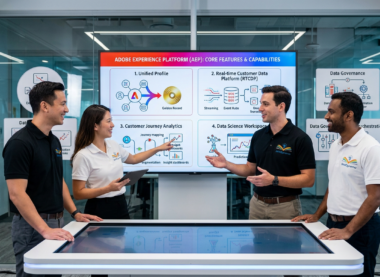
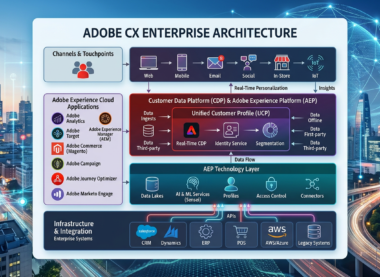
Adobe Experience Platform (AEP): AEP provides a foundation for bringing together customer data from supported sources, managing customer profiles, and enabling data-driven experiences. Authorized agents can use relevant platform capabilities to support audience analysis, customer insights, and personalization workflows.
Adobe Real-Time Customer Data Platform (RTCDP): RTCDP helps organizations unify customer profiles and create audiences from eligible data. When integrated with agent workflows, it can support audience discovery, segmentation recommendations, and activation planning, subject to consent, governance, and access controls.
Adobe Journey Optimizer (AJO): AJO supports customer journey orchestration and personalized engagement across supported channels. AI agents can assist with journey planning, content recommendations, decision support, and performance analysis. Publishing or activating journeys requires the appropriate configuration and authorization.
Adobe Experience Manager (AEM): AEM manages digital content and experiences across websites and other digital touchpoints. Agentic workflows can assist with content discovery, metadata generation, content adaptation, quality checks, and publishing preparation.
Adobe Firefly: Firefly supports generative content creation, including images and other creative assets. Agents can help prepare prompts, propose creative variations, and coordinate content production according to brand guidelines and applicable usage policies.
Adobe Marketo Engage: Marketo Engage supports marketing automation, lead management, and campaign execution. Connected agents can help with campaign planning, lead-nurturing recommendations, segmentation analysis, and performance reporting.
The exact integration options differ across Adobe products, product editions, APIs, and available AI capabilities. Not every workflow is available natively in every product.
3. How Agentic AI Works with Adobe Technology
An Agentic AI workflow typically follows six stages:
Step 1: Define the objective. A business user specifies a goal, such as improving campaign engagement, preparing personalized product content, or increasing qualified leads.
Step 2: Gather authorized information. The agent retrieves relevant information from permitted Adobe services and connected enterprise systems. This may include audience attributes, approved content, campaign history, or performance metrics.
Step 3: Analyze and plan. The agent evaluates the information, identifies suitable actions, and creates a sequence of tasks. For complex work, a coordinating agent may delegate specialized activities to separate agents.
Step 4: Execute through connected tools. Using approved APIs, connectors, or workflow services, the agent may prepare content, recommend audiences, create draft assets, or initiate permitted business processes. It can only perform actions supported by its integrations and permissions.
Step 5: Validate and request approval. The workflow checks results against business rules, brand requirements, consent restrictions, and quality standards. Human approval can be required before publishing content, sending communications, or changing customer-facing campaigns.
Step 6: Measure and improve. The system reviews available results and recommends adjustments. Where authorized, it can use feedback to refine subsequent workflow decisions.
This process creates a controlled cycle of planning, execution, validation, and optimization rather than a single question-and-answer interaction.
4. Practical Example: An Agentic AI-Powered Adobe Marketing Campaign
Consider an e-commerce company launching a new product. The marketing team wants to reach relevant customers with personalized content across its digital channels.
An Agentic AI workflow could operate as follows:
The agent receives the campaign objective and identifies the required tasks.
AEP provides access to relevant, authorized customer data and profile insights.
RTCDP supports the identification of eligible customer audiences.
The agent helps generate campaign messaging and creative concepts using Adobe Firefly.
AEM supports the preparation and management of approved landing pages and digital assets.
AJO supports the configuration of personalized customer journeys across supported channels.
Marketo Engage can support related lead-nurturing activities where the campaign uses marketing automation.
Analytics and campaign reporting help the team assess engagement, conversions, and customer responses.
The agent recommends improvements based on the available results, with further execution subject to configured permissions and approval requirements.
This example illustrates how Adobe products can work together as part of an agentic workflow. It does not imply that every integration is automatic or that a single agent can independently operate every Adobe application without additional implementation.
5. Business Benefits of Agentic AI and Adobe Integration
Improved personalization: AI-assisted audience analysis and content recommendations help organizations create more relevant customer experiences.
Faster content production: Integration with Firefly and AEM can reduce repetitive creative and content-management work, subject to review and approval processes.
Marketing workflow automation: Agents can coordinate tasks across supported systems, reducing manual handoffs and repetitive activities.
Better decision-making: By analyzing available campaign and customer data, agents can help identify performance trends and recommend improvements.
Operational efficiency: Organizations can standardize workflows, automate eligible routine tasks, and allow employees to focus on strategy and creative decisions.
Scalable customer engagement: Coordinated Adobe capabilities can help businesses manage personalized experiences across multiple audiences, campaigns, and digital touchpoints.
6. Challenges, Security, and Best Practices
Successful implementation requires more than connecting an AI model to Adobe applications. Organizations should establish clear agent responsibilities, secure authentication, least-privilege access, data governance, and reliable integration mechanisms.
Customer consent, privacy requirements, and data-retention policies must be respected when agents access customer information. Generated content should undergo appropriate factual, legal, accessibility, and brand-compliance checks.
Organizations should also introduce approval gates for high-impact actions, maintain audit logs, monitor agent performance, and provide fallback procedures when an agent encounters incomplete data or an unexpected result. Initial deployments should focus on limited, measurable use cases before expanding to more autonomous workflows.
7. Future Growth of Agentic AI in Adobe Technology
Agentic AI is likely to become increasingly important in digital experience platforms as organizations seek to connect data, content, decision-making, and customer engagement. Adobe’s investments in generative AI, experience orchestration, customer data, and AI-assisted enterprise workflows provide a foundation for developing these capabilities.
Future implementations may involve specialized agents for campaign strategy, content production, customer insights, journey optimization, and marketing operations working together under shared governance. Their effectiveness will depend on the maturity of the underlying models, the availability of supported integrations, data quality, and the ability to measure business outcomes.
Conclusion
Agentic AI with Adobe technology integration represents a shift from isolated AI assistance toward coordinated, goal-oriented business workflows. By combining AI agents with Adobe Experience Platform, RTCDP, Journey Optimizer, Experience Manager, Firefly, and Marketo Engage, organizations can develop more connected approaches to personalization, content creation, campaign management, and customer engagement.
The most effective strategy is to begin with a clearly defined business objective, connect the required Adobe capabilities through supported interfaces, establish appropriate governance, and measure results continuously. With a balance of automation, human supervision, and responsible AI practices, Agentic AI can help organizations build more adaptive and efficient digital experiences.