 -by
In a digitally connected world, customers expect brands to deliver relevant, consistent, and personalized experiences across websites, mobile applications, email, social media, and other channels. However, organizations often struggle with fragmented data, disconnected marketing tools, and limited visibility into customer behavior. Adobe Experience Platform (AEP) addresses these challenges by providing an enterprise foundation for collecting, standardizing, managing, and activating customer experience data.
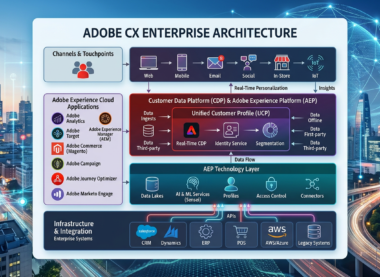
AEP enables businesses to connect data from multiple systems, build unified customer profiles, apply analytics and AI capabilities, and support personalized digital experiences. It also provides a foundation for Adobe solutions such as Real-Time Customer Data Platform (RTCDP), Adobe Journey Optimizer (AJO), and Customer Journey Analytics (CJA). Adobe Experience Platform overview
1. Unified Customer Data Management
One of AEP’s core features is its ability to bring together data from multiple enterprise sources. These may include CRM systems, e-commerce platforms, websites, mobile applications, customer service tools, and offline transactions.
By consolidating customer information in a common platform, organizations can reduce data silos and create a more consistent foundation for customer analysis and engagement. This helps marketing, analytics, and technology teams work with standardized information rather than relying on isolated datasets.
For example, a retailer can combine product browsing activity, purchase records, and customer account information to better understand customer interests and buying patterns.
2. Experience Data Model (XDM)
The Experience Data Model (XDM) is a standardized framework for structuring experience data in AEP. It defines schemas that describe the format and meaning of customer attributes, events, and other information collected by the platform.
XDM helps different systems exchange and interpret data consistently. Organizations can use standard schemas or create custom schemas to meet their business requirements.
A well-designed XDM structure improves data quality, simplifies integrations, and supports downstream services such as profile management, segmentation, and analytics. Careful schema planning is especially important when multiple teams and applications share the same data foundation.
3. Real-Time Customer Profile
AEP’s Real-Time Customer Profile capability combines supported customer attributes and experience events into a unified profile view. With appropriate identity configuration and profile-enabled datasets, organizations can develop a more complete understanding of customer interactions across different channels.
For example, a customer who browses a product online and later purchases it through an application may have relevant interactions reflected in their profile when the required identifiers and data flows are configured correctly.
This unified view supports more informed audience creation and personalization. Profile availability and freshness depend on ingestion methods, identity rules, configuration, and service-specific processing.
4. Identity Service and Identity Resolution
Customers may interact with a brand using different devices, accounts, and identifiers. AEP Identity Service helps connect related identifiers through identity graphs, supporting a more connected view of customer activity.
This can help businesses associate authenticated account information with relevant digital interactions, where the available data and configured identity rules permit it.
Effective identity management can reduce fragmentation and improve audience relevance. Organizations should define identity namespaces, prioritize suitable identifiers, and validate identity relationships to avoid inaccurate profile connections.
5. Data Ingestion and Integration
AEP supports data ingestion through supported connectors, APIs, and other collection methods. Batch ingestion is useful for scheduled imports, while streaming ingestion can support more immediate processing of incoming events.
Adobe Experience Platform Web SDK and Mobile SDK support data collection from digital experiences, while source connectors and APIs can help integrate enterprise systems.
Data Prep capabilities can help map, transform, and validate incoming data before it is used downstream. These features give organizations flexibility to connect existing technology investments while building a more unified customer data architecture.
6. Segmentation and Audience Management
AEP’s Segmentation Service enables organizations to define audiences using customer attributes, behavioral events, and supported profile data.
Businesses can create segments such as frequent purchasers, visitors interested in a particular category, customers who have not returned recently, or users who completed a specific interaction.
These audiences can support acquisition, retention, cross-selling, and re-engagement strategies. Depending on the selected service and configuration, audience evaluation can occur through different methods, including streaming, batch, or edge segmentation where supported.
For marketers, segmentation transforms raw data into actionable groups that can be used by connected activation and engagement solutions.
7. Data Governance, Privacy, and Security
Responsible data management is essential when organizations collect and use customer information. AEP includes governance capabilities such as data usage labels and policies that help restrict certain uses of data. It also provides access controls, audit logs, and integrations with privacy-related workflows.
These controls can help businesses manage access, establish consistent data-use practices, and support privacy obligations. Data lifecycle capabilities also help organizations manage data deletion and retention-related tasks.
However, platform features do not automatically guarantee legal compliance. Organizations must implement appropriate consent collection, retention policies, access reviews, and regulatory processes for their operating regions.
8. Query Service and Data Insights
AEP Query Service allows users to query supported platform datasets using SQL. This capability can help data engineers and analysts investigate customer data, validate ingestion results, perform exploratory analysis, and develop custom reporting workflows.
Combined with dashboards, data access tools, and connected analytics solutions, these features can improve visibility into data quality and customer behavior.
For organizations with complex data requirements, SQL-based analysis also provides flexibility beyond predefined reports, helping technical teams answer specific business questions using available data.
9. AI, Automation, and Intelligent Workflows
AI-related capabilities are becoming an increasingly important part of the AEP ecosystem. Adobe provides AI Assistant features to help users explore product knowledge and perform supported workflow tasks. Adobe has also introduced agentic capabilities designed to assist with activities such as data validation and marketing workflow optimization, subject to product availability and entitlements.
When used responsibly, these capabilities can help teams investigate data issues, reduce repetitive work, and improve operational efficiency. AI outputs should still be reviewed, especially when they affect customer targeting, data governance, or business-critical decisions.
10. Integration with Adobe Experience Cloud
AEP provides a data foundation for multiple Adobe applications and supported third-party integrations.
- Real-Time CDP: Supports audience creation, customer profile use, and activation to configured destinations.
- Adobe Journey Optimizer: Uses customer data to support cross-channel journeys and personalized engagement.
- Customer Journey Analytics: Helps analyze customer interactions across channels and datasets.
- Adobe Target: Supports experimentation and personalization in applicable implementations.
- Adobe Experience Manager: Helps deliver digital content and experiences that can be informed by customer data.
Together, these integrations can help organizations connect data collection, audience intelligence, experience delivery, and measurement within a coordinated architecture.
Business Benefits and Best Practices
AEP can help organizations improve data consistency, reduce fragmented customer views, enable more relevant experiences, and support better collaboration between marketing and technical teams.
To realize these benefits, businesses should define clear use cases, design scalable XDM schemas, establish identity rules, validate ingestion pipelines, implement governance controls, and monitor data quality. Teams should also measure outcomes such as conversion, retention, engagement, and operational efficiency instead of treating data collection as the end goal.
Conclusion
Adobe Experience Platform is more than a customer data repository; it is a flexible foundation for connected, data-driven customer experiences. Its features—including XDM, data ingestion, Real-Time Customer Profile, Identity Service, segmentation, governance, Query Service, AI capabilities, and integrations—help organizations turn fragmented information into useful business intelligence.
With a well-planned architecture and strong data governance, AEP can support personalization, analytics, and customer engagement at enterprise scale. Its long-term value depends on the quality of the data, the relevance of the use cases, and the ability to translate insights into meaningful customer experiences.