 -by
Modern marketing requires more than sending promotional emails. Organizations must understand customer preferences, coordinate campaigns across multiple channels, deliver relevant messages, and measure performance continuously. Adobe Campaign addresses these requirements through a marketing automation platform designed for data-driven, cross-channel campaign management.
By combining customer data management, audience segmentation, workflow automation, personalization, and campaign analytics, Adobe Campaign helps enterprises coordinate complex marketing activities while maintaining consistency across customer touchpoints. Its integration with the broader Adobe Experience Cloud ecosystem also enables organizations to connect campaign execution with content management, customer data, and digital experience optimization.
1. Cross-Channel Campaign Management
One of Adobe Campaign’s most important features is its ability to coordinate marketing communications across supported channels. Depending on the product version and configuration, these channels can include email, SMS, push notifications, direct mail, and other customer engagement touchpoints.
Instead of managing each communication independently, marketing teams can design coordinated campaigns around specific business objectives. For example, a retailer could send a promotional email, follow up with an eligible customer through a mobile notification, and use a later communication to encourage repeat purchases.
This centralized approach improves campaign consistency and helps businesses manage large-scale communication programs more efficiently.
2. Customer Data Management and Audience Segmentation
Effective marketing depends on reaching the right audience with the right message. Adobe Campaign supports customer profile management, data processing, audience creation, and segmentation using relevant customer attributes and behavioral information.
Marketers can define audiences based on purchase history, communication preferences, previous campaign engagement, and other available data. These segments can then support more relevant campaign targeting.
For example, an online retailer could develop separate campaigns for first-time purchasers, repeat customers, inactive subscribers, and customers interested in a particular product category.
The quality of these segments depends on accurate data, reliable identifiers, appropriate permissions, and sound segmentation rules. Integrations with Adobe Experience Platform can extend data availability and support connected audience activation where configured.
3. Advanced Personalization and Dynamic Content
Generic marketing messages often fail to reflect individual customer interests. Adobe Campaign enables marketers to personalize communications using available profile information, audience attributes, and business rules.
Personalization can include customer names, relevant product recommendations, promotional offers, localized messaging, and content variations for different segments. Dynamic content allows multiple message versions to be managed within a common campaign structure.
For example, a travel company could present different destination offers to customers based on their stated interests or eligible travel preferences.
Reusable templates and content components can also help marketing teams maintain brand consistency while reducing repetitive production work.
4. Workflow Automation and Campaign Orchestration
Adobe Campaign provides visual workflow capabilities that help teams automate campaign processes. Workflows can support data imports, audience selection, enrichment, filtering, delivery preparation, scheduling, and other operational tasks.
A campaign workflow may begin by importing customer records, validating data, excluding ineligible contacts, selecting an audience, preparing a message, and scheduling delivery.
Recurring and scheduled workflows are particularly useful for activities such as newsletters, loyalty campaigns, onboarding communications, and routine customer notifications.
Automation reduces repetitive manual work, improves process consistency, and makes complex campaign operations easier to manage. Workflow monitoring and error handling remain important for ensuring reliable execution.
5. Email and Mobile Marketing Capabilities
Email remains an important channel for customer acquisition, retention, and engagement. Adobe Campaign supports email creation, audience targeting, personalization, delivery preparation, and performance measurement.
Mobile marketing capabilities can support SMS and push notifications, subject to the selected version, configuration, and channel integrations. Coordinating email and mobile communications allows organizations to reach customers through suitable channels while managing communication frequency.
Transactional messaging is another valuable use case. Organizations can use supported real-time messaging capabilities for communications such as order confirmations, receipts, and account notifications.
These messages should be governed by appropriate business rules, delivery priorities, and consent requirements where applicable.
6. AI-Assisted Content Creation and Optimization
AI-assisted features are expanding the ways marketing teams can prepare and improve campaign content. Depending on the supported Adobe Campaign interface and configuration, AI Assistant capabilities can help generate email copy, subject lines, message variations, and other marketing content.
These tools can help teams explore creative alternatives and reduce the time required to prepare initial drafts. AI assistance may also support product guidance and streamline selected content-authoring activities.
However, generated content should be reviewed for factual accuracy, brand consistency, accessibility, privacy, and regulatory compliance. AI-generated recommendations should be evaluated against actual campaign results rather than assumed to improve performance automatically.
7. Campaign Testing, Analytics, and Optimization
Adobe Campaign supports campaign measurement through delivery and engagement reporting. Depending on the available capabilities, marketers can examine metrics such as delivery outcomes, opens, clicks, bounces, and conversions measured through connected systems.
Experimentation features can help teams compare message variations, including subject lines, content, and other campaign elements. Results can guide decisions about which version to use for a broader audience.
Organizations should select success metrics that reflect their objectives. For example, a customer retention campaign may prioritize repeat purchases, while an awareness campaign may focus on qualified engagement.
Reliable measurement requires accurate tracking, appropriate attribution assumptions, and consistent reporting definitions.
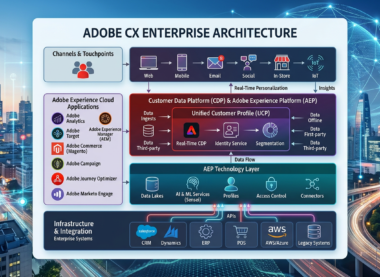
8. Integration with the Adobe Experience Cloud Ecosystem
Adobe Campaign becomes more valuable when connected to complementary enterprise applications. Depending on the implementation, integrations may include:
- Adobe Experience Manager: Supports content collaboration and reusable digital assets.
- Adobe Experience Platform: Helps connect customer data and eligible audiences.
- Adobe Journey Optimizer: Can complement Campaign in broader customer engagement strategies.
- Adobe Workfront: Supports campaign planning, collaboration, and approval workflows.
- External CRM and enterprise systems: Provide relevant customer, transaction, and operational information.
A clear integration architecture helps prevent duplicated data, inconsistent audience definitions, and disconnected workflows. Organizations should evaluate which system owns each dataset and how updates are synchronized.
9. Security, Governance, and Deliverability
Enterprise marketing requires appropriate controls over customer information and campaign execution. Adobe Campaign implementations should use suitable permissions, access restrictions, consent management, data governance, audit practices, and secure integrations.
Deliverability is equally important. Sender reputation, domain authentication, list hygiene, bounce management, and gradual sending-volume increases for new or reactivated sending infrastructure can influence inbox placement.
Regular monitoring and operational reviews help teams identify delivery problems and maintain reliable communication practices.
Conclusion
Adobe Campaign offers a broad set of features for enterprises seeking to coordinate data-driven marketing at scale. Cross-channel campaign management, audience segmentation, personalization, workflow automation, AI-assisted content creation, analytics, and enterprise integration make it a valuable platform for structured customer engagement.
Its effectiveness ultimately depends on more than the available features. Organizations must combine accurate customer data, relevant content, thoughtful campaign design, strong governance, and continuous performance measurement.
When implemented with these principles, Adobe Campaign can help marketing teams reduce operational complexity, deliver more relevant communications, and build a more consistent customer experience across supported channels.