 -by
Modern businesses interact with customers through websites, mobile applications, digital advertising, email, e-commerce platforms, and customer support channels. Each interaction generates valuable information, but when that data remains scattered across disconnected systems, organizations struggle to understand customer behavior and deliver consistent experiences.
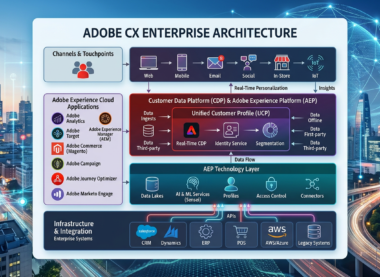
Adobe Real-Time Customer Data Platform (Adobe Real-Time CDP or RTCDP) helps address this challenge by bringing customer data together, supporting unified customer profiles, creating intelligent audience segments, and activating audiences across supported marketing and business channels. Built on Adobe Experience Platform, RTCDP enables organizations to make better use of first-party data while applying data governance and privacy controls.
Its value extends beyond marketing automation: it can help organizations establish a coordinated approach to customer understanding, audience management, and personalized engagement.
1. Unified Customer Profiles
One of Adobe RTCDP’s primary features is its ability to combine supported customer attributes and behavioral information from multiple sources into unified profiles.
Businesses can connect data from CRM platforms, websites, mobile applications, e-commerce systems, and other enterprise applications. With appropriate schemas, identifiers, and profile-enabled datasets, this information can contribute to a more comprehensive customer view.
For example, a retailer can combine browsing activity, purchase history, and loyalty information to understand customer preferences more effectively. This unified perspective helps marketing teams develop more relevant engagement strategies and reduces dependence on disconnected customer records.
2. Real-Time Data Ingestion and Processing
Adobe RTCDP supports batch and streaming data ingestion, enabling organizations to incorporate information from different systems according to their requirements.
Batch ingestion is useful for scheduled updates, such as customer lists and historical transaction records. Streaming ingestion can support faster processing of events generated by digital experiences.
For instance, when a customer views a product or abandons a shopping cart, incoming event data can contribute to profile updates and audience qualification. This can support timely engagement when the relevant data flows, audience evaluation methods, and activation destinations are configured appropriately.
The result is a more responsive customer data strategy than one based entirely on periodically refreshed lists.
3. Identity Resolution and Identity Graphs
Customers frequently interact with brands through multiple devices, browsers, and accounts. Adobe RTCDP uses identity capabilities from Adobe Experience Platform to help connect related identifiers and build a more coherent understanding of customer interactions.
Organizations can configure identity namespaces and rules to determine how identifiers relate to one another. This may help associate authenticated customer information with relevant digital activity, depending on the available data and identity configuration.
Effective identity resolution can reduce fragmentation and improve audience relevance. Businesses should regularly validate identifier quality and identity rules to prevent incorrect profile associations.
4. Advanced Audience Segmentation
Audience segmentation enables marketers to convert customer information into groups that support specific business objectives. Adobe RTCDP allows audiences to be defined using supported profile attributes, experience events, and behavioral criteria.
Examples include high-value customers, recent purchasers, inactive subscribers, customers interested in particular product categories, and prospects demonstrating strong purchase intent.
Depending on the use case and configuration, audiences can be evaluated through supported batch, streaming, or edge segmentation capabilities. The evaluation method affects how quickly audience membership can respond to changing customer behavior.
Well-designed segments help businesses improve campaign relevance, reduce unnecessary communications, and develop more targeted acquisition and retention strategies.
5. Cross-Channel Audience Activation
Audience data becomes actionable when it reaches the systems responsible for customer engagement. Adobe RTCDP supports activation to configured destinations, including supported advertising platforms, marketing applications, and other business systems.
Organizations can use audiences to coordinate paid media campaigns, personalize digital experiences, and support customer engagement workflows. Activation options and refresh frequency depend on the destination and implementation.
For example, a retailer might target interested prospects with relevant advertising while excluding recent purchasers from a product-acquisition campaign. This approach can reduce wasted advertising expenditure and improve the relevance of marketing communications.
6. Data Governance and Privacy Controls
Customer data management requires clear rules governing how information may be accessed and used. Adobe RTCDP provides governance capabilities that support data classification, usage policies, and restrictions on certain data-use scenarios.
Access-control capabilities help organizations manage user permissions, while privacy-related features can support data handling and deletion workflows. Consent information can also be incorporated into customer data processes where suitable integrations and business rules are implemented.
These controls help establish responsible data practices, but they do not independently guarantee compliance with privacy regulations. Organizations must maintain appropriate consent processes, retention policies, security measures, and legal oversight.
7. AI and Predictive Audience Intelligence
Adobe RTCDP can work with AI and machine-learning capabilities available across the Adobe Experience Platform ecosystem. Depending on product edition, licensing, and configuration, organizations may use predictive insights, propensity scores, and lookalike audience capabilities to improve audience discovery.
For example, a business could identify customers with a higher likelihood of purchasing or engaging with a particular offer. Marketing teams can then prioritize audiences and refine campaign strategies using these insights.
AI-supported targeting is most effective when supported by reliable data, appropriate model design, and ongoing evaluation. Teams should monitor performance and avoid treating predictions as guaranteed outcomes.
8. B2B and B2C Customer Data Capabilities
Adobe RTCDP supports different customer data requirements through its available editions and capabilities.
For B2C organizations, unified person profiles can support personalized campaigns, customer retention, product recommendations, and digital engagement. For B2B organizations, supported account-based capabilities can help connect people, companies, and business relationships.
This can help sales and marketing teams identify promising accounts, prioritize relevant audiences, and coordinate account-focused engagement. Organizations should select the appropriate edition based on their business model and required features.
9. Integration with Adobe Experience Cloud
RTCDP becomes more valuable when connected with other Adobe applications and supported external systems.
- Adobe Journey Optimizer: Uses customer data and audiences to support coordinated, cross-channel customer journeys.
- Adobe Customer Journey Analytics: Helps analyze customer interactions across channels and datasets.
- Adobe Experience Manager: Supports content delivery and digital experiences informed by relevant customer insights.
- Adobe Target: Supports personalization and experimentation in applicable implementations.
- CRM and advertising platforms: Help operationalize audience data across supported business and marketing workflows.
These integrations can connect customer data management with content, personalization, journey orchestration, and measurement.
10. Business Benefits and Implementation Best Practices
Adobe RTCDP can help organizations reduce data silos, improve audience quality, support more relevant communications, and increase the value of first-party customer data.
To achieve these outcomes, businesses should establish clear data ownership, design consistent schemas, validate identity rules, implement governance policies, and select meaningful use cases before scaling. Teams should also monitor data freshness, audience qualification, destination delivery, and campaign performance.
Success should be measured through business outcomes such as conversion rates, customer retention, engagement, and marketing efficiency rather than the volume of collected data alone.
Conclusion
Adobe Real-Time CDP provides a foundation for transforming fragmented customer information into actionable audience intelligence. Its capabilities in unified profiles, real-time data processing, identity resolution, segmentation, audience activation, governance, AI-supported insights, and enterprise integration help organizations build more connected customer experiences.
By combining reliable data practices with clearly defined business objectives, organizations can use RTCDP to improve marketing relevance, strengthen customer relationships, and support data-driven growth.