 -by
In today’s data-driven economy, organizations need accurate, accessible, and up-to-date information to make decisions, power applications, and deliver intelligent digital services. Traditional batch-based data integration can introduce delays, creating challenges for businesses that depend on real-time information. Oracle GoldenGate addresses this challenge through continuous data replication, change data capture, and integration across heterogeneous databases and cloud platforms.
Oracle GoldenGate has evolved from a database replication solution into a broader real-time data integration platform. With innovations across Oracle GoldenGate 23ai, Oracle GoldenGate 26ai, Oracle Cloud Infrastructure (OCI) GoldenGate, and GoldenGate Stream Analytics, the platform supports modern data architectures, AI-enabled applications, high availability, and enterprise analytics.
These capabilities help businesses synchronize information, modernize legacy systems, and make operational data available to applications and analytical platforms with minimal delay.
1. Real-Time Change Data Capture
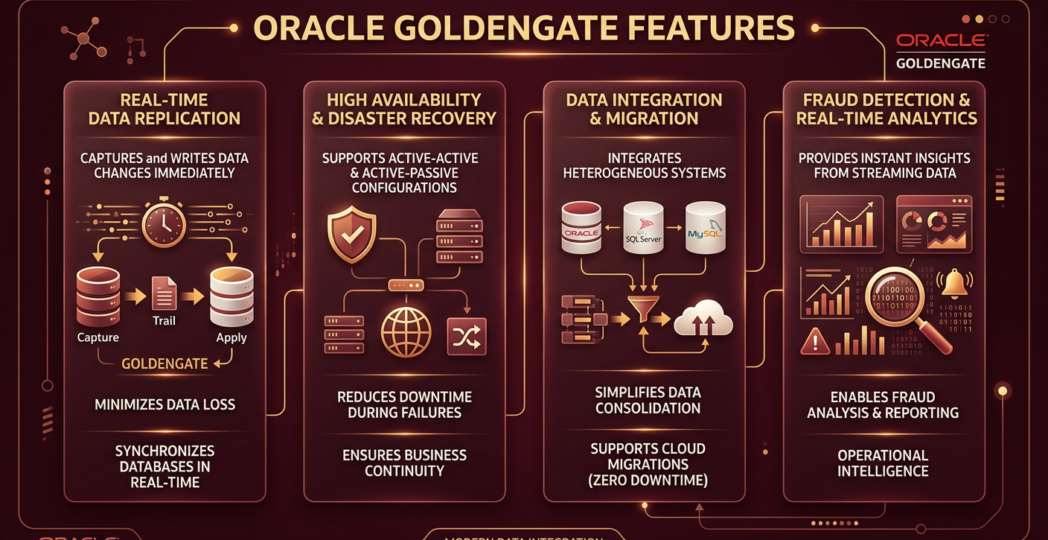
One of Oracle GoldenGate’s core features is change data capture (CDC). Instead of repeatedly copying entire database tables, GoldenGate captures changes from supported database transaction logs and delivers those changes to configured target systems.
This approach can reduce unnecessary data movement and provide downstream systems with more current information. For example, a financial services organization can replicate transaction changes to a reporting platform while its primary database continues processing business operations.
GoldenGate supports the replication of committed transactions and provides configuration options for filtering, mapping, and transforming data. These capabilities make it useful for operational reporting, application integration, and real-time analytics.
The business benefit is faster access to information without requiring every consuming application to query the production database directly.
2. Oracle GoldenGate 26ai and AI-Ready Data
A major development is Oracle GoldenGate 26ai, which extends the platform’s relevance to AI-oriented data architectures. GoldenGate can deliver current operational data to AI data hubs, semantic search systems, and retrieval-augmented generation (RAG) applications.
AI applications depend on reliable information. If a knowledge assistant uses outdated product records, customer details, or operational documents, its responses may no longer reflect the current business situation. GoldenGate can help maintain synchronized data feeds that reduce the delay between source-system changes and downstream availability.
GoldenGate 23ai also introduced support for replicating Oracle vector data types and supported vector-related use cases across heterogeneous environments. This is important for applications that rely on embeddings to retrieve semantically relevant information.
Organizations can use these capabilities to develop AI assistants and analytics workflows grounded in enterprise data. Successful implementations still require appropriate embedding generation, retrieval design, access controls, and validation of AI-generated results.
3. Heterogeneous and Multicloud Data Integration
Enterprises frequently operate databases across on-premises infrastructure, private clouds, and public cloud services. They may use Oracle Database alongside PostgreSQL, MySQL, Microsoft SQL Server, Db2, and other supported data platforms.
Oracle GoldenGate supports integration across many heterogeneous environments, subject to product edition, version, and connector certification. This flexibility helps organizations synchronize data without requiring every application to use the same database technology.
For example, a business migrating an application from an on-premises database to a cloud-hosted platform can use GoldenGate to replicate ongoing changes while the target environment is prepared and validated.
Multicloud integration also supports architectures in which operational data remains in one environment while analytics or AI processing occurs elsewhere. This can help organizations balance performance, regulatory requirements, infrastructure costs, and existing technology investments.
4. Low-Downtime Database Migration
Database modernization is often difficult because organizations cannot easily suspend critical applications for extended migration windows. Oracle GoldenGate can support near-zero-downtime migration strategies by keeping source and target databases synchronized while the transition is prepared.
A typical migration involves an initial data load, ongoing replication of subsequent changes, validation of the target, and a controlled application cutover. The exact sequence depends on the source and target technologies, application design, and migration plan.
This capability is valuable for financial systems, retail platforms, telecommunications applications, and other services where prolonged outages can affect revenue or customer trust.
However, a low-downtime migration is not automatically outage-free. Teams must test application compatibility, transaction consistency, replication lag, cutover procedures, and rollback options before moving production traffic.
5. High Availability and Business Continuity
GoldenGate can support high-availability architectures by replicating transactions between supported database environments. Depending on the topology and application design, organizations can maintain synchronized data across sites or regions and establish recovery strategies for planned and unplanned disruptions.
Some architectures support active-active configurations, where multiple systems accept writes under carefully managed rules. These designs require special attention to conflict detection, data ownership, transaction ordering, and application behavior.
For businesses operating around the clock, replication can reduce the effort required to keep secondary systems current. It can also support disaster recovery planning and help limit the impact of infrastructure failures.
GoldenGate should be considered one component of a wider resilience strategy that includes tested backups, monitoring, recovery objectives, network redundancy, and documented operational procedures.
6. OCI GoldenGate: Managed Cloud Integration
OCI GoldenGate provides a managed service for designing, deploying, orchestrating, and monitoring supported data replication pipelines. By reducing the need to provision and maintain the underlying replication infrastructure, it can simplify operational management for cloud-based integration projects.
Organizations can use the service to connect supported databases and other data platforms, depending on available connectors and service configuration. Managed deployment options can also help teams scale integration workloads as data volumes and business requirements change.
This approach is particularly relevant for enterprises modernizing their infrastructure or building cloud-based analytics platforms. Nevertheless, teams should assess service availability by region, connector support, networking, identity configuration, and pricing before choosing a managed deployment.
7. Real-Time Analytics and Stream Processing
GoldenGate can continuously deliver operational changes to data warehouses, data lakes, lakehouses, messaging systems, and analytics platforms. This allows organizations to analyze changing business conditions without relying exclusively on periodic batch transfers.
When combined with Oracle GoldenGate Stream Analytics, event data can be processed through pipelines designed for transformations, time-series analysis, geospatial processing, and other supported analytics functions.
For example, a logistics company could combine location-related events with operational records to identify delivery delays and support faster responses. A retailer could analyze inventory updates to improve replenishment decisions.
These capabilities help bridge the gap between operational systems and analytical decision-making. Actual processing latency and throughput depend on workload design, network conditions, source-system performance, and target capacity.
8. Data Integrity, Monitoring, and Developer Integration
Reliable replication requires more than moving records. Organizations must also confirm that source and target data remain consistent and that failures are detected quickly.
Oracle GoldenGate Veridata compares data between supported systems and identifies discrepancies. This helps teams investigate synchronization problems and improve confidence in replicated datasets.
GoldenGate also provides monitoring and management capabilities for observing replication processes, reviewing errors, and tracking operational health. Its microservices architecture includes APIs that support automation and integration with broader operational tools.
GoldenGate Data Streams and supported publish/subscribe interfaces can expose change events to applications, allowing developers to build event-driven services that respond to business updates.
Together, these features improve observability, validation, and integration flexibility across enterprise environments.
9. Market Impact and Future Opportunities
Oracle GoldenGate’s evolving capabilities reflect a broader market shift toward real-time data platforms and AI-ready enterprise architectures. Businesses increasingly expect data integration tools to support not only database migration and replication, but also analytics, cloud modernization, and intelligent applications.
GoldenGate can help organizations reduce the delay between business events and the systems that act on them. It can also help enterprises preserve existing database investments while connecting newer cloud and AI services.
This creates opportunities for database administrators, cloud architects, data engineers, integration specialists, and AI developers. At the same time, organizations must manage implementation complexity, licensing, operational skills, data governance, and the costs of running replicated environments.
Conclusion
Oracle GoldenGate continues to play an important role in enterprise data integration through real-time change data capture, heterogeneous replication, cloud migration, high availability, analytics integration, and AI-ready data delivery.
Its value lies in making trusted operational information available where it is needed, while helping organizations modernize their data architecture without unnecessarily disrupting business operations. By combining suitable GoldenGate capabilities with strong monitoring, security, and validation practices, enterprises can build more responsive, resilient, and intelligent data ecosystems.