Additional Information About Oracle Certification Courses
Oracle Certification Courses help learners build practical skills in databases, cloud computing, SQL, PL/SQL, Java, analytics, security, and enterprise applications.
SkillDynamo offers beginner-to-advanced Oracle training with expert-led sessions, hands-on labs, real-world projects, and certification-focused preparation.
Technologies Covered
Oracle Database
SQL and PL/SQL
Oracle Cloud Infrastructure
Java and MySQL
Oracle Analytics
Oracle ERP, HCM, and SCM
Database security and performance tuning
Skills You Can Build
Learners can develop skills in database administration, SQL development, cloud management, Java programming, data analysis, security, backup and recovery, and enterprise application management.
Training Options
Live instructor-led training
Self-paced online courses
Practical labs and projects
Certification exam preparation
Corporate training programs
Career Opportunities
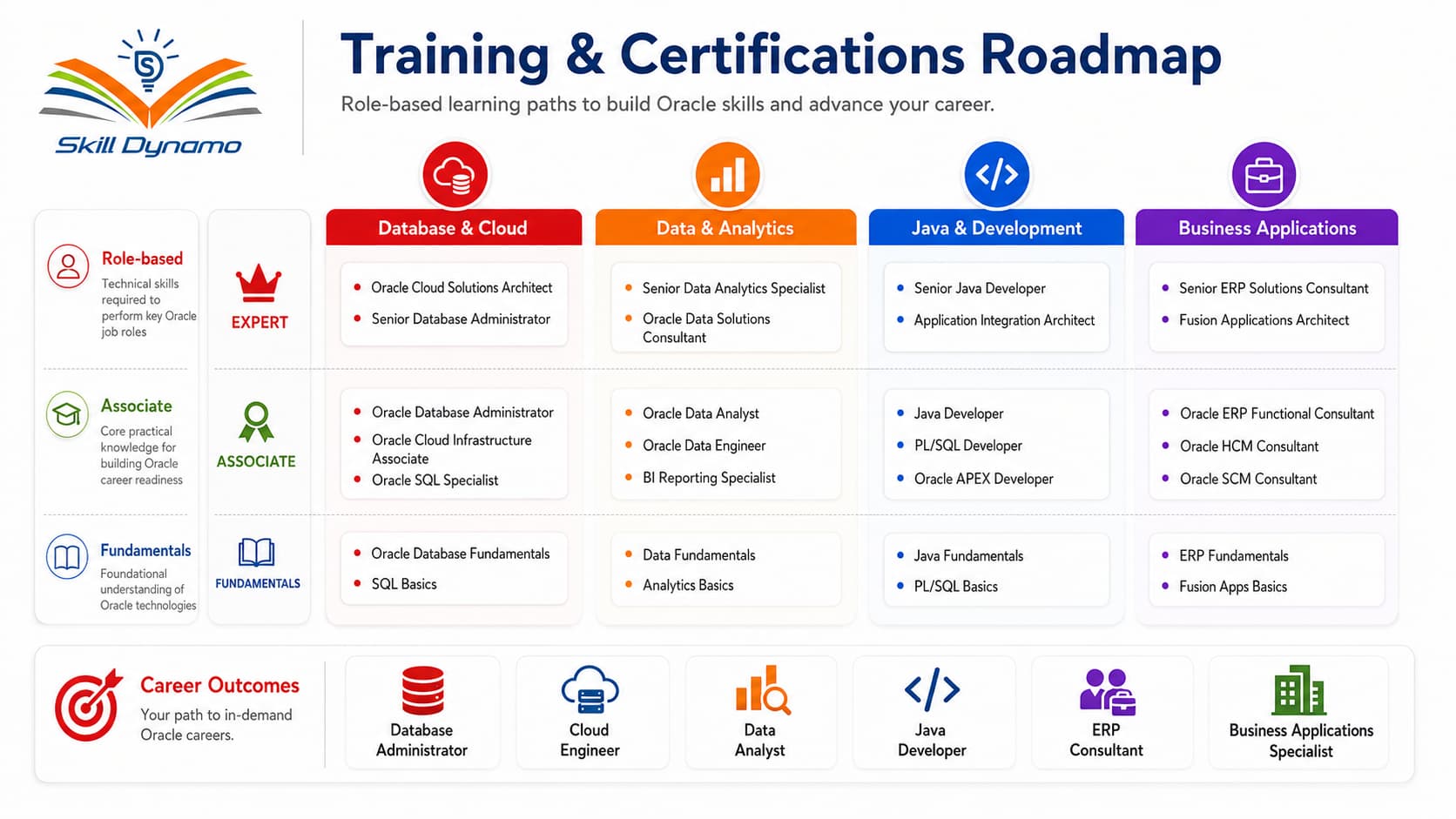
Oracle training can support roles such as Oracle Database Administrator, SQL Developer, PL/SQL Developer, Oracle Cloud Engineer, Java Developer, Data Analyst, and Oracle ERP, HCM, or SCM Consultant.
Why Choose SkillDynamo?
SkillDynamo provides practical Oracle training, updated course content, flexible learning options, and expert guidance to help learners build job-ready skills and prepare for Oracle certification exams.
Oracle: From Database Innovation to Global Cloud Technology
Oracle was founded in 1977 by Larry Ellison, Bob Miner, and Ed Oates with a vision to develop powerful database software for businesses and government organizations. The company was originally established as Software Development Laboratories and later became Oracle Corporation.
Oracle gained early recognition through the development of its relational database management system. Oracle Database helped organizations store, organize, secure, and retrieve large amounts of business-critical information more efficiently.
As enterprise technology needs expanded, Oracle grew beyond database software into business applications, middleware, analytics, hardware systems, and cloud computing. The company developed technologies that support finance, human resources, supply chain management, customer experience, data integration, and enterprise resource planning.
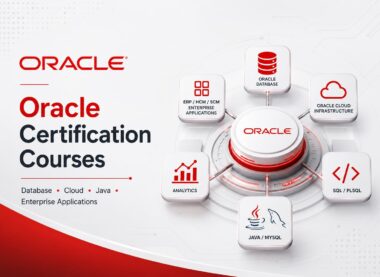
Major Oracle technologies include Oracle Database, SQL, PL/SQL, Java, MySQL, Oracle Cloud Infrastructure, Oracle Fusion Cloud Applications, Oracle Analytics, ERP, HCM, SCM, and database security solutions.
Oracle also strengthened its technology portfolio through major acquisitions, including Sun Microsystems. This expanded Oracle’s capabilities in Java, MySQL, servers, storage, operating systems, and enterprise computing.
With the growth of cloud computing, Oracle introduced Oracle Cloud Infrastructure to support computing, storage, networking, databases, analytics, artificial intelligence, and enterprise applications. Oracle Cloud enables organizations to run business systems, modernize applications, manage data, and support digital transformation.
Today, Oracle technologies are used by organizations across banking, healthcare, retail, telecommunications, manufacturing, government, education, and many other industries. Businesses rely on Oracle platforms to manage data, automate operations, improve security, analyze information, and support critical enterprise processes.
For learners, Oracle’s history represents continuous innovation in database systems, enterprise applications, programming, and cloud infrastructure. Learning Oracle technologies can help students and professionals prepare for careers in database administration, cloud computing, Java development, data analytics, and enterprise application consulting.
SkillDynamo’s Oracle courses are designed to help learners understand the Oracle technology ecosystem, develop practical skills, prepare for certification exams, and build knowledge aligned with modern business and IT requirements.
Latest Trends in Oracle Technologies
Oracle technologies are rapidly evolving around artificial intelligence, cloud computing, multicloud database services, enterprise automation, data security, and intelligent business applications. Professionals building careers with Oracle now need skills that combine databases, cloud infrastructure, AI, analytics, Java, security, and enterprise application management.
Oracle AI Database 26ai
Oracle AI Database 26ai is becoming a major focus for modern database professionals. It brings artificial intelligence closer to enterprise data, helping organizations build AI-powered applications while keeping business information secure and accessible.
The platform supports operational databases, analytics, vector search, application development, and agentic AI workloads within an integrated database environment. Learners should develop knowledge of Oracle Database administration, SQL, PL/SQL, AI Vector Search, data security, performance management, and application integration.
Agentic AI and Intelligent Automation
Agentic AI is one of the most important developments across Oracle’s technology ecosystem. Oracle is introducing AI agents that can understand business data, automate tasks, support decisions, and execute multi-step workflows.
These AI capabilities are being integrated into finance, human resources, supply chain, sales, marketing, and customer service applications. Professionals working with Oracle Fusion Cloud Applications can benefit from learning AI agent configuration, workflow automation, data governance, testing, and enterprise security.
AI Vector Search and Enterprise Data
AI Vector Search enables applications to search documents, images, text, and business information based on meaning rather than exact keywords. This supports modern use cases such as semantic search, recommendation systems, intelligent assistants, retrieval-augmented generation, and enterprise knowledge discovery.
Oracle learners should understand vector embeddings, similarity search, structured and unstructured data, generative AI integration, and secure access to enterprise information.
Multicloud Database Services
Oracle is expanding its database services across Oracle Cloud Infrastructure, Microsoft Azure, Amazon Web Services, and Google Cloud. This multicloud approach allows organizations to use Oracle databases alongside analytics, AI, application, and cloud services from different providers.
Skills in Oracle Database@Azure, Oracle Database@AWS, Oracle Database@Google Cloud, cloud networking, workload migration, security, monitoring, and cost management are becoming increasingly valuable.
Oracle Cloud Infrastructure for AI
Oracle Cloud Infrastructure is expanding to support demanding AI training, inference, analytics, and high-performance computing workloads. Organizations use OCI for scalable computing, GPU infrastructure, storage, networking, databases, and enterprise AI solutions.
Cloud professionals should build knowledge of OCI compute, networking, identity and access management, storage, databases, observability, high availability, and AI infrastructure fundamentals.
Embedded AI in Oracle Fusion Applications
Oracle is embedding AI directly into Fusion Cloud Applications to help organizations automate business processes and improve decision-making. AI agents can support finance operations, workforce management, supply chain planning, sales, marketing, procurement, and customer service.
This trend is creating opportunities for Oracle ERP, HCM, SCM, CX, and Fusion Cloud professionals who understand both business processes and AI-enabled automation.
AI Agent Studio and Custom Enterprise Agents
Oracle AI Agent Studio allows organizations to create, extend, test, deploy, and manage AI agents for specific business requirements. It supports the development of customized agents and connected agent teams that operate across enterprise workflows.
Professionals can benefit from learning agent design, prompt development, application integration, security, validation, data access controls, and workflow automation.
High Availability and Cyber Resilience
Database availability, disaster recovery, security, and business continuity remain major priorities for Oracle customers. New developments focus on faster failover, stronger workload protection, resilient cloud architectures, and support for mission-critical applications.
Oracle database professionals should understand Real Application Clusters, Data Guard, backup and recovery, disaster recovery, Exadata, database security, monitoring, patching, and performance optimization.
Oracle Exadata and High-Performance Databases
Oracle Exadata continues to support high-performance database workloads across on-premises, cloud, hybrid, and multicloud environments. It is designed for demanding AI, analytics, online transaction processing, and enterprise application workloads.
Relevant skills include Exadata architecture, database performance tuning, workload management, storage optimization, high availability, monitoring, and capacity planning.
Autonomous Database and Automated Administration
Oracle Autonomous Database uses automation to manage tasks such as provisioning, patching, tuning, backup, scaling, and security. This helps organizations reduce routine administration while improving database reliability.
Database administrators are increasingly expected to combine traditional administration knowledge with automation, cloud management, observability, security, and performance analysis.
Cloud-Native Application Development
Oracle developers are increasingly working with cloud-native applications, APIs, microservices, containers, Kubernetes, Java, low-code tools, and modern database features.
Knowledge of Java, SQL, REST APIs, Oracle Kubernetes Engine, containers, DevOps, CI/CD pipelines, application security, and cloud deployment can support modern Oracle development careers.
Data Analytics and Intelligent Decision-Making
Oracle Analytics and AI-powered data platforms help organizations combine operational and business data to generate insights. Natural-language interaction, predictive analytics, automated visualization, and AI-assisted reporting are becoming more important.
Learners can benefit from building skills in Oracle Analytics, SQL, data modelling, dashboards, data visualization, machine learning concepts, and business intelligence.
Skills Oracle Professionals Should Learn
Oracle AI Database 26ai
SQL and PL/SQL development
Oracle AI Vector Search
Oracle Cloud Infrastructure
Oracle Database administration
Multicloud database services
Oracle Fusion Cloud Applications
AI agents and workflow automation
Oracle Exadata
Autonomous Database
Database security and disaster recovery
Java and cloud-native development
Oracle Analytics and data visualization
Identity and access management
Performance monitoring and optimization
Prepare for the Future of Oracle
SkillDynamo’s Oracle courses help learners develop practical skills aligned with the latest developments in artificial intelligence, databases, cloud infrastructure, multicloud services, analytics, Java, security, and enterprise applications.
Through structured learning paths, hands-on exercises, certification preparation, and real-world projects, learners can prepare for evolving roles in Oracle database administration, cloud engineering, application development, analytics, AI, and enterprise consulting.