About ISACA Certification Courses
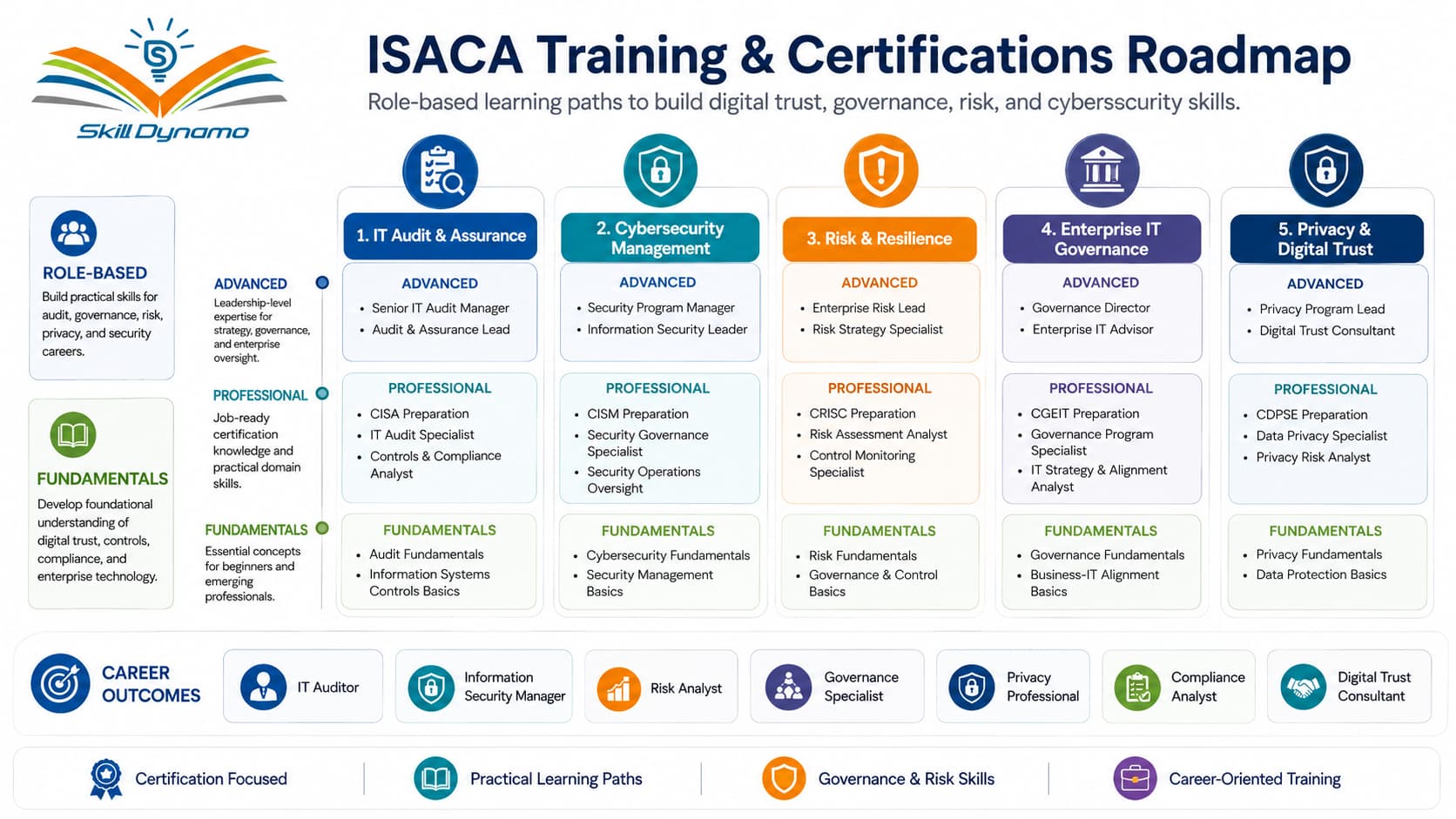
ISACA Certification Courses help professionals build practical knowledge in information systems auditing, cybersecurity management, enterprise risk, IT governance, privacy, compliance, and digital trust.
At SkillDynamo, our ISACA training programs cover CISA, CISM, CRISC, CGEIT, CDPSE, and other professional certifications. Each course includes expert guidance, practical examples, real-world business scenarios, and certification-focused preparation.
Why Learn ISACA Skills?
Organizations need qualified professionals to audit information systems, manage cybersecurity programs, assess technology risks, maintain compliance, protect sensitive data, and align IT strategy with business goals.
Learning ISACA skills can help professionals prepare for leadership and specialist roles in IT audit, information security, risk management, governance, privacy, and compliance.
SkillDynamo Training Approach
SkillDynamo provides structured ISACA training through expert-led sessions, practical case studies, governance and risk scenarios, exam-focused guidance, and role-based learning paths.
Our training helps learners understand complex concepts clearly, apply industry frameworks, and prepare confidently for ISACA certification exams and professional responsibilities.
Who Can Join?
ISACA courses are suitable for:
- IT auditors
- Cybersecurity professionals
- Risk managers
- Compliance specialists
- Information security managers
- Privacy professionals
- IT governance professionals
- Internal auditors
- Technology consultants
- Working professionals seeking career advancement
Start Your ISACA Learning Journey
Choose the right ISACA Certification Course with SkillDynamo and build career-ready skills in IT audit, cybersecurity management, risk, governance, privacy, compliance, and digital trust.
ISACA: From IT Auditing Association to Global Digital Trust Leader
ISACA was established in 1969 as the EDP Auditors Association by a group of technology professionals who recognized the growing need for standards, guidance, and professional development in electronic data processing audits.
As computer systems became more important to business operations, the organization expanded its focus beyond traditional auditing to include information security, risk management, IT governance, privacy, compliance, and digital trust.
In 1973, the association began publishing the EDP Auditor, which later became the ISACA Journal. This publication helped professionals share knowledge, research, audit practices, and guidance related to information systems and technology controls.
ISACA introduced the Certified Information Systems Auditor (CISA) credential in 1978. CISA became one of the most recognized certifications for professionals working in information systems audit, assurance, control, and compliance.
In 1994, the organization adopted the name Information Systems Audit and Control Association to reflect its wider role in technology audit and control. It later began using the name ISACA independently as its professional community expanded into cybersecurity, governance, privacy, and enterprise risk.
A major milestone came in 1996 with the launch of COBIT, a framework designed to help organizations govern and manage enterprise information and technology. COBIT became widely used for aligning IT activities with business objectives, managing risk, improving controls, and supporting compliance.
Over time, ISACA expanded its certification portfolio with credentials including CISM for information security management, CGEIT for enterprise IT governance, CRISC for information systems risk and control, and CDPSE for data privacy solutions.
ISACA also strengthened its role in technology capability and digital transformation through research, training, professional communities, frameworks, conferences, and the acquisition of the CMMI Institute in 2016.
Today, ISACA supports professionals working in IT audit, cybersecurity, governance, risk, compliance, privacy, and digital trust. Its certifications and resources help individuals and organizations manage technology responsibly, protect information, improve resilience, and align IT investments with business goals.
For learners, ISACA’s history reflects the evolution of technology assurance from computer auditing into a broader digital-trust profession. Learning ISACA frameworks and certification domains can support careers in IT audit, information security, governance, privacy, enterprise risk, and compliance.
SkillDynamo’s ISACA courses help learners understand professional frameworks, practise real-world scenarios, prepare for certification exams, and develop skills aligned with modern governance, cybersecurity, audit, privacy, and risk-management roles.
Latest Trends in ISACA Certifications and Digital Trust
ISACA certifications are evolving to address artificial intelligence, cybersecurity, IT auditing, enterprise risk, governance, privacy, regulatory compliance, and digital trust. Modern professionals need practical skills that help organizations adopt technology responsibly, manage emerging risks, maintain compliance, and protect critical information.
AI Governance and Responsible Technology
Artificial intelligence governance is becoming a major priority for organizations. Businesses need clear policies, accountability structures, risk assessments, security controls, and monitoring processes before deploying AI across critical operations.
Professionals should understand responsible AI principles, data governance, model accountability, regulatory requirements, ethical risks, performance monitoring, and executive oversight.
Advanced AI Audit
Auditors are increasingly expected to assess AI systems, models, controls, data sources, automated decisions, and governance processes.
ISACA’s Advanced in AI Audit pathway focuses on AI governance and risk, AI operations, and practical auditing techniques. These skills help professionals evaluate whether AI systems are secure, reliable, explainable, compliant, and aligned with business objectives.
Enterprise AI Risk Management
AI introduces risks related to data privacy, inaccurate outputs, bias, intellectual property, cybersecurity, legal liability, operational dependence, and third-party services.
Risk professionals need structured approaches for identifying, assessing, treating, monitoring, and reporting AI risks across the organization. Leadership accountability and clear risk ownership are becoming increasingly important.
AI Security Management
AI systems create new security challenges, including model manipulation, data poisoning, prompt injection, unauthorized access, information leakage, and insecure integrations.
Security managers should understand AI-specific threats, security controls, access management, data protection, incident response, secure deployment, and continuous monitoring.
Agentic AI Security
Autonomous AI agents can make decisions, complete multi-step tasks, connect with external systems, and act with limited human supervision.
This creates new governance and security concerns involving permissions, identity, accountability, tool access, transaction approval, data exposure, and unexpected agent behaviour. Organizations need strong safeguards and human oversight for agentic systems.
AI and Automation in IT Auditing
Artificial intelligence and automation are changing how IT audits are planned and performed. Auditors can use automated tools to analyse large datasets, identify unusual activities, test controls, monitor risks, and improve audit coverage.
Human judgement remains essential for validating automated findings, understanding business context, assessing control effectiveness, and communicating risks clearly.
Continuous Auditing and Control Monitoring
Organizations are moving from periodic audits toward continuous monitoring of technology risks and controls.
Automated dashboards, system logs, analytics, alerts, and governance platforms can help audit and risk teams identify issues earlier. Professionals should understand continuous assurance, control testing, audit trails, exception management, and real-time reporting.
Third-Party and Supply-Chain AI Risk
Organizations increasingly depend on external cloud providers, AI platforms, data services, software vendors, and technology partners.
Professionals must evaluate vendor governance, data handling, contractual responsibilities, security controls, regulatory compliance, operational resilience, model transparency, and incident-response capabilities.
Cyber Resilience and Business Continuity
Cybersecurity programs are expanding beyond attack prevention to include resilience, rapid recovery, crisis management, and business continuity.
Relevant skills include ransomware readiness, incident response, disaster recovery, backup protection, third-party resilience, communication planning, and post-incident improvement.
Privacy and Data Governance
Privacy is becoming closely connected with cybersecurity, AI governance, risk, and legal compliance.
Professionals should understand privacy-by-design, data classification, consent, retention, cross-border data transfers, access controls, sensitive-data protection, and regulatory obligations.
Integrated Governance, Risk and Compliance
Organizations are bringing audit, risk, cybersecurity, privacy, compliance, and governance teams together to improve technology oversight.
Integrated GRC helps businesses reduce duplicated work, improve risk visibility, coordinate controls, and provide clearer information to senior leadership and boards.
COBIT for Modern Technology Governance
COBIT remains an important framework for aligning technology with business objectives, managing enterprise risk, assigning accountability, measuring performance, and strengthening governance.
Organizations are also applying COBIT principles to artificial intelligence, cloud services, cybersecurity, digital transformation, and emerging technologies.
Digital Trust as a Business Priority
Digital trust includes confidence in the security, privacy, reliability, ethics, resilience, and transparency of technology systems.
Professionals with audit, cybersecurity, governance, risk, compliance, and privacy knowledge play an important role in building trust between organizations, customers, regulators, employees, and technology partners.
Skills ISACA Professionals Should Develop
AI governance and responsible AI
AI auditing and assurance
Enterprise AI risk management
AI security management
Agentic-AI risk and controls
Information-systems auditing
Cybersecurity program management
Enterprise IT governance
Privacy and data governance
Third-party technology risk
Continuous control monitoring
Regulatory compliance
Cyber resilience and incident response
COBIT implementation
GRC reporting and board communication
Prepare for the Future with ISACA
SkillDynamo’s ISACA courses help learners build practical knowledge aligned with IT audit, cybersecurity management, enterprise risk, governance, privacy, compliance, artificial intelligence, and digital trust.
Through structured learning paths, practical case studies, real-world governance scenarios, and certification-focused preparation, learners can prepare for careers in IT audit, security leadership, risk management, governance, privacy, compliance, and technology assurance.





 SkillDynamo