 -by
In the digital economy, customers expect businesses to deliver consistent, relevant, and personalized experiences across websites, mobile applications, email, digital advertising, commerce platforms, and customer service channels. Meeting these expectations requires more than deploying individual marketing tools. Organizations need an integrated technology architecture that connects customer data, digital content, analytics, marketing operations, and customer engagement.
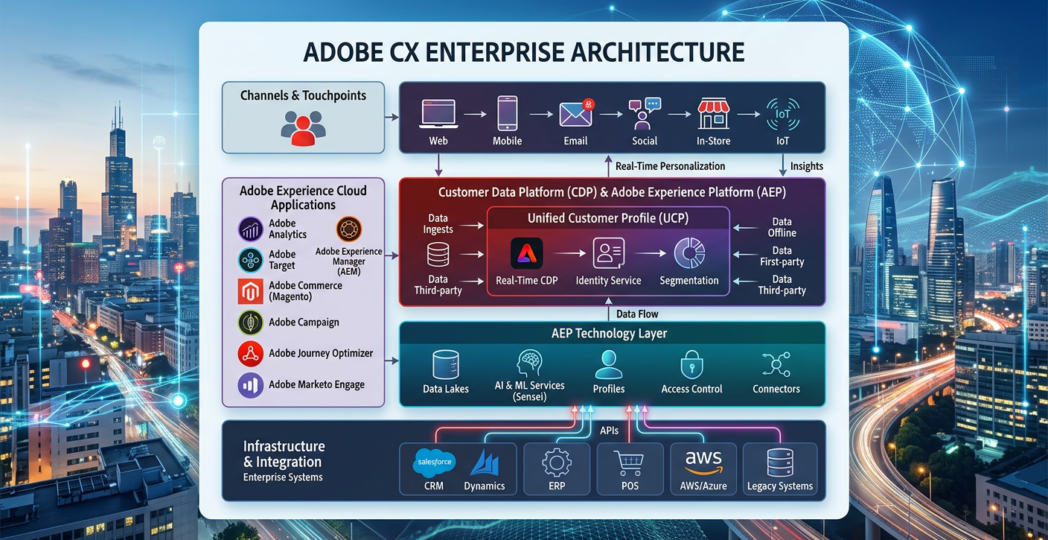
Adobe CX Enterprise Architecture provides a framework for bringing these capabilities together through the broader Adobe Experience Cloud ecosystem, with Adobe Experience Platform serving as a foundational data and services layer for supported applications. The architecture helps organizations connect customer information, coordinate experiences, measure performance, and improve how they engage with customers. Adobe Experience Platform overview
1. Understanding Adobe CX Enterprise Architecture
Adobe CX Enterprise Architecture is best understood as an enterprise solution design that connects Adobe applications, shared platform services, existing business systems, data sources, and customer-facing channels.
Rather than treating content management, marketing automation, analytics, and customer data as separate technology investments, organizations can design an integrated environment in which each capability contributes to a connected customer experience.
For example, an online retailer may collect browsing events from its website, combine relevant information with permitted CRM and transaction data, identify customer segments, deliver personalized content, and analyze the resulting engagement. Each stage depends on appropriate data models, integration patterns, business rules, and governance.
The architecture must therefore address not only which Adobe products are deployed, but also how information moves between them, which systems own particular data, and how customer-facing decisions are controlled.
2. The Core Architectural Layers
A practical Adobe CX enterprise architecture can be organized into several interconnected layers.
Customer Data and Experience Platform Layer
Adobe Experience Platform provides foundational capabilities for data ingestion, standardization, identity resolution, customer profiles, and governance. It supports the integration of information from different enterprise sources into a consistent framework.
Important architectural components include:
- Data ingestion from websites, mobile applications, CRM systems, and other enterprise platforms.
- Experience Data Model (XDM) schemas for standardizing experience data.
- Identity Service for linking supported identifiers into identity graphs.
- Real-Time Customer Profile for combining eligible data into customer profiles.
- Data governance controls for managing permitted data usage.
The quality of this layer directly affects downstream personalization, audience creation, and customer journey analysis. Inconsistent identifiers or poorly defined schemas can produce fragmented profiles and unreliable audience results. Adobe Identity Service documentation
Content and Digital Experience Layer
The content layer enables teams to create, manage, organize, and deliver digital experiences.
Adobe Experience Manager (AEM) supports enterprise content management through capabilities such as website authoring, reusable content components, digital asset management, and content workflows. Depending on the implementation, content can be connected to personalization and analytics capabilities.
Adobe Commerce may support commerce experiences, while other content and campaign tools may contribute to the broader customer engagement process.
A well-designed content architecture establishes reusable components, clear ownership, metadata standards, approval workflows, localization practices, and appropriate publishing controls. This reduces duplication and makes it easier to maintain consistent experiences across channels.
Audience, Personalization, and Journey Layer
Once customer data is available, enterprise teams can use audience and engagement applications to deliver relevant experiences.
Adobe Real-Time Customer Data Platform (Real-Time CDP) supports customer profile and audience activation use cases. Adobe Target supports experimentation and personalization, while Adobe Journey Optimizer supports customer journey orchestration and cross-channel engagement.
These capabilities serve different purposes but can contribute to a coordinated experience strategy. For example, a retailer could identify customers who have abandoned a shopping journey, determine which communication is appropriate under its consent rules, and use a supported engagement workflow to deliver a relevant follow-up.
The architecture must define audience eligibility, data freshness expectations, journey entry criteria, channel dependencies, and safeguards against conflicting communications.
Analytics and Optimization Layer
An enterprise CX architecture must measure whether its experiences achieve the intended business outcomes.
Adobe Analytics provides digital analytics capabilities, while Customer Journey Analytics supports analysis of customer interactions across connected datasets and touchpoints. The exact reporting design depends on available data, product entitlements, and implementation choices.
Organizations should establish a consistent measurement framework covering engagement, conversion, customer journey progression, campaign performance, and relevant business outcomes.
Analytics should also inform experimentation and optimization. Instead of relying on assumptions, teams can use measured results to refine content, audience definitions, customer journeys, and campaign strategies.
Marketing Operations and Integration Layer
Technology integration alone does not guarantee operational efficiency. Enterprise teams also need processes for planning campaigns, coordinating resources, managing approvals, and tracking delivery.
Adobe Workfront can support marketing work management, project coordination, and approval processes where deployed. APIs, supported connectors, event-driven integrations, and middleware can connect Adobe applications with CRM, commerce, data warehouses, customer service platforms, and other enterprise systems.
The integration layer should define system ownership, authentication, error handling, data synchronization rules, monitoring, and recovery procedures. These practices help prevent inconsistent records, duplicated activities, and failures that could affect customer-facing experiences.
3. How Data Moves Through the Architecture
A typical customer experience workflow follows a connected sequence:
Data collection: Websites, mobile applications, CRM platforms, and business systems generate customer and transaction information.
Data standardization: Relevant data is mapped into agreed structures and validated against quality requirements.
Identity and profile processing: Supported identifiers and eligible attributes contribute to customer profile creation.
Audience definition: Business teams define audiences using appropriate profile attributes and behavioral signals.
Experience delivery: Connected applications use approved audience or customer context to support content delivery, personalization, or journey orchestration.
Measurement: Analytics capabilities capture relevant outcomes and reveal opportunities for improvement.
Optimization: Teams use insights to refine the experience, update business rules, and improve future campaigns.
This sequence is a conceptual implementation pattern, not a guarantee of instantaneous processing at every stage. Actual latency, data availability, and integration behavior depend on the services and architecture selected. Adobe’s architecture blueprints provide additional implementation patterns and diagrams. Adobe Experience Platform architecture diagrams
4. Security, Privacy, and Governance by Design
Customer experience systems frequently process personal information, behavioral events, and marketing preferences. Consequently, governance must be incorporated into the architecture from the beginning rather than added after deployment.
Key design considerations include:
- Role-based and least-privilege access.
- Clear data ownership and stewardship.
- Data usage labels and policies.
- Consent and preference management.
- Appropriate data retention and minimization.
- Monitoring, audit trails, and incident response.
- Validation of downstream data activation and sharing.
Adobe Experience Platform includes governance, privacy, and security capabilities, but organizations must configure them appropriately and align their use with applicable laws and internal policies. Adobe governance, privacy, and security overview
5. The Emerging Role of AI and Agentic Workflows
AI can extend the value of a connected CX architecture by helping teams analyze information, generate content, summarize performance, and identify potential improvements. Agentic workflows can go further by coordinating multiple steps and using approved tools to complete defined tasks.
For example, an agent-enabled marketing workflow might analyze a campaign brief, retrieve approved brand guidelines, summarize audience insights, draft a content recommendation, and prepare a report for review.
However, these workflows require clearly defined permissions, reliable knowledge sources, evaluation criteria, and human approval for sensitive or high-impact actions. Agentic capabilities should be integrated only where supported by the selected products and services; they should not be assumed to exist uniformly across every Adobe application.
The architectural priority is to provide controlled access to reliable information and services while maintaining accountability for decisions and actions.
6. Key Benefits of a Well-Designed Architecture
A thoughtfully implemented Adobe CX enterprise architecture can deliver several business advantages:
- Connected customer experiences: Better coordination between content, customer data, engagement, and analytics.
- More relevant personalization: Use of suitable customer context and audience information to support targeted experiences.
- Operational efficiency: Reusable content, standardized integrations, and streamlined marketing workflows.
- Improved measurement: Clearer visibility into customer interactions and campaign outcomes.
- Scalable integration: Defined patterns for connecting Adobe applications with existing enterprise systems.
- Stronger governance: More consistent management of data access, usage policies, and operational controls.
- Continuous improvement: Feedback from analytics and experimentation can inform future experience design.
These benefits depend on implementation quality, data readiness, business adoption, and appropriate configuration; they are not automatic outcomes of purchasing the technology.
7. Best Practices for Implementation
Organizations should begin with business objectives rather than a product-first deployment strategy. Identify priority customer journeys, define measurable outcomes, and document the systems and data required to support them.
Next, establish a target architecture that specifies data ownership, schemas, identity strategy, integration methods, application responsibilities, and governance controls. Validate the design through a limited proof of concept before extending it across additional business units or channels.
Implementation teams should also document API dependencies, error-handling procedures, access requirements, testing standards, monitoring responsibilities, and release processes. Cross-functional collaboration between architects, marketing teams, developers, data engineers, security specialists, and business owners is essential.
Finally, measure success using agreed indicators such as campaign conversion, customer journey completion, content production time, data quality, operational reliability, and customer engagement. Regular reviews help ensure that the architecture continues to support evolving business requirements.
Conclusion
Adobe CX Enterprise Architecture is more than a collection of digital marketing applications. It is a coordinated design for connecting customer data, content, personalization, journey orchestration, analytics, marketing operations, and enterprise systems.
By combining a well-governed data foundation with clear integration patterns and measurable customer experience workflows, organizations can create a flexible environment for delivering relevant digital interactions and improving business performance. As AI-assisted and agentic workflows mature, a secure, interoperable architecture will become even more important for turning customer insights into controlled, valuable actions.
The strongest implementation is not necessarily the one with the most products or integrations. It is the one that connects the right capabilities, protects customer information, supports business teams, and continuously improves the experiences customers receive.