 -by
Cloud computing has transformed how organizations store information, deploy applications, manage infrastructure, and deliver digital services. As businesses migrate workloads to the cloud, protecting sensitive data and maintaining secure operations have become essential priorities. Amazon Web Services (AWS) provides a broad collection of security services and built-in controls designed to help organizations protect cloud resources, identify threats, manage access, and meet security requirements.
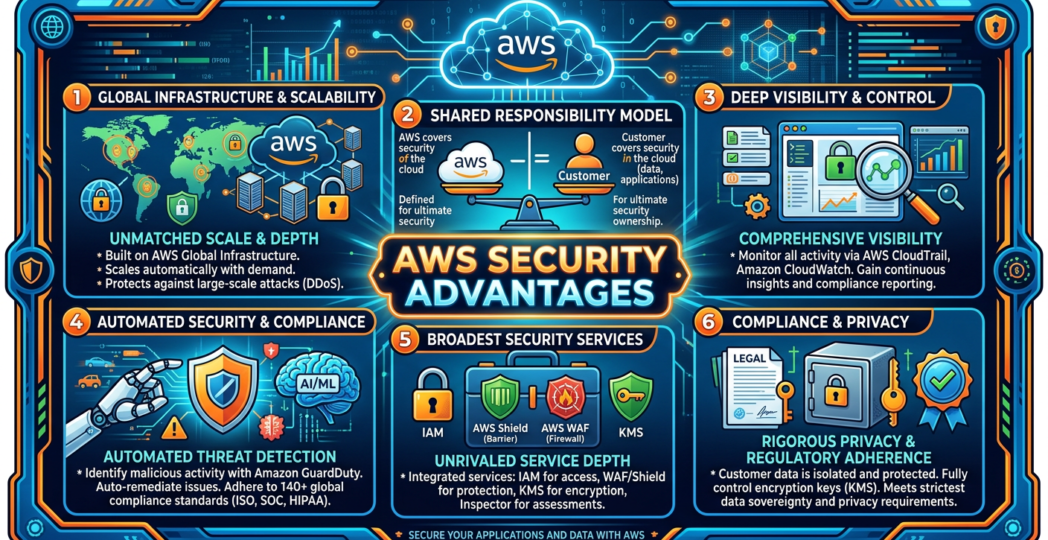
AWS Security combines infrastructure protection, identity management, data encryption, threat detection, network security, monitoring, and compliance capabilities. These services allow organizations to develop security strategies tailored to their applications, workloads, and risk profiles. However, cloud security is a shared responsibility: AWS secures the underlying cloud infrastructure, while customers remain responsible for securing their data, identities, configurations, and workloads according to the services they use.
Understanding the benefits of AWS Security helps businesses build reliable cloud environments, reduce operational risks, and support sustainable digital transformation.
1. Strong Data Protection and Encryption
One of the primary benefits of AWS Security is its ability to help organizations protect sensitive information throughout its lifecycle. Businesses store customer records, financial transactions, application data, intellectual property, and confidential business documents in cloud environments. Unauthorized exposure of this information can lead to financial losses, reputational damage, and regulatory consequences.
AWS supports encryption for data at rest and in transit through services and features such as AWS Key Management Service (AWS KMS), AWS Certificate Manager, and encryption options available across many AWS storage and database services.
AWS KMS helps organizations create and manage encryption keys and control their use through permissions and policies. Depending on the service and configuration, businesses can use AWS-managed keys or customer-managed keys to meet specific security and governance requirements.
Encryption should be combined with appropriate access restrictions, secure key management, data classification, and backup protection. These measures help prevent unauthorized disclosure and support a more comprehensive information security strategy.
2. Centralized Identity and Access Management
AWS Identity and Access Management (IAM) enables organizations to control who can access AWS resources and which actions identities are permitted to perform. Administrators can create policies that grant specific permissions to users, groups, and roles according to operational requirements.
A major advantage of IAM is support for the principle of least privilege. Instead of granting broad administrative access to every employee or application, organizations can assign only the permissions needed to complete particular tasks.
IAM roles also support secure access for applications and workloads without requiring developers to distribute permanent access keys unnecessarily. AWS IAM Identity Center can help organizations manage workforce access to multiple AWS accounts and supported applications.
When combined with multifactor authentication, careful credential management, and regular permission reviews, these capabilities help reduce the risk of compromised accounts and unauthorized resource changes.
3. Continuous Threat Detection and Monitoring
Cloud threats can emerge from compromised credentials, unusual API activity, malicious software, suspicious network connections, or incorrectly configured resources. Identifying these activities quickly is important for limiting potential damage.
AWS provides threat detection and monitoring capabilities through services such as Amazon GuardDuty, AWS Security Hub, and Amazon CloudWatch. GuardDuty analyzes supported data sources and security signals to identify potentially malicious activity. Security Hub helps organizations consolidate and assess security findings across supported services and integrations, while CloudWatch supports monitoring, metrics, and alerting.
Security teams can use these capabilities to investigate unusual behavior, prioritize findings, and initiate incident response procedures. Integration with other security tools can further improve visibility across cloud workloads.
Detection services do not eliminate the need for human oversight. Organizations should define alert priorities, establish escalation procedures, and regularly test their incident response processes to ensure that important threats receive timely attention.
4. Advanced Network Security and Traffic Control
Network security is essential for protecting applications, databases, and infrastructure against unauthorized access. AWS offers multiple controls for managing traffic between cloud resources and external networks.
Amazon Virtual Private Cloud (Amazon VPC) enables organizations to define logically isolated networks and configure subnets, routing, and connectivity. Security groups provide stateful traffic filtering for supported resources, while network access control lists offer additional subnet-level controls.
AWS Network Firewall can help organizations implement managed network traffic filtering, and AWS WAF provides protection against common web application threats through configurable rules. AWS Shield offers distributed denial-of-service protection, with different capabilities available across its service options.
Organizations can use these services to reduce unnecessary exposure, separate application components, and control inbound and outbound traffic.
Effective network security requires deliberate architecture. Public-facing services should be separated from sensitive internal resources, administrative interfaces should be restricted, and traffic rules should be reviewed regularly as applications change.
5. Compliance Support and Security Governance
Many organizations must demonstrate that their technology environments follow legal, contractual, and industry-specific security requirements. AWS provides compliance documentation, certifications, and service capabilities that can help customers assess how AWS services align with applicable standards.
AWS Artifact provides access to certain AWS compliance reports and agreements. AWS Config can help organizations assess resource configurations against desired settings or supported compliance rules. AWS Security Hub also provides security checks and findings that can help teams evaluate selected security controls.
These capabilities can improve visibility into configuration changes, support internal audits, and help organizations identify gaps in their cloud security posture.
However, using AWS does not automatically make an organization compliant. Customers must configure services appropriately, manage their own data and identities, and meet the requirements applicable to their business. Compliance responsibilities depend on the services used, deployment architecture, and relevant regulations.
6. Faster Incident Response and Security Automation
When a security incident occurs, rapid and coordinated action can reduce disruption and limit the impact on business operations. AWS supports security automation through services such as AWS Lambda, Amazon EventBridge, AWS Systems Manager, and integrations with security monitoring tools.
For example, an organization may configure a workflow that responds to a high-priority security finding by notifying the security team, collecting relevant details, or initiating an approved containment procedure.
Automation can reduce repetitive manual work and help security teams respond consistently to recurring events. It can also improve the speed at which alerts are routed to the correct personnel.
Nevertheless, automated actions must be designed carefully. Automatically changing network rules, disabling accounts, or isolating workloads can interrupt legitimate business activities if a finding is incorrect or the workflow is poorly configured.
Organizations should test automated responses, maintain audit records, establish approval requirements for high-impact actions, and periodically review their response playbooks.
7. Improved Visibility Across Cloud Resources
Large cloud environments may contain many accounts, applications, storage services, databases, and computing resources. Without centralized visibility, security teams can struggle to identify misconfigurations, track changes, and understand where sensitive information resides.
AWS provides services that help organizations inventory resources, evaluate configurations, collect logs, and consolidate security findings. AWS Config records supported resource configuration changes, while AWS CloudTrail records account activity and API events for supported operations. These records can help investigators understand what changed, when it changed, and which identity performed an action.
Centralized logging can also support incident investigations, operational troubleshooting, and security reporting. Organizations should define appropriate log retention, access restrictions, and monitoring requirements based on their risk and compliance obligations.
Greater visibility helps security teams identify weaknesses earlier and make more informed decisions about protecting cloud workloads.
8. Scalable Security for Growing Businesses
As organizations expand, their security requirements evolve. They may launch additional applications, enter new markets, onboard employees, or increase their use of cloud infrastructure. AWS provides security services that can support environments ranging from small deployments to complex enterprise architectures.
Organizations can apply identity policies, encryption controls, logging, monitoring, and network protections across supported services as their environments grow. AWS Organizations and AWS Control Tower can help businesses structure and govern multiple AWS accounts, depending on their architecture and operational needs.
This flexibility allows security controls to evolve alongside business requirements. Teams can establish baseline configurations, standardize account management, and introduce additional protections as workloads become more sensitive.
Scalability still requires governance. Without clear ownership, consistent policies, and regular configuration reviews, larger environments can become difficult to secure. A documented cloud security architecture helps maintain control as complexity increases.
9. Business Continuity and Operational Resilience
Security includes more than preventing unauthorized access. Organizations must also prepare for accidental deletion, infrastructure failures, ransomware-related disruption, and other incidents that can affect the availability of critical information.
AWS provides backup, recovery, and resilience capabilities through services such as AWS Backup and Amazon S3 features designed for data protection. Businesses can establish backup schedules, protect selected resources, and develop recovery strategies appropriate to their workloads.
Resilience planning should include defined recovery time objectives and recovery point objectives. Organizations should also test restoration procedures, protect backup credentials, restrict deletion permissions, and consider geographically separate recovery arrangements where appropriate.
Backups alone do not guarantee business continuity. Successful recovery depends on workload architecture, data consistency, dependencies, capacity, and tested procedures. A well-designed resilience strategy helps businesses restore essential services and reduce the operational impact of disruptive events.
10. Long-Term Security Improvement and Cost Awareness
AWS Security enables organizations to improve their security posture through ongoing assessment, monitoring, and refinement. Security teams can review findings, remove excessive permissions, correct exposed resources, strengthen authentication, and update configurations as threats and business needs change.
Security automation and managed services can reduce some administrative burdens, allowing teams to concentrate on higher-value risk management activities. However, service costs, log ingestion, data retention, network inspection, and monitoring requirements should be considered during design.
Organizations should select services based on business risk, regulatory obligations, workload sensitivity, and operational capacity. Regular cost reviews and security assessments help ensure that protective measures remain effective and sustainable.
The strongest results come from combining AWS technologies with trained personnel, documented processes, and clear accountability.
Conclusion
AWS Security provides organizations with a comprehensive foundation for protecting cloud infrastructure, sensitive information, identities, and applications. Its major benefits include stronger data protection, centralized access management, continuous threat detection, network defense, compliance support, automated incident response, improved visibility, scalability, operational resilience, and ongoing security improvement.
Achieving these benefits requires an understanding of the AWS shared responsibility model and a deliberate approach to configuration, monitoring, and governance. Businesses should implement least-privilege permissions, protect encryption keys, maintain reliable logs, test recovery procedures, and regularly assess their security posture.
As organizations continue to adopt cloud technologies and AI-enabled services, AWS Security can help them manage evolving risks while supporting innovation and business growth. A proactive, well-governed security strategy enables organizations to use cloud infrastructure more confidently and build stronger foundations for long-term digital transformation.