About Splunk Certification Courses
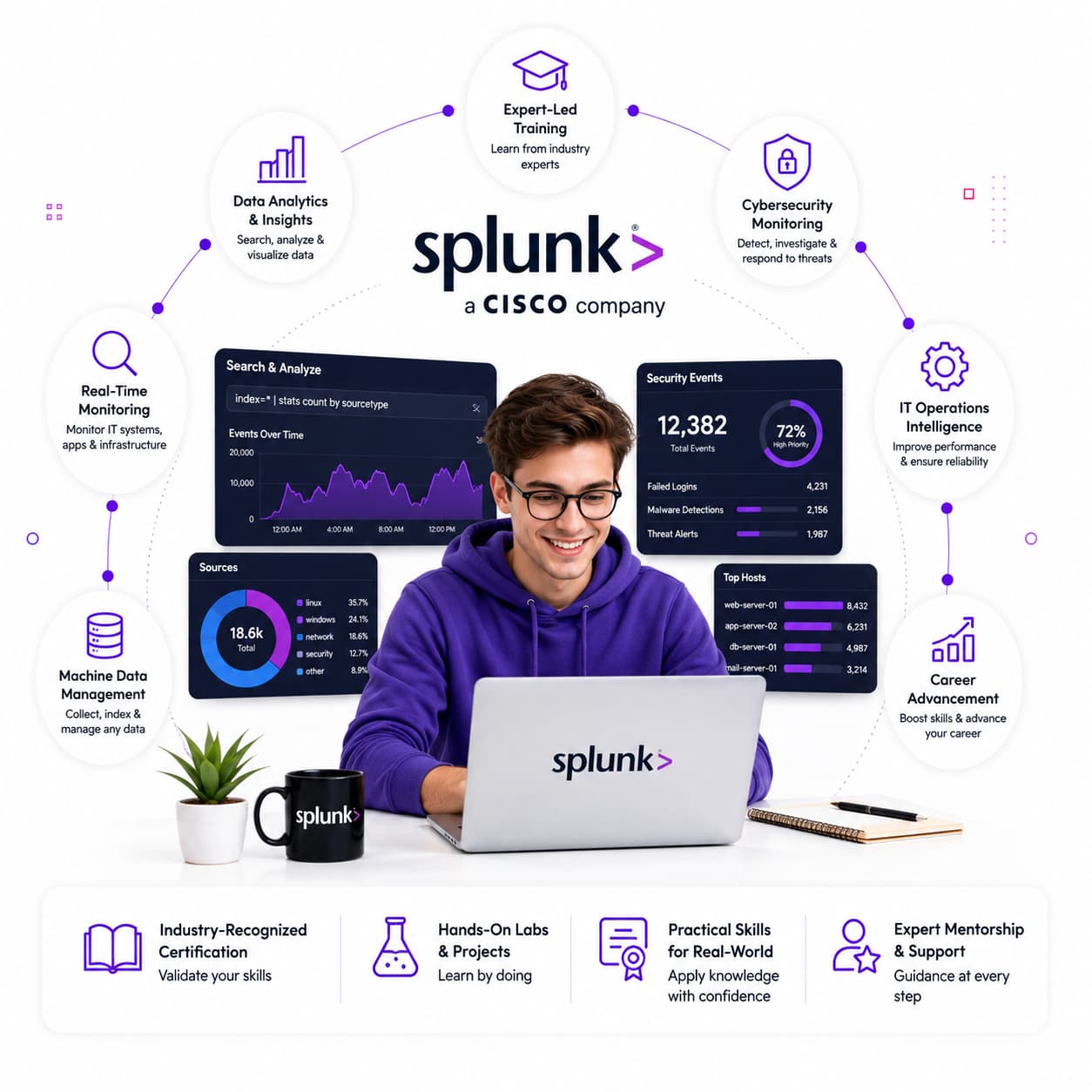
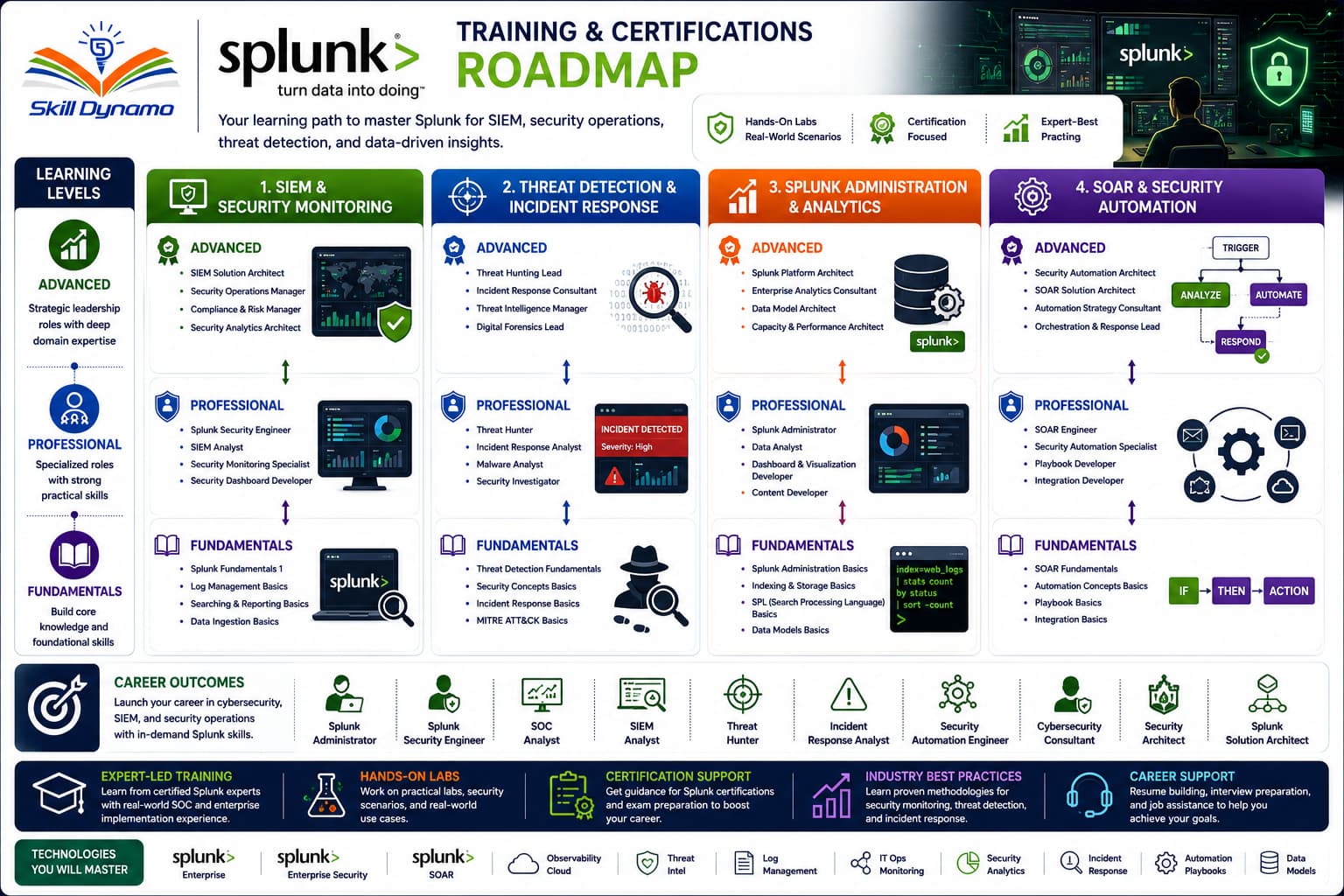
Splunk Certification Courses help learners develop practical skills in Security Information and Event Management (SIEM), Security Operations Center (SOC) workflows, Threat Detection, Incident Response, Log Analysis, Security Monitoring, Data Analytics, and Enterprise Security Operations.
At Skill Dynamo, our Splunk training programs cover Splunk Enterprise, Splunk Enterprise Security (ES), Splunk SOAR, Threat Hunting, Security Analytics, Dashboard Development, Log Management, and Cybersecurity Monitoring. Each course is designed with expert guidance, practical labs, and implementation-focused learning.
Why Learn Splunk?
Splunk is one of the world’s leading data analytics and cybersecurity platforms used by organizations to monitor systems, analyze machine data, detect security threats, investigate incidents, and improve operational visibility.
Skill Dynamo Training Approach
Skill Dynamo provides structured Splunk training through expert-led sessions, practical security labs, real-world SOC use cases, and implementation-focused projects. Our approach helps learners gain job-ready cybersecurity and analytics skills.
Who Can Join?
These courses are suitable for cybersecurity professionals, SOC analysts, security engineers, network administrators, system administrators, data analysts, IT professionals, students, and fresh graduates.
Start Your Learning Journey
Choose the right Splunk course with Skill Dynamo and build future-ready cybersecurity, SIEM, and security analytics skills.
Splunk: Turning Machine Data into Actionable Intelligence
Splunk was founded in 2003 with a mission to make machine-generated data accessible, searchable, and useful. As organizations generated increasing volumes of logs and operational data, Splunk emerged as a powerful platform for collecting, indexing, and analyzing machine data in real time.
Initially focused on operational intelligence and log management, Splunk later expanded into cybersecurity, observability, IT operations, and business analytics. Its ability to process massive amounts of data made it a preferred platform for security operations centers (SOCs) and enterprise monitoring teams.
The introduction of Splunk Enterprise Security (ES), Splunk SOAR, and advanced analytics capabilities strengthened Splunk’s position as a leader in SIEM and security operations.
Today, Splunk is widely used by enterprises, government agencies, financial institutions, healthcare organizations, and technology companies to improve security visibility, threat detection, compliance, and operational performance.
For learners, Splunk provides excellent opportunities to build expertise in cybersecurity operations, SIEM technologies, data analytics, and incident response.
Skill Dynamo’s Splunk courses help learners gain practical skills aligned with modern security and analytics requirements.
Splunk Skills for the 2026 Cybersecurity Workplace
Security Operations Center (SOC) Modernization
Organizations continue investing in modern SOC platforms to improve threat detection, security monitoring, and incident response capabilities.
Threat Hunting and Detection Engineering
Proactive threat hunting and advanced detection engineering have become essential cybersecurity practices for identifying sophisticated attacks.
SIEM and Security Analytics
Security Information and Event Management platforms remain critical for monitoring security events, managing compliance, and investigating threats.
SOAR and Security Automation
Security Orchestration, Automation, and Response (SOAR) technologies help organizations automate repetitive security tasks and accelerate incident response.
Observability and IT Monitoring
Businesses increasingly rely on observability platforms to monitor infrastructure, applications, cloud services, and user experiences.
AI-Driven Security Operations
Artificial intelligence and machine learning are transforming cybersecurity by improving threat detection, anomaly identification, and security analytics.
Future-Ready Learning with Skill Dynamo
Skill Dynamo’s Splunk courses help learners stay aligned with cybersecurity trends through practical projects, hands-on security labs, expert-led training, and implementation-focused learning.


 SkillDynamo