 -by
In today’s digitally connected world, computer networks are essential for communication, cloud computing, cybersecurity, business operations, and data exchange. Organizations depend on reliable network infrastructure to support employees, applications, servers, and customers across multiple locations. As networking technologies continue to evolve, skilled networking professionals are increasingly important for maintaining secure, efficient, and high-performing IT environments. Cisco Certified Network Associate (CCNA) training and certification provide an excellent foundation for individuals who want to develop networking expertise and advance their IT careers.
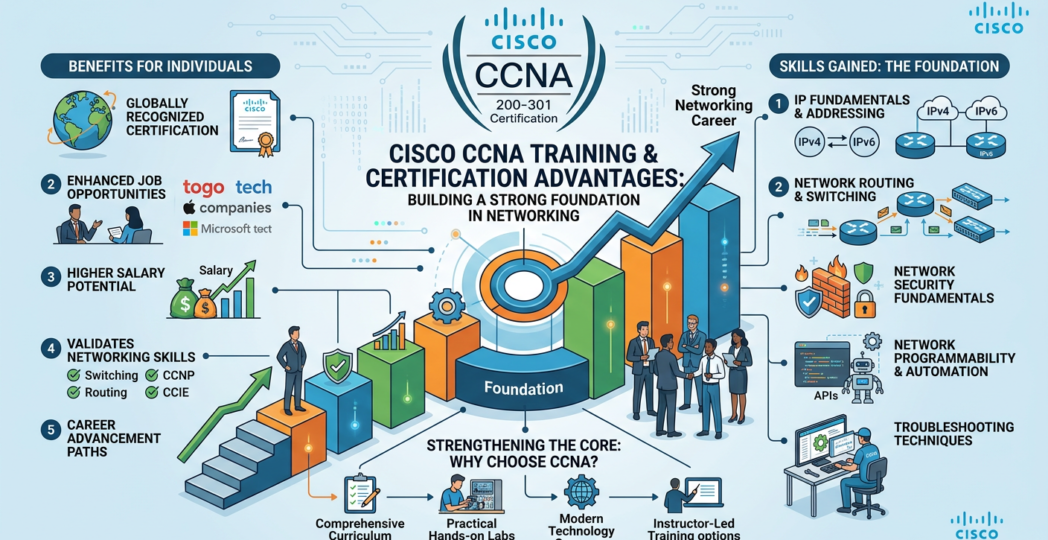
The Cisco CCNA certification validates foundational knowledge of networking concepts, IP connectivity, network access, IP services, security fundamentals, and automation. Through structured training and practical exercises, learners develop the technical skills needed to understand, configure, troubleshoot, and maintain modern networks. Whether someone is starting an IT career or upgrading existing technical knowledge, CCNA training can provide valuable professional and career benefits.
1. Develop Strong Networking Fundamentals
One of the primary advantages of CCNA training is the opportunity to build a solid understanding of networking fundamentals. Participants learn how computer networks operate, how devices communicate, and how information travels between systems.
The training introduces essential concepts such as network topologies, Ethernet, switching, routing, network protocols, and communication models. Learners also explore the roles of routers, switches, wireless access points, and other network components. This foundational knowledge helps professionals understand how enterprise networks are designed and maintained.
A strong grasp of these concepts makes it easier to learn advanced technologies and work confidently in different networking environments.
2. Gain Practical Configuration and Troubleshooting Skills
Networking professionals must do more than understand theoretical concepts. They need to configure devices, identify problems, and restore services efficiently. CCNA training commonly incorporates hands-on exercises and lab simulations to help learners apply their knowledge.
Participants can practise configuring network devices, assigning IP addresses, setting up VLANs, implementing routing protocols, and verifying connectivity. They also learn how to use command-line interfaces and diagnostic commands to investigate network issues.
These practical skills are valuable when addressing real-world challenges such as connectivity failures, incorrect configurations, routing problems, and communication delays. Hands-on learning also improves confidence when working with networking equipment and troubleshooting tools.
3. Improve Career Opportunities in IT
CCNA certification can strengthen a candidate’s profile when applying for entry-level and intermediate networking roles. Employers often look for professionals who understand networking fundamentals and can support daily infrastructure operations.
Depending on experience and job requirements, CCNA knowledge can support career paths such as:
Network Support Engineer
Network Administrator
Junior Network Engineer
IT Support Specialist
Network Operations Center (NOC) Technician
Technical Support Engineer
Infrastructure Support Engineer
Certification alone does not guarantee employment, but it can demonstrate structured learning and commitment to networking. Combining CCNA with practical lab experience, communication skills, and relevant work experience can make candidates more competitive in the job market.
4. Understand IP Addressing and Subnetting
IP addressing is a fundamental component of network design and administration. CCNA training helps learners understand IPv4 and IPv6 addressing, subnet masks, network prefixes, and address allocation.
Subnetting is particularly important because it enables administrators to divide larger networks into smaller, manageable segments. Correct subnet design can improve address utilization, simplify network management, and support better traffic organization.
Learners practise identifying network and host portions of addresses, calculating subnets, and understanding how devices communicate across different networks. These skills are useful in enterprise environments, cloud-connected infrastructures, branch-office deployments, and data center networks.
5. Learn Switching, VLANs, and Routing
Switching and routing are central to modern network operations. CCNA training introduces learners to how switches forward traffic within local area networks and how routers direct traffic between separate networks.
Participants learn about virtual LANs (VLANs), trunk links, inter-VLAN routing, routing tables, and static routing. They also study foundational dynamic routing concepts, including Open Shortest Path First (OSPF) for IPv4 in supported single-area scenarios.
Understanding these technologies helps professionals design logical network segments, manage communication between departments, and investigate connectivity issues. These skills form an important foundation for more advanced enterprise networking and infrastructure responsibilities.
6. Build Awareness of Network Security
Security is a critical consideration in every network environment. Unauthorized access, weak configurations, and mismanaged network traffic can expose organizations to operational and security risks.
CCNA training introduces foundational security concepts, including device access controls, secure management practices, access control lists, port security concepts, and wireless security fundamentals. Learners also explore how network segmentation and appropriate configurations can help reduce unnecessary access.
This knowledge encourages a security-conscious approach to network administration. Although CCNA is not a specialized cybersecurity certification, its security fundamentals can prepare learners for further study in network security, security operations, and infrastructure protection.
7. Explore Wireless Networking Technologies
Wireless connectivity enables employees, mobile devices, and business applications to communicate without relying exclusively on wired connections. CCNA training introduces important wireless networking concepts and explains how wireless networks integrate with enterprise infrastructure.
Learners develop an understanding of wireless access points, service set identifiers, radio-frequency basics, wireless authentication, and common connectivity issues. They also explore how wireless networks differ from wired Ethernet networks and why proper configuration matters.
These concepts are useful for professionals supporting office networks, educational institutions, retail environments, and organizations with mobile or hybrid workforces.
8. Understand Network Services and Automation Fundamentals
Modern networks depend on several services that simplify communication and infrastructure management. CCNA training covers foundational knowledge of services such as Dynamic Host Configuration Protocol (DHCP), Domain Name System (DNS), Network Address Translation (NAT), and network time synchronization.
Learners also gain an introduction to network automation and programmability. They explore why APIs, structured data formats, and automation tools are increasingly important in managing large and repetitive network tasks.
This knowledge helps networking professionals understand the transition from manually configured devices toward more consistent, scalable, and automated infrastructure operations. It also provides a useful starting point for learning network scripting and software-defined networking concepts.
9. Increase Professional Confidence Through Structured Learning
A structured CCNA course helps learners study networking concepts in a logical sequence. Instead of relying solely on fragmented tutorials or informal experience, participants follow a learning path that connects theoretical principles with practical implementation.
Instructor-led training can provide opportunities to ask questions, review complex topics, and receive feedback on lab exercises. Self-paced learning can offer flexibility for working professionals, while instructor-guided labs may help learners develop troubleshooting techniques more efficiently.
Regular practice, revision, and mock assessments can also help participants identify knowledge gaps and prepare for certification requirements.
10. Strengthen Your Professional Resume
Earning CCNA certification demonstrates that a professional has studied a recognized networking curriculum and passed the applicable certification examination. It can help candidates communicate their networking knowledge to employers, recruiters, and technical teams.
For professionals already working in IT support or infrastructure administration, CCNA can help formalize existing experience and identify areas for improvement. For beginners, it provides a structured way to demonstrate foundational technical knowledge.
However, employers also evaluate practical competence, problem-solving ability, communication, customer service, and relevant experience. A strong resume should therefore combine certification with lab projects, documented troubleshooting experience, and examples of technical achievements.
11. Create a Pathway to Advanced Networking Specializations
CCNA can serve as a starting point for continued professional development. After building foundational knowledge, learners may choose to explore more specialized networking domains based on their career goals.
Potential areas of further study include enterprise networking, network security, data center infrastructure, wireless networking, automation, and cloud networking. Cisco’s professional-level certifications, including CCNP pathways, may be relevant for individuals seeking deeper technical expertise and greater responsibility.
The best next step depends on the learner’s experience, interests, and target role. Continued hands-on practice is essential for translating certification knowledge into practical capability.
12. Deliver Value to Organizations
The benefits of CCNA training extend beyond individual career development. Organizations can benefit when employees understand network operations, follow consistent configuration practices, and troubleshoot infrastructure issues methodically.
Trained staff may help reduce avoidable configuration errors, identify connectivity problems more quickly, and support network documentation and maintenance. A stronger understanding of routing, switching, security fundamentals, and network services can also improve communication between IT support, infrastructure, and security teams.
These benefits depend on how effectively employees apply their knowledge, follow organizational procedures, and continue developing their technical skills.
Conclusion
Cisco CCNA training and certification offer a valuable foundation for anyone seeking to build a career in computer networking or strengthen existing IT expertise. The learning experience develops knowledge of networking fundamentals, IP addressing, switching, routing, wireless technologies, network services, security, and automation concepts.
Through practical labs and structured preparation, learners can improve troubleshooting ability, develop confidence, strengthen their resumes, and prepare for a range of networking-related roles. CCNA can also support continued learning toward more advanced networking and infrastructure specializations.
Ultimately, the greatest advantage comes from combining certification with consistent practice, real-world problem-solving, and ongoing professional development. For aspiring network engineers and IT professionals, CCNA is a practical step toward building a strong technical foundation and pursuing long-term growth in the networking industry.