 -by
Modern businesses depend on reliable, scalable, and secure IT infrastructure to support cloud applications, virtualization, enterprise databases, artificial intelligence, and digital services. As data centers become more complex, organizations require skilled professionals who can manage computing resources, storage connectivity, network integration, and infrastructure automation. Cisco Unified Computing System (UCS) is an important data center technology designed to simplify server management and integrate computing, networking, and management capabilities within a unified architecture.
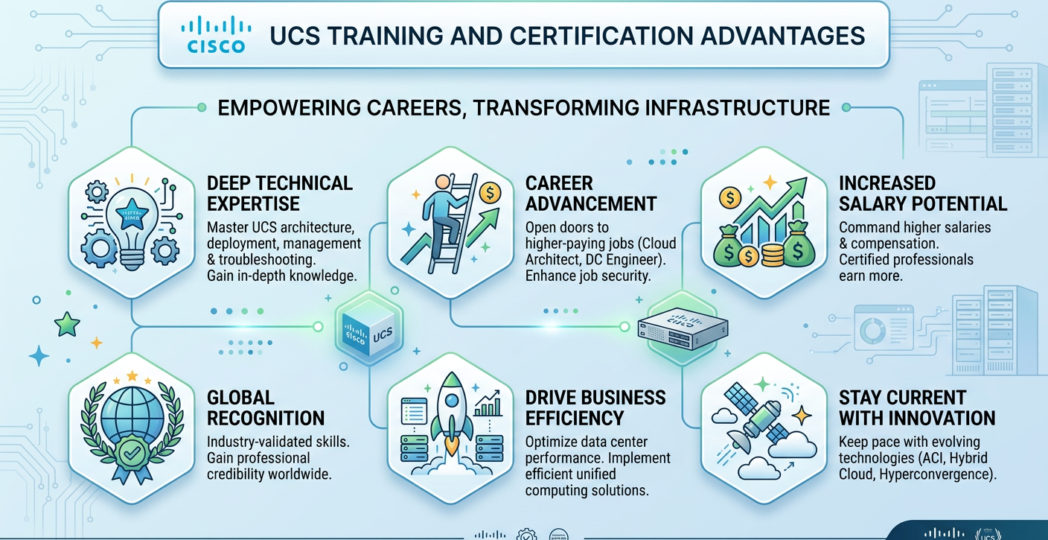
Cisco UCS training and certification help IT professionals develop the knowledge and practical skills required to deploy, configure, monitor, and troubleshoot UCS environments. These learning pathways can support infrastructure administrators, data center engineers, network specialists, virtualization professionals, and cloud infrastructure teams.
By combining technical training with hands-on experience, professionals can strengthen their expertise in enterprise computing and prepare for responsibilities involving modern data center operations. This article explores the major advantages of Cisco UCS training and certification and explains how they can contribute to career development and organizational performance.
1. Strong Understanding of Cisco UCS Architecture
One of the primary benefits of Cisco UCS training is gaining a structured understanding of the technology’s architecture. Cisco UCS combines computing resources, networking connectivity, and centralized management to help organizations operate data center infrastructure more consistently.
Training introduces important components and concepts, including UCS servers, fabric interconnects, fabric extenders where applicable, server connectivity, management interfaces, and service profiles. Learners explore how these components work together to provide computing resources for enterprise workloads.
Understanding the architecture helps professionals recognize how infrastructure decisions affect availability, scalability, performance, and administration. It also provides a foundation for designing environments that meet organizational requirements.
For IT professionals who previously worked mainly with standalone servers, UCS training can introduce a more integrated approach to managing enterprise computing infrastructure.
2. Improved Server Administration Skills
Cisco UCS training helps administrators develop practical knowledge of server provisioning, configuration, monitoring, and maintenance. These skills are important because server infrastructure supports critical applications, databases, virtual machines, and business services.
Depending on the UCS platform and course content, learners may study server discovery, hardware inventory, firmware management, policies, server profiles, and operational monitoring. They can also learn how to investigate hardware alerts and identify common configuration issues.
This knowledge helps administrators perform routine tasks more systematically and reduces dependence on manual configuration methods. A structured management approach can also make it easier to maintain consistency across multiple servers.
Hands-on practice is especially valuable because it allows learners to explore management interfaces, examine configuration dependencies, and understand how changes affect infrastructure behavior before applying similar procedures in production environments.
3. Better Data Center Networking Knowledge
Cisco UCS integrates server connectivity with data center networking technologies. Professionals working with UCS benefit from understanding how servers communicate with network infrastructure and how connectivity is configured and maintained.
Training may cover fabric interconnects, virtual network interfaces, VLANs, uplinks, network policies, and supported connectivity designs. Depending on the course, learners may also explore storage networking concepts and integration with enterprise switching environments.
This knowledge helps infrastructure teams troubleshoot connectivity problems more effectively. For example, an administrator investigating an application connectivity issue may need to distinguish between a server configuration problem, a network policy issue, and an upstream switching problem.
A stronger understanding of these relationships can improve collaboration between server, network, and storage teams and help reduce delays during infrastructure troubleshooting.
4. Increased Career Opportunities in Data Center Technology
Cisco UCS skills can support career development in enterprise infrastructure and data center operations. Organizations operating Cisco-based data centers may need professionals who understand server administration, infrastructure integration, virtualization, and operational troubleshooting.
Relevant job roles may include data center administrator, UCS engineer, infrastructure engineer, systems administrator, virtualization engineer, and technical support specialist. The specific responsibilities depend on the employer’s technology environment and the candidate’s experience.
Training can help professionals demonstrate that they understand important UCS concepts and are prepared to work with enterprise computing platforms. Certification, where available and relevant, can provide an additional way to demonstrate knowledge against a defined assessment.
However, a course or certification does not guarantee employment or promotion. Practical experience, broader networking knowledge, virtualization skills, problem-solving ability, and communication skills remain important when employers evaluate candidates.
5. Preparation for Relevant Cisco Certifications
Structured Cisco training can help professionals prepare for appropriate certification pathways by providing organized learning objectives and opportunities to practice key concepts.
Cisco’s certification portfolio and exam requirements evolve over time, so candidates should confirm current credential names, exam availability, prerequisites, and coverage through official Cisco certification resources before enrolling.
Depending on their career goals, UCS professionals may benefit from broader Cisco data center certifications or relevant infrastructure-focused learning. Such pathways can cover data center networking, computing, automation, and operational troubleshooting beyond an individual UCS platform.
Certification preparation encourages learners to study technical concepts systematically and identify gaps in their understanding. It can also provide a clear framework for professional development.
The most useful approach is to choose training that aligns with the candidate’s current responsibilities and target role rather than selecting a certification solely for its title.
6. Better Understanding of Virtualization and Cloud Infrastructure
Enterprise servers frequently support virtualization platforms, private cloud environments, and hybrid infrastructure. Cisco UCS training provides a foundation for understanding the computing layer that supports these workloads.
Learners can explore how server resources, network connectivity, and infrastructure policies affect virtualization deployments. Depending on the training program, related topics may include integration with VMware virtualization platforms, storage connectivity, and infrastructure provisioning for virtualized applications.
This knowledge helps professionals understand the relationship between physical infrastructure and software-defined environments. For example, a virtualization administrator investigating performance problems may need to consider server capacity, firmware compatibility, network configuration, and hardware health.
As organizations modernize their data centers, professionals who understand both physical infrastructure and virtualization can contribute more effectively to deployment planning, troubleshooting, and capacity management.
7. Greater Efficiency Through Centralized Management
A key advantage of Cisco UCS is its centralized approach to managing supported infrastructure components. Training helps administrators understand how policies, templates, and service profiles can simplify repeatable configuration tasks.
When used appropriately, standardized configurations can reduce manual work and help maintain consistency across server deployments. Administrators can apply established settings rather than configuring every server independently.
Training may also introduce management automation and integration options supported by the relevant UCS platform. These capabilities can help teams reduce repetitive administrative tasks and improve the consistency of operational procedures.
Automation must still be governed carefully. Configuration templates should be validated, changes should follow approval procedures, and administrators should maintain suitable backups and recovery plans.
By applying standardized management practices, organizations can improve operational efficiency while reducing the likelihood of configuration errors.
8. Stronger Troubleshooting and Problem-Solving Capabilities
Data center environments contain interconnected hardware, networking, storage, firmware, and software components. A problem in one area can affect multiple applications or services, making systematic troubleshooting essential.
Cisco UCS training can help learners develop a structured approach to identifying faults, interpreting alerts, reviewing configurations, and isolating possible causes. Depending on the course, exercises may include server discovery problems, connectivity failures, firmware compatibility issues, and hardware-related alerts.
Hands-on labs help professionals practice troubleshooting techniques in a controlled environment. They can learn to collect evidence, test hypotheses, verify dependencies, and document corrective actions.
These skills can improve incident handling and reduce the risk of making unnecessary configuration changes during an outage. They also help infrastructure professionals communicate technical findings more clearly to other IT teams.
9. Organizational Benefits and Operational Reliability
Cisco UCS training can benefit organizations as well as individual professionals. Teams with a stronger understanding of the platform may be better prepared to deploy infrastructure consistently, maintain server configurations, and respond to operational problems.
Standardized administration can help reduce avoidable errors, while improved troubleshooting skills can support more effective incident resolution. Better infrastructure knowledge also assists teams in planning capacity, maintaining firmware compatibility, and evaluating the impact of proposed changes.
Organizations may use training to improve internal technical capability, support infrastructure modernization, and reduce excessive reliance on external assistance for routine tasks.
The actual benefits depend on how well the training matches operational requirements and whether employees have opportunities to apply their learning. Training is most effective when combined with documented procedures, practical labs, knowledge sharing, and ongoing skills development.
10. Long-Term Professional Growth and Adaptability
Data center technologies continue to evolve as businesses adopt hybrid cloud, software-defined infrastructure, automation, and AI workloads. Professionals who understand enterprise computing fundamentals are better positioned to adapt to these changes.
Cisco UCS training can serve as a foundation for further learning in data center networking, virtualization, storage integration, infrastructure automation, and cloud architecture. These related skills can help professionals move toward senior engineering, infrastructure design, technical consulting, or data center architecture roles as their experience develops.
Continuous learning is important because specific platforms, software versions, management interfaces, and certification requirements may change. Professionals should regularly review vendor documentation, practice in labs, and stay informed about supported architecture and operational recommendations.
Combining UCS expertise with broader infrastructure knowledge creates a more flexible skill set that can remain useful across different enterprise technology projects.
Conclusion
Cisco UCS training and certification can provide valuable advantages for IT professionals seeking to strengthen their data center expertise. Key benefits include a better understanding of UCS architecture, improved server administration, stronger networking knowledge, career development opportunities, certification preparation, virtualization awareness, centralized management skills, and more effective troubleshooting.
Organizations can also benefit from improved technical capability, more consistent infrastructure practices, and better support for data center operations.
To achieve the greatest value, learners should select training that matches their experience and career objectives, prioritize hands-on exercises, and verify current Cisco certification requirements before committing to an exam pathway. Combining formal training with practical experience and continuous learning can help professionals build a strong foundation for long-term growth in data center engineering and enterprise infrastructure management.