 -by
Cybersecurity has become one of the most important priorities for organizations operating in a digitally connected world. Businesses depend on cloud platforms, enterprise applications, online transactions, and interconnected networks to deliver services and manage information. At the same time, cyber threats such as phishing, ransomware, data breaches, identity theft, and software vulnerabilities continue to create serious risks for organizations of every size.
As a result, companies increasingly need professionals who understand how to protect digital assets, identify security weaknesses, respond to incidents, and maintain effective security policies. Cybersecurity certifications provide a structured way for individuals to develop relevant knowledge, demonstrate professional competence, and strengthen their career opportunities.
Certifications offered by organizations such as CompTIA, ISC2, ISACA, EC-Council, Cisco, and cloud technology providers cover different areas of cybersecurity, including security operations, ethical hacking, cloud security, governance, risk management, and incident response.
This article explores the major advantages of cybersecurity certifications and explains how they can benefit individuals, employers, and the wider technology industry.
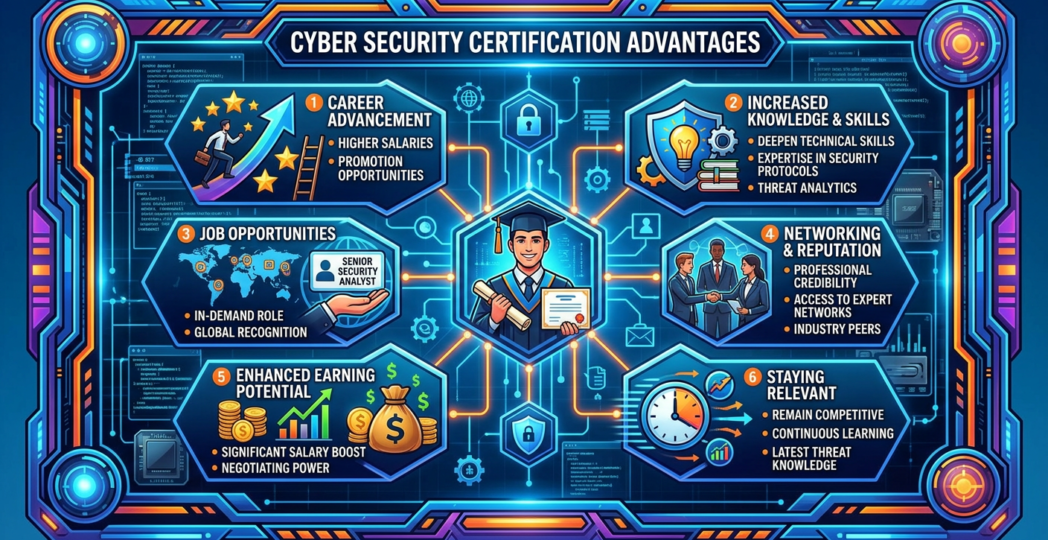
1. Improved Career Opportunities
One of the most significant advantages of cybersecurity certification is the opportunity to qualify for a broader range of professional roles. Employers need skilled professionals to protect networks, investigate suspicious activity, manage security controls, and support regulatory requirements.
Certifications can help candidates demonstrate foundational or specialized knowledge relevant to roles such as security analyst, security administrator, penetration tester, incident responder, cloud security engineer, and information security consultant.
For beginners, entry-level certifications can provide a structured introduction to security principles and help establish a foundation for further learning. Experienced IT professionals can pursue specialized certifications to demonstrate expertise in areas such as digital forensics, security architecture, identity management, and governance.
However, certification alone does not guarantee employment. Employers may also consider practical experience, technical assessments, communication skills, and the ability to solve real-world security problems. Combining certification with hands-on labs, projects, and professional experience can make candidates more competitive.
2. Validation of Technical Knowledge and Skills
Cybersecurity involves many technical disciplines, including network defense, access management, encryption, vulnerability assessment, secure configuration, and incident investigation. Certifications provide structured learning objectives that help professionals understand these subjects systematically.
For example, CompTIA Security+ introduces important security concepts, while more specialized credentials may focus on penetration testing, security operations, cloud infrastructure, or security architecture. Advanced certifications often address complex technical responsibilities or management-level requirements.
Preparing for a certification encourages learners to study established practices, understand terminology, and connect security concepts with practical scenarios. Some certifications also require relevant work experience or practical assessments, depending on the credential.
The value of certification is greatest when professionals can apply what they learn. Combining theoretical knowledge with laboratory exercises, simulations, and real-world projects helps individuals develop the confidence needed to perform security tasks effectively.
3. Higher Earning Potential and Professional Value
Cybersecurity professionals with specialized skills may qualify for roles that offer attractive compensation. As organizations invest in protecting sensitive data and critical systems, experienced specialists in areas such as cloud security, penetration testing, security engineering, and governance can be valuable to employers.
Certifications may strengthen a candidate’s professional profile by demonstrating commitment to learning and familiarity with relevant security practices. This can be useful when applying for specialized positions, pursuing promotions, or negotiating responsibilities.
Nevertheless, earning potential depends on several factors, including geographical location, industry, years of experience, technical proficiency, organizational size, and demand for specific skills. A certification does not automatically produce a salary increase.
Professionals should therefore select certifications based on their career objectives and the capabilities required for their target roles. Credentials that complement existing experience and address a genuine skills gap are generally more valuable than collecting certifications without a clear professional direction.
4. Enhanced Practical Problem-Solving Abilities
Cybersecurity work frequently involves analyzing unfamiliar situations, identifying the source of a problem, and choosing appropriate defensive measures. Certification preparation can strengthen analytical thinking by introducing structured approaches to common security challenges.
Learners may study how to interpret logs, investigate suspicious network activity, assess vulnerabilities, configure security controls, and prioritize remediation. These activities help professionals understand the relationships between technical weaknesses, potential threats, and business consequences.
For example, a security analyst may need to distinguish legitimate activity from suspicious behavior, while a cloud engineer may need to identify an overly permissive access policy. A penetration tester must understand how vulnerabilities can be discovered and validated within an authorized testing environment.
Practical labs and scenario-based assessments are particularly useful because they help learners move beyond memorizing definitions. Developing these problem-solving skills can improve performance in security operations, technical support, infrastructure administration, and incident response.
5. Specialization in Emerging Security Domains
The cybersecurity field continues to expand as organizations adopt cloud computing, artificial intelligence, connected devices, and increasingly complex digital services. Professionals can use certifications to develop expertise in specific areas that align with their interests and industry requirements.
Common specialization pathways include:
Cloud security: Protecting workloads, identities, storage, and applications across cloud environments.
Ethical hacking and penetration testing: Identifying vulnerabilities through authorized security assessments.
Security operations: Monitoring systems, investigating alerts, and responding to threats.
Governance, risk, and compliance: Managing security policies, risk assessments, audits, and regulatory obligations.
Identity and access management: Protecting accounts, authentication methods, and privileged access.
Incident response and digital forensics: Investigating security incidents and supporting recovery.
Specialization can help professionals distinguish themselves in the job market. Before choosing a credential, candidates should review its prerequisites, practical requirements, renewal conditions, and relevance to the roles they want to pursue.
6. Greater Employer Confidence and Industry Recognition
Certifications can provide employers with a recognizable indication of a candidate’s training and assessed knowledge. Well-established credentials may help hiring teams compare applicants and identify individuals who have studied relevant security frameworks, technical concepts, or operational practices.
For organizations, certified employees can support security projects by bringing structured knowledge to vulnerability management, security monitoring, risk assessment, and policy implementation. Certifications may also help teams establish common terminology and consistent working methods.
However, credentials differ in scope and rigor. Some emphasize foundational knowledge, others focus on practical technical skills, and some address governance or management responsibilities. Employers should evaluate certifications according to job requirements rather than assuming every credential demonstrates the same level of competence.
A strong professional profile combines recognized certification with practical experience, sound judgment, ethical conduct, and the ability to communicate security risks clearly.
7. Better Understanding of Risk Management and Compliance
Cybersecurity is not limited to technical defenses. Organizations must also understand business risks, protect personal information, document controls, and demonstrate compliance with applicable requirements.
Certifications in information security management, auditing, risk management, and governance can help professionals understand how security activities connect with organizational objectives. They may cover risk assessment, policy development, access reviews, incident planning, control evaluation, and audit preparation.
This knowledge is particularly useful for professionals pursuing roles in security governance, risk and compliance, internal auditing, and security management.
For example, a risk professional may need to assess the business impact of a data breach, evaluate existing controls, and recommend improvements. A security auditor may examine whether documented policies are implemented and supported by appropriate evidence.
Certifications do not automatically make an organization compliant, but knowledgeable professionals can help establish stronger processes and support more effective risk management.
8. Stronger Professional Credibility and Networking
Cybersecurity certifications can contribute to professional credibility by demonstrating that an individual has invested time in structured learning and assessment. They can also provide a common reference point when professionals discuss security technologies, methodologies, and best practices.
Some certification communities offer access to professional networks, educational resources, events, and continuing development opportunities. These connections can help individuals learn from experienced practitioners, explore emerging technologies, and discover career pathways.
Professional networking is especially valuable for people entering cybersecurity from other IT disciplines or transitioning from nontechnical careers. Discussions with experienced professionals can provide insight into the day-to-day responsibilities of different security roles.
Maintaining credibility also requires ethical behavior and ongoing learning. Professionals should accurately represent their qualifications, respect certification requirements, and avoid claiming expertise beyond their actual experience.
9. Continuous Learning and Adaptability
Cybersecurity is a rapidly evolving field. New vulnerabilities, attack techniques, defensive technologies, and regulatory requirements continually change the knowledge professionals need.
Many certifications require renewal, continuing professional education, or periodic reassessment. These requirements can encourage professionals to maintain their skills and remain familiar with industry developments.
Even when a certification does not require formal renewal, professionals benefit from studying updated documentation, practicing in laboratories, participating in security exercises, and learning about emerging threats.
For example, a network security specialist may need to develop additional cloud security knowledge as an organization moves applications to cloud infrastructure. Similarly, a security analyst may need to understand new detection techniques as attackers change their methods.
A commitment to continuous learning helps cybersecurity professionals remain adaptable and better prepared for changing responsibilities.
10. A Structured Pathway for Long-Term Career Growth
Cybersecurity certifications can help individuals plan their development in stages rather than attempting to learn every security discipline simultaneously.
A beginner might start with networking and security fundamentals before progressing to security operations or cloud security. An experienced network administrator could pursue a credential related to network defense, while a systems engineer might focus on cloud security or identity management. Professionals interested in leadership may choose certifications focused on security management, auditing, or risk governance.
The most effective learning pathway depends on the individual’s background, interests, and career objectives. Candidates should review job descriptions, identify recurring skill requirements, and select certifications that support their intended progression.
Hands-on experience remains essential throughout this journey. Practical labs, internships, authorized security projects, and incident-response exercises help translate learning into professional capability.
Conclusion
Cybersecurity certifications offer numerous advantages, including improved career opportunities, validation of technical knowledge, potential earning benefits, stronger problem-solving skills, and opportunities to specialize in emerging security domains. They can also support employer confidence, improve understanding of risk and compliance, expand professional networks, and encourage continuous learning.
Their true value depends on selecting the right credential and applying the knowledge gained. Individuals should consider their experience, target job roles, certification prerequisites, practical requirements, and long-term goals before investing in a program.
As cyber threats continue to evolve, organizations need professionals who combine technical knowledge with sound judgment, ethical responsibility, and practical experience. Cybersecurity certification can provide an important foundation for developing these capabilities and building a sustainable career in the information security industry.