 -by
Artificial intelligence is changing how organizations develop products, analyze information, automate operations, and deliver customer experiences. As businesses seek practical ways to adopt AI, Amazon Web Services (AWS) provides a broad ecosystem of artificial intelligence, machine learning, and generative AI services designed to support innovation at different levels of technical complexity.
AWS enables organizations to build intelligent applications, develop customized AI solutions, process large datasets, and deploy generative AI capabilities without having to create every underlying component from scratch. Services such as Amazon Bedrock, Amazon SageMaker AI, Amazon Q, Amazon Rekognition, and Amazon Textract support different business requirements, from building applications that generate content to training machine learning models and extracting information from documents.
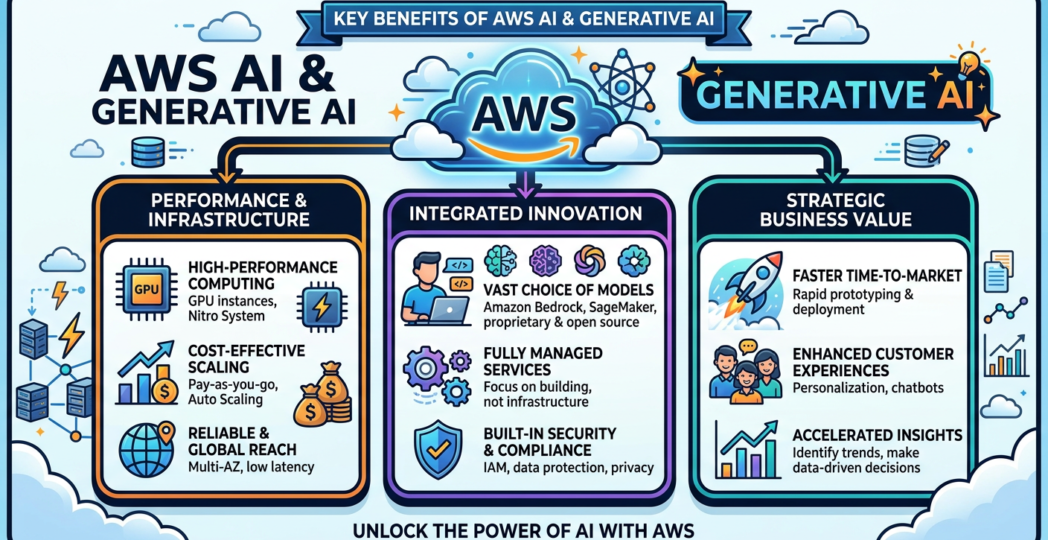
The advantages of AWS AI and Generative AI extend beyond automation. They include improved productivity, faster application development, enhanced customer support, advanced data analysis, scalable infrastructure, and opportunities to develop new business models. When implemented with appropriate security, governance, and human oversight, these technologies can help organizations create measurable business value.
1. Faster Application Development and Innovation
One of the major advantages of AWS AI is its ability to accelerate the development of intelligent applications. Traditionally, building an AI solution could require organizations to assemble infrastructure, select models, prepare data, develop integrations, and manage deployment processes independently.
AWS offers managed services that simplify many of these activities. Amazon Bedrock provides access to supported foundation models through a managed service, enabling developers to build generative AI applications without managing the underlying foundation-model infrastructure themselves. Amazon SageMaker AI supports building, training, customizing, and deploying machine learning models.
These services allow development teams to experiment with new ideas and move from prototypes toward production applications more efficiently. Businesses can explore conversational assistants, document-processing systems, recommendation engines, and intelligent search experiences.
Although managed services simplify development, successful projects still require careful design, data preparation, evaluation, and operational planning. The principal advantage is that teams can concentrate more on solving business problems instead of building every component of an AI platform from the beginning.
2. Increased Employee Productivity Through Automation
Generative AI can help employees complete repetitive knowledge-based tasks more efficiently. Activities such as drafting documents, summarizing information, generating code, organizing research, and answering routine questions often consume significant working time.
AWS AI services can support automation through conversational interfaces, intelligent workflows, and AI-powered applications integrated with business systems. For example, an organization could develop an internal assistant that helps employees locate approved procedures, summarize technical documentation, or retrieve relevant information from authorized knowledge sources.
Amazon Q Business can help users discover and work with organizational information through supported enterprise integrations and access controls. Amazon Q Developer offers AI assistance for software development and related technical tasks.
These capabilities can reduce manual effort and help employees focus on analysis, decision-making, and creative problem-solving. However, productivity improvements depend on task complexity, information quality, and how well the tools are integrated into existing workflows. AI-generated results should be reviewed when accuracy and accountability are important.
3. Personalized Customer Experiences
Customer expectations increasingly favor responsive, relevant, and convenient digital interactions. AWS AI can help organizations develop applications that personalize recommendations, improve customer support, and adapt services to individual needs.
Machine learning models can analyze suitable customer interaction data to identify preferences, predict likely needs, and support more relevant product or service recommendations. Generative AI can power conversational assistants that answer questions, explain product information, and guide users through common processes.
For example, an online retailer could develop an AI assistant that helps customers compare products, understand delivery policies, and locate relevant information. A financial services organization could use carefully controlled AI applications to explain general product information while directing sensitive or complex cases to qualified staff.
Personalization must be implemented responsibly. Organizations should respect privacy requirements, limit data access, and avoid using sensitive information inappropriately. When designed around customer needs and trustworthy information, AWS AI solutions can support more engaging and efficient service experiences.
4. Advanced Data Analysis and Business Intelligence
Organizations generate large volumes of structured and unstructured data through transactions, applications, documents, and customer interactions. Turning this information into actionable insights is a major challenge for business leaders.
AWS AI and machine learning services can help organizations identify patterns, detect anomalies, classify information, and generate summaries from suitable datasets. Amazon SageMaker AI supports the development of predictive models, while Amazon Bedrock can support generative applications that interpret and summarize information when connected to appropriate data sources.
These capabilities can assist with sales forecasting, operational analysis, customer feedback classification, risk identification, and demand planning. For example, a logistics business could use machine learning to estimate delivery demand, while a support team could analyze recurring customer complaints to identify service improvements.
AI does not automatically guarantee correct conclusions. Data quality, model assumptions, evaluation methods, and domain expertise remain essential. Organizations should validate results before using them for high-impact financial, operational, or strategic decisions.
5. Scalable Infrastructure and Flexible Deployment
A significant advantage of AWS is its cloud infrastructure, which allows organizations to scale computing resources according to their requirements. AI workloads can vary considerably in resource consumption, especially when training models, processing large datasets, or serving generative AI applications to many users.
AWS provides managed services and infrastructure options that support different AI workloads. Amazon Bedrock simplifies access to supported foundation models, while Amazon SageMaker AI provides tools and infrastructure for machine learning development and deployment.
This flexibility allows businesses to start with smaller experiments and expand successful solutions as demand grows. Organizations can also select architectures based on performance, cost, data location, and operational requirements.
Scalability still requires careful cost management. Model selection, request volume, token consumption, storage, data transfer, and computing capacity can all influence total expenses. Monitoring usage and setting budgets help organizations balance application performance with financial sustainability.
6. Intelligent Document Processing and Content Understanding
Many business processes depend on extracting information from invoices, contracts, forms, reports, and other documents. Manual processing can be slow and error-prone, particularly when organizations handle large volumes of information.
AWS provides AI services that can help automate document and media analysis. Amazon Textract can extract text and structured information from supported documents, while Amazon Comprehend offers natural-language processing capabilities for supported text analysis tasks. Amazon Rekognition supports image and video analysis use cases.
Generative AI can complement these services by summarizing extracted information, organizing content, or answering questions about documents when used within a suitable application architecture.
For example, an organization could develop a workflow that extracts invoice details, validates selected fields, and routes exceptions to a finance employee. This can reduce repetitive data entry and improve processing speed.
Important documents still require validation, especially when errors could affect payments, legal obligations, or regulatory reporting. Combining AI extraction with rules, confidence checks, and human review can improve reliability.
7. Improved Software Development and Technical Operations
AI is creating new opportunities for software engineering and IT operations. AWS offers AI-powered development assistance through Amazon Q Developer, which can help developers with supported coding, code explanations, troubleshooting, and development workflows.
These capabilities can help software teams understand unfamiliar code, generate initial implementations, create tests, and investigate technical problems. AI assistants may also help engineers navigate documentation and identify possible solutions more quickly.
In operations environments, AI can support log analysis, incident investigation, and knowledge retrieval when integrated with suitable tools and data sources. For example, an IT support team could build an assistant that summarizes incident details and recommends relevant troubleshooting documentation.
AI-generated code and technical recommendations should always be reviewed, tested, and assessed for security vulnerabilities. Developers remain responsible for validating correctness, checking dependencies, protecting secrets, and following organizational coding standards.
When integrated into a disciplined engineering process, AWS AI tools can support faster development while preserving the importance of code quality and secure software practices.
8. Stronger Security and Responsible AI Governance
Security and governance are essential when organizations introduce AI into business-critical processes. AWS provides cloud security capabilities that can help protect AI applications, data, and supporting infrastructure.
Organizations can use AWS Identity and Access Management, encryption services, logging, network controls, and monitoring capabilities to protect resources and limit unauthorized access. Amazon Bedrock also provides features for building generative AI applications, with available safeguards and controls depending on the service and configuration.
Responsible AI governance should address data privacy, access permissions, model evaluation, harmful outputs, hallucinations, bias, and appropriate human oversight. Organizations should determine which information an AI application may access and ensure that users cannot retrieve data beyond their authorization.
Retrieval-augmented generation can help applications ground responses in approved knowledge sources, but it does not eliminate incorrect answers. Businesses should evaluate outputs, monitor application behavior, and define escalation procedures for sensitive decisions.
A strong governance framework helps organizations adopt AI while maintaining accountability, protecting information, and managing operational risks.
9. Cost Efficiency and Reduced Infrastructure Management
Developing and maintaining AI systems can involve significant infrastructure, staffing, and operational expenses. AWS managed services can reduce some of this complexity by providing ready-to-use capabilities for model access, development, deployment, and application integration.
Instead of maintaining every infrastructure component independently, organizations can choose services that align with their technical requirements and operational capacity. This can allow teams to allocate more resources to application development, business integration, and model evaluation.
However, AI is not automatically cheaper than traditional software. Costs can arise from model usage, computing, data storage, integration work, monitoring, and ongoing evaluation. Poorly designed prompts or unnecessary model calls may increase expenses without delivering additional value.
Organizations should compare model performance, establish usage limits, monitor cost trends, and test smaller solutions before scaling. Measuring the business outcomes of AI projects is essential for determining whether the investment delivers meaningful returns.
10. New Business Opportunities and Future Growth
AWS AI and Generative AI can help organizations develop new products, improve existing services, and explore business models that were previously difficult to implement. Companies can create intelligent customer assistants, automated research tools, industry-specific document solutions, predictive maintenance systems, and AI-enhanced digital services.
Generative AI also enables organizations to combine language, structured data, documents, and application workflows in new ways. With appropriate architecture, businesses can build assistants that retrieve approved information and support tasks across enterprise systems.
As AI technologies continue to develop, organizations are likely to place greater emphasis on AI agents, multimodal applications, customized workflows, and stronger governance. Success will depend on selecting appropriate use cases, measuring outcomes, and ensuring that AI solutions remain secure, reliable, and useful.
Businesses that invest in employee skills, data readiness, and responsible experimentation will be better positioned to translate AI capabilities into sustainable competitive advantages.
Conclusion
AWS AI and Generative AI offer substantial opportunities to improve productivity, accelerate innovation, personalize customer experiences, analyze data, automate document processing, enhance software development, and create new digital services. Services such as Amazon Bedrock, Amazon SageMaker AI, Amazon Q, Amazon Textract, and Amazon Rekognition support different use cases across the AI lifecycle.
The strongest results come from aligning technology with clear business objectives, reliable data, appropriate security controls, and measurable outcomes. Organizations should begin with well-defined use cases, evaluate AI-generated results carefully, manage costs, and maintain human oversight for important decisions.
As cloud computing and artificial intelligence continue to evolve, AWS provides a flexible foundation for organizations seeking to adopt intelligent applications responsibly. With thoughtful implementation and continuous improvement, AWS AI and Generative AI can become valuable drivers of business innovation, operational efficiency, and long-term digital growth.