
 -by
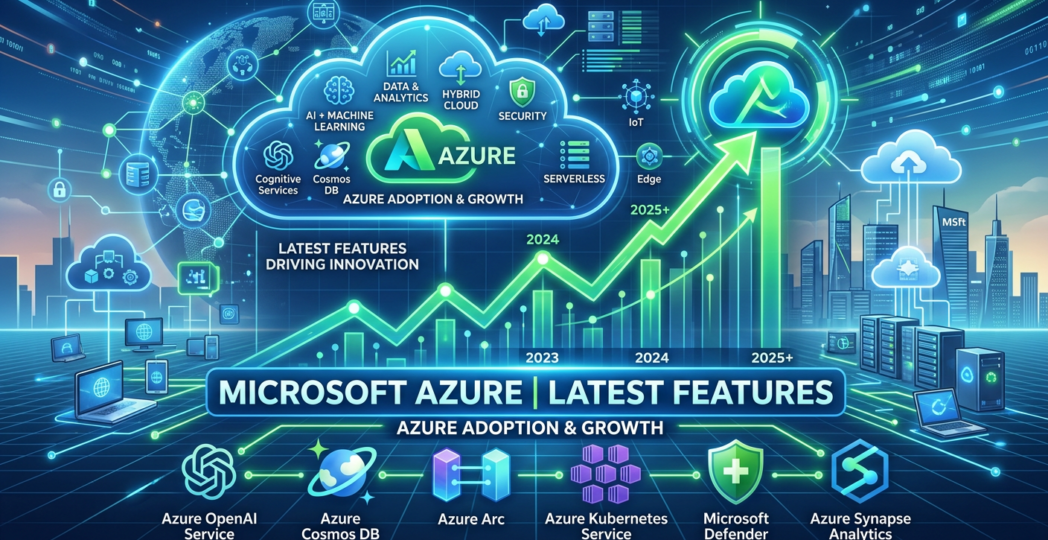
Microsoft Azure is a comprehensive cloud computing platform that enables organizations to build, deploy, manage, and secure applications across cloud, hybrid, and edge environments. Its capabilities span artificial intelligence (AI), virtual infrastructure, databases, analytics, networking, cybersecurity, application development, and enterprise governance.
In 2026, Azure’s evolution is increasingly focused on AI-powered applications, intelligent agents, modern data platforms, confidential computing, and simplified cloud operations. Organizations are looking beyond basic cloud migration toward solutions that improve productivity, strengthen security, automate routine tasks, and turn business data into actionable insights.
The following features and capabilities highlight important areas of Azure innovation and their practical value to modern enterprises.
1. Microsoft Foundry and AI-Powered Application Development
One of the major developments in Azure is the evolution of its AI application platform, Microsoft Foundry, which brings together capabilities for building, evaluating, deploying, and managing AI applications and agents.
Developers can use supported foundation models to create intelligent assistants, enterprise knowledge systems, document-processing applications, and conversational interfaces. Model selection allows architects to balance accuracy, latency, availability, and cost according to application requirements.
Retrieval-augmented generation (RAG) is an important implementation pattern. It connects AI models to approved enterprise information so responses can be grounded in relevant documents and organizational knowledge. Azure AI Search, Azure storage services, and identity controls can form part of this architecture.
AI evaluation, monitoring, access restrictions, and responsible-AI practices are essential when moving prototypes into production. Organizations should assess response quality, protect confidential information, and establish clear limits on what AI applications can access or execute.
2. Agentic AI and Intelligent Automation
Azure is advancing beyond traditional chatbots toward AI agents capable of completing multi-step tasks using approved tools and business systems. Microsoft Foundry Agent Service provides a managed environment for developing and operating supported AI-agent workflows.
Enterprise use cases include customer-service assistance, IT support automation, research, document analysis, and workflow coordination. For example, an agent could retrieve information from authorized knowledge sources, summarize a support request, and recommend a response for human approval.
Agentic applications require careful architecture. Developers should implement least-privilege permissions, tool validation, execution limits, logging, and human oversight for sensitive actions. Organizations must also consider prompt injection, inaccurate outputs, and the possibility that an agent could perform an unintended operation.
The future opportunity lies in connecting agents to enterprise data and applications while preserving security, accountability, and operational control.
3. Azure Infrastructure and Virtual Machine Enhancements
Azure continues to expand its infrastructure capabilities to support demanding workloads, including enterprise applications, large-scale computing, AI, and specialized processing. Virtual machine families provide different combinations of CPU, memory, storage, and acceleration resources.
Recent platform developments include new Arm-based and AMD-based virtual machine options announced in 2026, reflecting Microsoft’s efforts to expand compute choice and improve workload efficiency. Availability depends on the relevant Azure region, VM family, and deployment configuration.
Architects should select compute resources according to workload characteristics rather than relying exclusively on processor specifications. Memory-intensive databases, high-throughput web applications, GPU-accelerated AI workloads, and general-purpose enterprise systems have different requirements.
Azure Virtual Machines, Virtual Machine Scale Sets, Azure Load Balancer, and Azure Monitor can be combined to support scalable deployments. Availability zones, resilient application design, backup policies, and tested recovery procedures help reduce operational risk.
4. Azure Kubernetes Service and Cloud-Native Applications
Azure Kubernetes Service (AKS) supports organizations that need to deploy and manage containerized applications at scale. Containers provide consistent application packaging, while Kubernetes helps coordinate deployment, scaling, service discovery, and workload recovery.
Modern Azure application architectures increasingly combine containers, managed databases, messaging, API management, and automated deployment pipelines. Azure Container Apps can provide a simpler managed environment for selected container workloads without requiring teams to manage a full Kubernetes platform.
Organizations can use Azure DevOps or GitHub-based workflows to automate testing and deployment. Infrastructure as Code, image scanning, secret management, and deployment approvals help improve consistency and security.
The most effective approach is to choose the simplest platform that meets operational requirements. AKS can suit complex container environments, while serverless and managed container services may reduce operational overhead for less complex applications.
5. Azure Data, Databases, and Analytics
Data platforms remain central to Azure’s enterprise capabilities. Azure SQL Database, Azure SQL Managed Instance, Azure Cosmos DB, and Azure Database for PostgreSQL serve different transactional and application-data requirements.
Azure Cosmos DB supports globally distributed application architectures and is developing additional capabilities for AI applications, including agent memory, retrieval, and improved query patterns. Features announced in 2026 include enhancements for search relevance and data access, with availability varying by capability. <Cite refs={[“turn837793search2″,”turn837793search3”]}/>
Microsoft Fabric complements Azure data services by bringing data engineering, analytics, data science, and business intelligence into an integrated platform. Organizations can combine governed data with reporting and AI workloads to reduce fragmentation between operational systems and analytical environments.
A modern data strategy should include data quality, lineage, access controls, retention, encryption, and clear ownership. These practices help ensure that analytical results and AI-generated answers are based on appropriate, trustworthy information.
6. Microsoft Entra ID and Advanced Cloud Security
Identity-based security is a fundamental component of Azure architecture. Microsoft Entra ID supports identity management, multifactor authentication, single sign-on, and Conditional Access policies. These capabilities help organizations control who can access applications and under what conditions.
Azure security architecture can also incorporate Microsoft Defender for Cloud, Microsoft Sentinel, Azure Key Vault, and Azure Policy. Together, these services can support cloud security posture management, threat detection, secret protection, compliance monitoring, and governance.
Recent identity developments include enhancements to authentication methods, identity lifecycle automation, and governance capabilities. Organizations should evaluate new features according to their licensing, tenant configuration, and deployment requirements. <Cite refs={[“turn837793search4”]}/>
A modern security approach should adopt least privilege, strong authentication, network segmentation, continuous monitoring, and automated policy enforcement. Security controls should be applied consistently across subscriptions, resource groups, applications, and hybrid environments.
7. Hybrid Cloud, Azure Arc, and Sovereign Cloud
Many enterprises cannot move every application or dataset into a public cloud. Azure supports hybrid approaches that combine public cloud services with on-premises infrastructure and supported edge environments.
Azure Arc helps organizations manage supported resources across different environments through Azure management capabilities. Azure Local supports infrastructure scenarios in which organizations need to run workloads closer to their facilities or maintain specific operational requirements.
Sovereign cloud capabilities are also gaining attention as governments and regulated industries seek greater control over data residency, operational access, and compliance. Azure’s confidential computing and isolated-environment offerings can support selected sensitive workloads, depending on the service and deployment model.
Architects should assess regulatory obligations, latency, connectivity, data location, and disaster recovery before choosing between public cloud, hybrid, and localized deployment models.
8. Azure DevOps, Automation, and Infrastructure as Code
Azure provides extensive capabilities for automating infrastructure deployment and application delivery. Azure Resource Manager templates, Bicep, Terraform, and CI/CD pipelines help teams establish repeatable deployment processes.
Automation reduces manual configuration, improves consistency, and enables infrastructure changes to be reviewed and tested before deployment. Organizations can also automate resource tagging, compliance checks, monitoring configuration, and environment cleanup.
AI-assisted development is creating additional opportunities to accelerate coding, testing, and troubleshooting. However, AI-generated code and infrastructure changes should undergo security reviews, automated tests, and human approval before production deployment.
9. Future Opportunities and Career Growth
Azure’s future opportunities are closely linked to AI engineering, cloud security, platform engineering, data modernization, hybrid infrastructure, and intelligent automation. Businesses will need professionals who can connect these technologies to measurable business outcomes.
Important career paths include Azure Solutions Architect, Azure Administrator, Azure Security Engineer, Azure AI Engineer, Azure Data Engineer, DevOps Engineer, and Cloud Platform Engineer.
Practical skills in architecture design, networking, identity management, infrastructure automation, disaster recovery, monitoring, and cost optimization remain essential. Professionals should also develop experience with AI application governance and data security as enterprises introduce intelligent agents into business processes.
Conclusion
Microsoft Azure in 2026 offers a broad set of capabilities for building intelligent, secure, scalable, and resilient digital solutions. AI agents, modern compute infrastructure, Kubernetes, advanced databases, integrated analytics, identity security, and hybrid cloud management are shaping the platform’s direction.
Organizations can gain the greatest value by selecting services according to their business needs, applying security from the beginning, automating repeatable operations, and continuously reviewing performance and costs. For technology professionals, combining strong Azure fundamentals with AI, data, cybersecurity, and DevOps expertise provides a solid foundation for the next generation of cloud computing.