 -by
Introduction
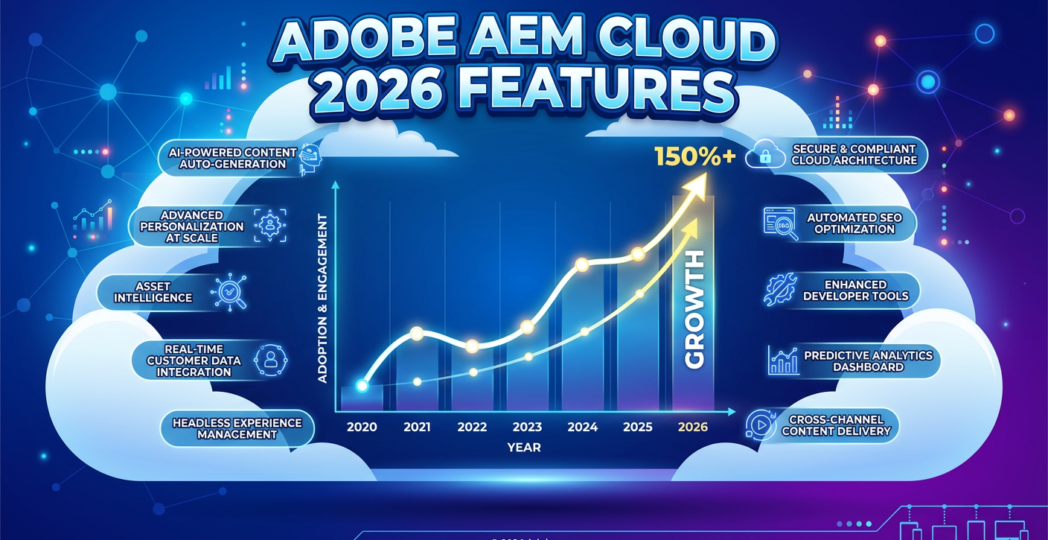
Adobe Experience Manager (AEM) as a Cloud Service continues to evolve as enterprises seek faster digital experiences, intelligent content management, personalized customer journeys, and streamlined content delivery. In 2026, AEM’s strategic direction centers on cloud-native content operations, generative AI, automation, composable digital experiences, and tighter integration across Adobe Experience Cloud.
For organizations already using AEM, the cloud platform offers a continuously updated service model instead of relying exclusively on traditional, manually managed upgrade cycles. For businesses evaluating migration from on-premise AEM, these capabilities provide opportunities to modernize content delivery, simplify operations, and prepare for AI-assisted digital experiences.
Important distinction: Not every capability described as part of Adobe’s broader AI or Experience Cloud strategy is automatically included in every AEM Cloud environment. Availability can depend on the product, licensing, region, release rollout, and configuration. The sections below distinguish established AEM cloud capabilities from emerging AI-led directions; confirm specific 2026 feature availability in Adobe’s current release notes before implementation.
1. AI-assisted content creation and agentic capabilities
One of the most significant developments in the AEM ecosystem is the move toward AI-assisted content operations. Adobe’s 2026 release notes describe agentic capabilities that help teams create, update, discover, and prepare content and assets through natural-language instructions, while working within established brand and governance controls. These capabilities are available through Adobe’s CX Enterprise Coworker experience, subject to access and rollout.
For content teams, this direction can reduce repetitive tasks such as locating assets, preparing content for different channels, and checking whether content is ready for publication. For developers, AI-assisted tooling can help identify legacy implementation patterns and suggest modernization work.
Practical example: A digital marketing team could use an AI-assisted workflow to identify campaign content that needs updating, prepare relevant assets, and review content readiness before publication. Human review should remain part of the workflow, especially for regulated or customer-sensitive content.
AI features should be evaluated against accuracy, permissions, auditability, brand safety, and the amount of human review required—not just the speed of content generation.
2. AI-assisted code migration and developer productivity
Adobe’s 2026 updates include AI-assisted code migration tooling for teams moving AEM 6.5 or earlier Java-based implementations to AEM as a Cloud Service. The tooling uses findings from the Best Practices Analyzer (BPA) to guide modernization and can identify patterns that need attention across an existing project.
The migration skill covers examples such as converting legacy user interfaces, modernizing static templates, identifying unsupported run modes, updating Dispatcher configuration structures, and detecting package dependencies that can block Cloud Manager deployments.
This is particularly valuable for enterprises with large codebases, custom components, legacy dialogs, and years of accumulated technical debt. Rather than treating migration as a manual rewrite, development teams can use AI assistance to produce a structured assessment and a proposed migration plan.
However, generated changes still require engineering review, compilation, automated testing, and validation in a cloud development environment. Teams should begin with a read-only assessment, inspect the proposed changes, and apply them incrementally through source control.
3. Cloud Manager MCP Server and natural-language operations
The Model Context Protocol (MCP) is another important development in Adobe’s cloud administration ecosystem. The 2026 release notes describe Cloud Manager MCP capabilities that allow supported operations to be initiated from compatible development tools using natural-language prompts. Examples include checking environment status and executing pipelines.
This can help reduce the friction of routine development and operations tasks. Instead of switching repeatedly between an IDE, documentation, and the Cloud Manager interface, authorized users can use supported tools to inspect environments or initiate approved workflows.
Typical potential benefits include:
- Faster access to pipeline and environment information.
- Less repetitive navigation for development teams.
- More convenient integration between AI coding assistants and AEM development workflows.
- Better support for repeatable operational procedures.
MCP does not eliminate access controls or release governance. Organizations should validate permissions, restrict access to production operations, and retain review and approval steps for deployments. Only supported operations should be assumed available, and availability may depend on the release and configuration.
4. AI-powered asset discovery and Content Hub improvements
Adobe Experience Manager Assets is becoming more intelligent through improvements to Content Hub, the experience used to discover and distribute approved digital assets.
The 2026 updates include AI Search, which interprets the meaning and intent of a query instead of relying only on exact keyword matches. It supports multilingual searches, synonyms, misspellings, and conceptually related terms. For example, searching for a person drinking coffee may return assets tagged with related descriptions such as latte or cappuccino.
Another improvement is Smart Collections, which automatically display assets matching saved search criteria. Custom sorting options also let administrators organize assets using business-specific metadata, such as region, campaign, channel, or product SKU.
These features can help large enterprises manage extensive digital asset libraries, improve asset reuse, reduce manual searching, and maintain consistent branding across marketing channels.
5. Dynamic Media: smarter and more accessible content delivery
Dynamic Media continues to expand its capabilities for delivering optimized images and video experiences. The 2026 release notes describe AI-generated video captions, support for multiple audio and caption tracks, video smart cropping, and a customizable video viewer with engagement analytics.
Video Smart Crops use AI-powered analysis to keep the main subject in focus across different aspect ratios. This is useful when a single video must be adapted for desktop websites, mobile devices, and campaign placements.
Multiple caption and audio tracks can help organizations deliver localized experiences using one primary video asset. The customizable viewer also supports branded playback experiences and provides metrics such as watch time and completion rate.
Organizations should verify the availability status of individual capabilities before planning a rollout: some features may be generally available, while others require limited-availability access or additional configuration.
6. Improved content editing and structured content management
AEM Sites is also improving the experience of creating and maintaining structured content. The March 2026 release introduced changes to the Content Fragment Editor, including migration to TipTap rich-text editing technology, a more consistent editing experience with Universal Editor, and additional editing capabilities such as find and replace.
Content Fragments are particularly useful for organizations adopting headless or hybrid content architectures. They allow teams to manage structured content independently from individual page layouts and deliver it to websites, mobile applications, and other digital channels.
Improved content management workflows can help editors reuse content, coordinate approvals, and reduce inconsistencies across multiple channels. Enterprises should review their content models, references, APIs, and editorial processes to determine how these changes affect existing implementations.
7. Safer deployments and improved platform operations
Cloud-native delivery remains a core AEM advantage, and the 2026 updates add improvements to release validation and administration.
Adobe’s September 2026 release notes describe canary deployments, which allow a new release to be tested against production infrastructure before it receives all live traffic. Selected requests can be routed to the candidate release while other traffic continues using the stable version. Teams can then promote or cancel the release within the documented validation window.
The same release includes OpenTelemetry-based application performance monitoring in limited availability, along with richer identity-authentication errors to support troubleshooting.
Simplified Index Management, introduced earlier in 2026, also makes custom index configuration easier to maintain by allowing supported customizations to be defined in a single JSON file rather than requiring teams to manage complete copied index definitions manually.
Together, these changes support more controlled deployments, easier diagnosis, and better maintainability. Teams should still test queries, indexes, monitoring integrations, and deployment procedures before production adoption.
8. Java runtime readiness and upgrade planning
Enterprises should not focus exclusively on new features. Compatibility and maintenance requirements are equally important.
Adobe’s 2026 release notes identify deprecated Java APIs that can cause Cloud Manager pipeline failures and affect eligibility for critical platform updates if left unresolved. Adobe also published a roadmap for the Java 25 runtime transition, with optional validation planned before the phased migration of environments in 2027.
Development teams should therefore:
- Scan application code for deprecated API usage.
- Review Cloud Manager code-quality failures and address them promptly.
- Validate dependencies and build configurations against the supported SDK.
- Test custom bundles, integrations, and performance against the upcoming runtime.
- Plan lower-environment validation before changing staging and production environments.
These measures help prevent avoidable deployment interruptions and reduce the risk of compatibility problems during platform updates.
9. How organizations should prepare for AEM Cloud innovations
A practical adoption strategy starts with identifying which capabilities address measurable business needs.
Priority | Recommended action |
|---|---|
AI and automation | Select repetitive content or development tasks suitable for controlled AI assistance. |
Asset management | Improve metadata quality and evaluate AI Search and Smart Collections. |
Video delivery | Assess accessibility, localization, smart cropping, and engagement reporting requirements. |
Development | Evaluate AI-assisted migration and supported MCP workflows in a controlled environment. |
Release management | Review canary deployment availability and strengthen automated regression tests. |
Platform maintenance | Resolve deprecated APIs and prepare for runtime compatibility changes. |
Organizations should also review licensing, permissions, privacy requirements, data governance, and feature availability before adoption.
Conclusion
Adobe Experience Manager as a Cloud Service in 2026 is advancing across AI-assisted content operations, intelligent asset discovery, video delivery, structured content editing, developer productivity, and safer cloud deployments. These improvements can help enterprises deliver digital experiences more efficiently while reducing repetitive administration and modernizing legacy implementations.
The greatest benefit comes from combining new features with sound architecture, clean metadata, automated testing, secure access, and disciplined release management. Rather than enabling every new capability immediately, organizations should prioritize features based on business value, validate their availability, and introduce them through measurable pilot projects.
For the most accurate feature status, consult Adobe’s official AEM as a Cloud Service release notes, which are updated as new releases and feature activations become available. As of October 28, 2026, the latest published feature release is 2026.9.0, with 2026.10.0 planned for October 29.